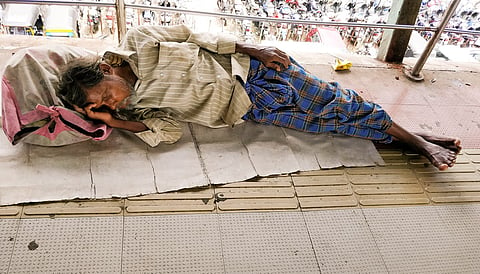


Measuring poverty — a fundamental tool to direct development programmes — is definitely a tough exercise. It is limited broadly to two types of measures — direct income survey like in many advanced economies and the expenditure survey to be used as a proxy to gauge income, as in India. Based on such surveys, a “poverty line” is drawn. Those who have income/expenditure below this line are categorised as “poor”. Both the measures have been tried and tested adequately to a point that there is hardly any progress in evolving other ways of income poverty measurement.
Measuring poverty using poverty line throws some challenges that have the potential of excluding populations from development programmes directed at such groups. For instance, even a population having income just above the poverty line will be excluded from the poverty list. In case of India, the poverty line is often termed as “deprivation line” and “starvation line” as it is very low. But a significant population living just a few rupees above this mark is considered above the poverty line and is being kept away from development programmes even though they experience the same level of poverty or deprivation as people below the poverty line.
Moreover, the consumption expenditure survey used for measuring poverty usually captures a household’s expenditure at the time of the survey, thus not reflecting the real annual expenditure level. A survey done during post-harvest time in India will throw up different consumption levels due to more cash inflow and even produce that could be bartered for other consumables. The same survey done during the monsoon period, considered to be lean in terms of earning, will capture different or lower consumption levels. Usually, there is just one round of survey.
Olivier Sterck, an associate Professor with the University of Antwerp and the University of Oxford, has proposed a new measure of poverty without deploying a poverty line. He explains his new measure, “The idea is to measure poverty across the entire income distribution, rather than classifying people as poor or non-poor based on an arbitrary threshold.” Sterck’s new measure that he has already applied to derive poverty rate spanning over 1995-2025 does away with the income/day module. Instead, he measures how much time a person spends to earn how much. “If person A earns half as much as person B, then A is twice as poor. Poverty is therefore simply measured as the reciprocal of income, and its unit is simply inverted. If incomes are measured in dollars per day ($/day), poverty is measured in days per dollar (days/$).” This is how he says his poverty measure is not just inclusive but also brings out closer poverty level estimation. He has termed this measure as “average poverty”. And he defines it: “Average poverty is simply the average time it takes to earn $1 in a given population.”
Sterck has applied the logic in the “average poverty” measure that is used in many other fields that have reciprocal relationships. For example, he has cited the case of judging pace for a runner that is “simply the reciprocal of speed”. “A runner covering 20 kilometres per hour is twice as fast as one covering 10 kilometres per hour.” So, his average poverty measure categorises population according to their time needed to earn a specific amount. This way, anti-poverty measures can also be targeted effectively without excluding the population near the poverty line. He calls this measure “distribution-sensitive”. “A $1 gain for someone at $1/day reduces poverty more than the same gain for someone at $2, $5, $10, or $100/day. This addresses a major limitation of the headcount and poverty gap, which ignores the severity of poverty,” he argues.
