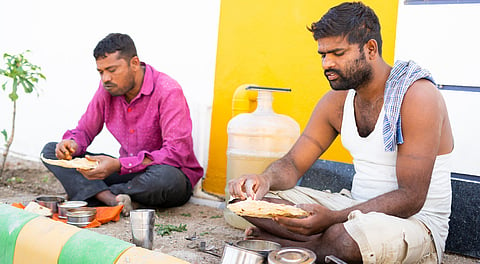


For several decades, the Indian conception of development has been anchored in the triad of roti, kapda, aur makaan—food, clothing, and shelter. Rooted in the post-Independence emphasis on welfare and human dignity, and reinforced through political discourse, public policy, and popular culture, this formulation articulated a foundational social contract: the assurance of basic material needs for all citizens.
The phrase roti, kapda, aur makaan entered India’s political vocabulary in the late 1960s and gained national prominence during the 1971 general elections, when it was closely associated with Indira Gandhi’s campaign and the broader Garibi Hatao agenda. Rooted in post-Independence welfare thinking, the slogan articulated a state-led vision of development centered on meeting basic material needs rather than pursuing economic growth in isolation. It resonated strongly in a period marked by food shortages, unemployment, inflation, and widespread poverty, offering a language of dignity and survival that connected directly with everyday experiences. Beyond electoral politics, the phrase was reinforced through popular culture, particularly Hindi cinema of the era, which further embedded it in the public imagination as a moral benchmark for development and state responsibility.
However, in the contemporary context—characterised by accelerating climate change, growing socioeconomic inequality, and increasing pressure on public infrastructure—it is necessary to re-examine how this developmental ideal is interpreted and implemented. The relevance of roti, kapda, makaan remains intact, but the conditions under which these needs are met have changed significantly. Issues such as groundwater depletion, deteriorating air quality, housing unaffordability, and climate-induced environmental stress raise important questions about the sustainability of existing development pathways.
An analytical framework that offers useful insights in this regard is Doughnut Economics, proposed by economist Kate Raworth. This framework challenges the conventional reliance on continuous economic growth as the primary indicator of progress. Instead, it defines development as the ability of societies to meet essential human needs while remaining within the ecological limits of the planet. Conceptually represented as a doughnut, the inner boundary signifies a social foundation—encompassing food, health, education, housing, and equity—while the outer boundary represents planetary limits, including climate stability, biodiversity integrity, and freshwater availability. The space between these boundaries constitutes a “safe and just space for humanity.”
Viewed through this perspective, India’s longstanding commitment to roti, kapda, makaan appears not obsolete but incomplete. Each component of this triad now intersects directly with ecological sustainability and climate resilience.
With respect to roti, India has achieved substantial gains in agricultural production and food grain availability. Nevertheless, high levels of child malnutrition and anaemia persist, while agricultural livelihoods are increasingly threatened by climate variability, heat stress, and declining groundwater reserves. Contemporary food security, therefore, extends beyond caloric sufficiency to include nutritional quality, livelihood security, and ecological resilience.
Similarly, kapda, historically associated with dignity, self-reliance, and national identity, is today embedded within globalised production systems. The expansion of fast-fashion industries has intensified water consumption, chemical pollution, labour precarity, and textile waste. Consequently, the challenge is no longer limited to access and affordability but also concerns the environmental and social costs embedded in production and consumption patterns.
The dimension of makaan reflects comparable tensions. Rapid urbanisation has expanded housing stock but often at the expense of wetlands, floodplains, and peri-urban commons. Persistent housing shortages coexist with speculative real estate development, informal settlements, and increasing exposure to climate hazards such as floods and heatwaves. Housing provision that neglects environmental context can inadvertently heighten vulnerability rather than enhance security.
The central issue, therefore, is not whether India should guarantee food, clothing, and shelter—this normative commitment remains unquestioned—but how these guarantees are fulfilled. Key policy questions include whether housing can be delivered without degrading river systems, whether agriculture can sustain large populations without ecological degradation, and whether clothing can be produced in ways that uphold both human dignity and environmental integrity.
These concerns are reflected in concrete outcomes, including urban air pollution, recurrent flooding events, occupational heat stress, and climate-induced migration. Collectively, they underscore the limitations of development models that prioritise aggregate economic growth while externalising environmental costs and social inequalities.
While Doughnut Economics does not provide a prescriptive policy template for India, it offers a conceptual reframing of development objectives. It encourages evaluation of progress not solely through indicators such as GDP growth, but through the extent to which basic needs are met without transgressing ecological thresholds. In the Indian context, this would imply delivering roti, kapda, makaan in ways that preserve ecosystem functions, maintain environmental quality, and reduce long-term climate risks.
This perspective does not imply a retreat from ambition. Rather, it calls for a more comprehensive and demanding conception of development—one that seeks societal well-being within biophysical limits. Ensuring universal access to food, clothing, and shelter alongside clean air, safe water, and a stable climate constitutes a higher, not lower, standard of social justice.
As India approaches future electoral and policy cycles, revisiting foundational development narratives may be as important as introducing new ones. The critical question for policymakers is no longer solely how to expand the economy, but how to enable human flourishing within a finite ecological system. In an era defined by climate change, the measure of development lies not in the scale of economic expansion, but in its ability to remain equitable, resilient, and environmentally sustainable within the “doughnut.”
Santonu Goswami is Professor, School of Climate Change and Sustainability, Azim Premji University, Bengaluru
Views expressed are the author’s own and don’t necessarily reflect those of Down To Earth