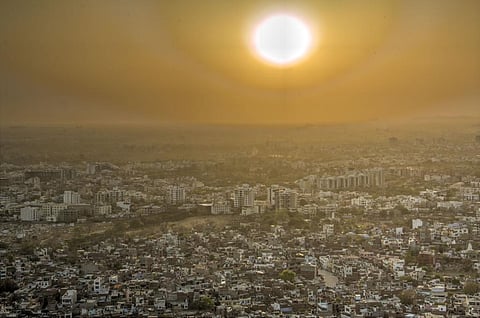


Jaipur faces rising temperatures due to climate change, with heat stress days increasing significantly.
The Centre for Science and Environment has developed a cooling framework to address this issue, focusing on spatial planning, energy transition, and policy action.
The framework prioritises wards based on thermal hazard intensity.
Climate change is intensifying urban heat vulnerability across Indian cities, threatening public health, energy systems, affordability and overall habitability. The United Nations Environment Programme (UNEP) projects warming of up to 4°C in many cities by 2100 — a challenge particularly acute in hot-dry climatic zones where baseline summer temperatures already exceed 45°C.
Rajasthan's cities illustrate the scale of the problem. Jaipur's mean annual temperatures have risen by 0.53°C per decade — more than double the global average of 0.2°C — and heat stress days now routinely exceed 40–50 annually, compared to just 20–30 in the 1990–2010 baseline.
Without structural intervention, higher temperatures drive wider air-conditioning adoption, releasing waste heat that deepens the urban heat island effect and raises cooling demand further — a vicious, self-reinforcing cycle.
Delhi-based think tank Centre for Science and Environment (CSE) has developed an integrated urban cooling framework for Jaipur that addresses both immediate heat mitigation and long-term heat-resilient development through spatial planning, energy transition, and coordinated policy action.
Local thermal hazard
Jaipur's 250 wards face markedly different levels of heat exposure, driven primarily by built-up density, lack of green-blue infrastructure, and related anthropogenic activity. The National Building Code of India, 2016 sets a thermal comfort threshold of 35.5°C for Jaipur — providing indoor comfort at 32°C. Using the temperature delta from this threshold, wards were classified into five zones, from Zone 1 (<6°C delta) through to Zone 5 (>12°C delta).
Some 13 per cent of Jaipur's wards fall in the high and extremely high intensity zones (Zone 4 and 5). A further 35 per cent are in moderate-high Zone 3, and 48 per cent in moderate-low Zone 2. This thermal hazard mapping directly informs ward-level heat action priorities across the city.
CSE estimates residential space cooling in Jaipur will nearly triple by 2037—rising to approximately 1,700 MU from the current 636 MU. Projections combined AC penetration rates from India's Cooling Action Plan (ICAP) 2019 with a socioeconomic variability model, both normalised to produce final demand estimates. Commercial cooling demand is projected to reach an additional 800 MU by 2037, placing severe and unprecedented pressure on the city's energy infrastructure.
Prioritisation of wards for cooling interventions
CSE developed a prioritisation matrix applied across all 250 wards, based on four factors: thermal hazard intensity, population density, green-blue infrastructure coverage, and economic status. The analysis identified 38 high-priority and 172 medium-priority wards where interventions are critical to containing Jaipur's cooling demand. Crucially, 88 per cent of these wards are dominated by low-income households, making cooling equity — central to ICAP's goal of thermal comfort for all — a non-negotiable design principle for every intervention.
Identifying cooling solutions for all
To restore Jaipur to NBC ambient temperature thresholds, CSE developed a three-pronged cooling strategy that safeguards existing green and blue infrastructure, integrates passive design principles, and deploys innovative energy and technology solutions tailored to the city's distinct urban landscape.
The Urban Cooling Framework draws on Jaipur's centuries-old heat-resilient architectural traditions combined with contemporary climate science, creating an equitable and sustainable cooling paradigm that reduces conventional energy dependence and supports the transition to cleaner fuels across development regions.
Tier 1: Green and Blue Infrastructure — Natural Coolth
The first tier focuses on amplifying the inherent cooling potential of Jaipur's natural resources. Green spaces, water bodies, and ecological corridors provide essential temperature regulation but face mounting development pressure. Jaipur's Development Plan 2025 designates 93 sq km in the northern and eastern landscape — comprising Reserve Forest, Protected Forest, and the Aravalli Hills — as Ecological and Green Zones. The framework calls for conserving and intensifying this natural heritage through encroachment control, afforestation drives, native species promotion, and soil and water conservation practices.
Tier 2: Adaptive Resilience — Learning from Heritage
Jaipur's historic built environment has managed harsh climatic conditions for centuries through ingenious passive design strategies. This tier translates traditional cooling wisdom into contemporary practice across the city's municipal area, targeting both indoor and outdoor temperatures to ensure cooling equity. Interventions include thermally efficient materials for redevelopments, cool roof retrofitting, reflective paints, and shading devices, alongside assessments of their market feasibility.
Microclimate enhancement at high-footfall landmarks and nodes is also prioritised given the city's significant tourist influx. Key measures include expanded tree canopy, fountains, UV-resistant shading structures, and low-heat-absorption pavements. Effective delivery requires coordination among the Jaipur Development Authority, Jaipur Municipal Corporation, and the UNESCO World Heritage Committee.
Tier 3: Energy and Technology Integration
The third tier addresses active cooling systems through zoning aligned with land-use compatibility, energy demand profiles, and ward-level socioeconomic status. Non-refrigerant technologies — such as evaporative cooling systems — consume 75-80 per cent less power than conventional air conditioning while supplying 100 per cent fresh air, making them ideally suited to Jaipur's hot-dry climate. Earth-air tunnel and geothermal systems can lower indoor temperatures by 6-8°C and reduce cooling demand by 40 per cent when integrated at the planning stage.
Centralised chilled water production and distribution reduces refrigerant consumption by 43 per cent over its lifecycle, and thermal energy storage integration delivers a further 25-40 per cent in energy savings through load shifting. City-level solar generation has potential to offset 35 per cent of projected residential cooling load by 2037, with complementary contributions from biomass, municipal waste, industrial waste heat, and geothermal sources.
As Jaipur confronts a threefold increase in cooling demand by 2037, continuing with individual, energy-intensive air conditioning will strain grids, escalate emissions, and deepen thermal comfort inequities. An integrated framework breaks this cycle by treating cooling as essential urban infrastructure — akin to water supply or waste management — rather than a luxury commodity.
Each tier of the framework reinforces the others: Passive design reduces heat gain at the building scale; green-blue infrastructure lowers ambient temperatures at the neighbourhood scale; district cooling networks provide shared efficiency; renewable energy supplies clean power; and waste heat recovery creates circular energy flows. Cumulative benefits far exceed the sum of individual measures.
Jaipur's case demonstrates that rigorous thermal vulnerability assessment and demand projections can enable targeted, equity-focused interventions. Success, however, requires coordinated action across building regulations, urban planning, clean energy systems, local resource management, and urban design. While ICAP 2019 provides the strategic direction for thermal comfort, cities currently lack clear operational guidance to manage heat and reduce cooling energy burdens. This framework offers both a practical method to implement ICAP and a pathway toward inclusive, energy-efficient urban planning—consistent with a net-zero future.
Check out CSE's poster on integration of cooling interventions across Jaipur development region.