
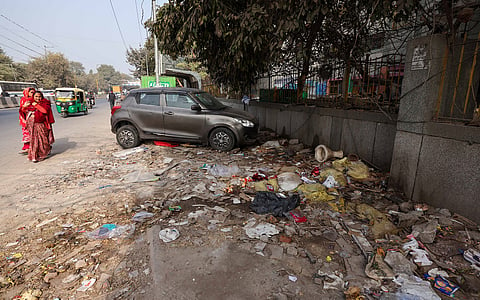

Delhi is a capital city with a difference. Its pavements and sidewalks do not serve the wider public at large. Rather, these are heavily encroached.
Whether it is waste being dumped, or cars being illegally parked or vendors and illegal structures, pavements in India’s capital hardly serve the purpose they have been built for.

The Indian Road Congress’s guidelines clearly state that footpaths in residential areas are required to have three distinct zones, a frontage or dead zone, a clear pedestrian zone, and a furniture or multi‑functional zone, with the pedestrian zone alone being at least 1.8 meters wide.
According to these guidelines, the walkability score of a road depends on “footpaths that are free of encroachments”, among other factors, notes a report by Newslaundry.
But Delhi’s pavements, as is seen, hardly adhere to these norms and guidelines.
The heavy encroachment of these sidewalks has often led to frequent anti-encroachment drives by agencies like the Municipal Corporation of Delhi as well as interventions by the Delhi High Court and Supreme Court.
But Delhi’s pavements continue to remain encroached.