

Delhi and the National Capital Region (Delhi-NCR)’s environmental crisis is no longer seasonal. What was once seen as a winter pollution spike has evolved into a year-round strain on infrastructure, public health and household finances. Summers are hotter, heatwaves last longer, and the city’s built environment is struggling to cope. According to the Intergovernmental Panel on Climate Change (IPCC), urban areas across South Asia are already experiencing more frequent and intense heat extremes, with cities like Delhi facing compounded risks due to density and built-up surfaces.
The debate, therefore, is not whether Delhi should move towards a green economy. It is whether it can act quickly—and decisively—in the sectors that matter most. Construction, transport and waste sit at the centre of this transition.
Delhi’s rapid expansion has made construction one of the least scrutinised yet most persistent sources of pollution. Data from the Commission for Air Quality Management and Central Pollution Control Board (CPCB) consistently identify road dust and construction activities as among the largest contributors to PM2.5 and PM10 levels in Delhi-NCR, often accounting for a substantial share of particulate pollution.
At the same time, the region generates thousands of tonnes of construction and demolition (C&D) waste daily. Estimates from the Union Ministry of Housing and Urban Affairs (MoHUA) suggest that Indian cities generate over 150 million tonnes of C&D waste annually, with only a fraction being scientifically processed and reused. Delhi has established recycling facilities, yet utilisation remains below potential due to weak market demand.
This is not a technological gap—it is a policy one. Public procurement can shift markets. Mandating recycled materials in public projects would create demand certainty and normalise their use across the sector.
Equally important is how buildings are designed. Energy-efficient layouts, passive cooling and better material choices can significantly reduce long-term energy demand—an important consideration in a city where electricity consumption spikes during extreme heat.
Transport policy in Delhi has increasingly focused on electrification. While necessary, this emphasis risks overlooking a more immediate reality: mobility in the city is becoming physically more difficult.
As temperatures cross 45°C with increasing frequency—consistent with projections highlighted by the IPCC—everyday commuting turns into an endurance challenge. Public transport, to remain viable, must also be climate-resilient.
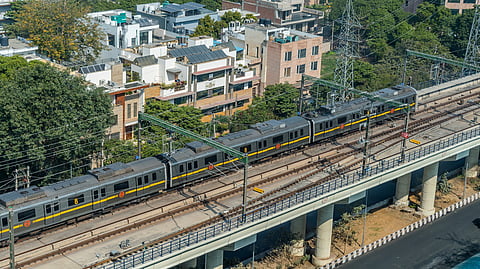
The metro network has expanded significantly, yet last-mile connectivity remains uneven. In the absence of reliable feeder systems, many commuters continue to rely on private vehicles. Data from urban transport assessments supported by MoHUA indicate that inadequate last-mile connectivity remains a key barrier to public transport adoption in Indian cities.
Buses remain central to any meaningful shift. However, fleet size and service coverage have not kept pace with demand. Without strengthening bus systems, gains from metro expansion and vehicle electrification will remain limited.
Infrastructure design must also respond to rising temperatures. Shaded bus stops, tree-lined pedestrian routes and climate-sensitive materials are no longer optional—they are essential for usability in extreme heat.
Few issues capture Delhi’s environmental challenge as starkly as its landfills. Ghazipur, Bhalswa and Okhla continue to handle large volumes of waste, even as biomining efforts are underway.
Delhi generates roughly 11,000-13,000 tonnes of municipal solid waste daily, according to data reported to the CPCB. A significant portion still ends up in landfills due to gaps in segregation and processing. These sites emit methane—a greenhouse gas far more potent than carbon dioxide in the short term—and contribute to fires, leachate and local air pollution.
MoHUA has emphasised source segregation and decentralised processing under programmes like Swachh Bharat Mission (Urban), yet implementation remains uneven.
At the same time, informal waste workers recover a substantial share of recyclable material, often with minimal institutional support. Integrating them into formal systems could improve both efficiency and equity.
The costs of environmental stress are already visible in household budgets.
Electricity demand in Delhi peaks sharply during summer months, driven by cooling needs. As heatwaves intensify—consistent with projections from the IPCC—this trend is expected to worsen, increasing both household expenditure and system-level stress.
Water stress adds another layer. In many NCR areas, supply gaps force reliance on private tankers, raising out-of-pocket expenses. MoHUA has repeatedly highlighted urban water security as a growing concern in rapidly expanding regions.
Health impacts are equally significant. Long-term exposure to high PM2.5 levels—regularly recorded by the CPCB—is linked to respiratory and cardiovascular diseases, resulting in increased healthcare costs and productivity losses.
These are not isolated pressures. They reflect a broader pattern where environmental inefficiencies translate directly into economic burdens for residents.
Urban green cover offers a practical, if underutilised, intervention.
Research referenced by the IPCC shows that urban vegetation can reduce local temperatures, mitigate heat island effects and improve air quality. In Delhi, expanding dense, native tree cover along transport corridors and high-exposure zones can provide measurable benefits—cooler microclimates, reduced dust and improved livability.
This is not about beautification. It is functional infrastructure that supports mobility, reduces energy demand and enhances resilience.
The larger challenge is one of integration. Construction, transport and waste are deeply interconnected, yet governance remains fragmented across agencies and jurisdictions.
What is needed is a coordinated approach—one that aligns urban growth with climate priorities.
This transition should not be seen as a constraint. It is an economic opportunity. Green construction can create skilled jobs. Efficient transport systems improve productivity. Circular waste models generate livelihoods while reducing costs.
Delhi has the tools and institutional frameworks to act. What is required now is coherence, coordination and sustained investment.
The path forward is not about choosing between growth and sustainability. For Delhi NCR, the two are now inseparable.
Ashish Mansharamani is the Associate Director at Indian Social Responsibility Network
Views expressed are the author’s own and don’t necessarily reflect those of Down To Earth
