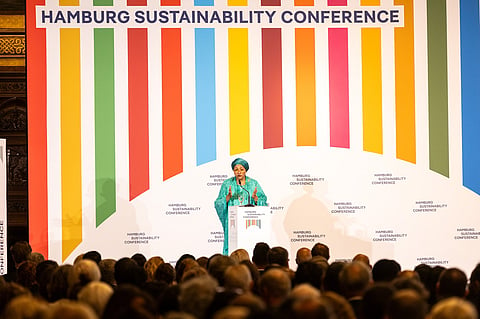


Fossil fuel subsidies, which had been on a downward trend globally, are on track to reach US$1.1 trillion in 2026 — US$410 billion more than in 2025 — since the West Asia conflict and countries with no stake in the ongoing geopolitical conflicts are watching their potential for future growth being absorbed by the fallout, top global development officials highlighted at the Hamburg Sustainability Conference that opened in Germany on June 29.
Gathering around 1,600 participants from 115 countries — including German Federal President Frank-Walter Steinmeier, 22 ministers, 13 high-level representatives of international organisations, and more than 280 executives from the private sector, the two-day conference convened under the theme ‘The Power of Cooperation: Driving Progress Together.’
UNDP (United Nations Development Programme) Administrator Alexander De Croo made a pointed case for renewable energy as both an economic and a security imperative. Accelerating the clean energy transition, he argued, is no longer just a climate argument — renewables are cheaper than fossil fuels, less volatile, and crucially, less dependent on the chokepoints that leave countries exposed.
“Energy security and energy transition are intimately linked,” he said. Development itself, he added, is “part of hard power, it is a way with which you avoid conflict. Countries that are growing, that are inclusive, have less propensity for developing conflicts.”
German Federal President Steinmeier set the tone early, warning that the international rules-based order that has guided global affairs for decades is now “in jeopardy,” with a few powerful states openly violating norms in pursuit of their own interests.
Speaking in Hamburg, a major international port where disruptions to trade are “particularly quickly felt,” he pointed to the blockage of the Strait of Hormuz as a stark reminder of how dependent the world remains on safe shipping routes and supply chains.
“Without greater international cooperation, without mutual trust, we will not be able to master global challenges such as climate change or the fight against hunger and poverty,” he said.
The message from all the speakers was unambiguous: the compounding weight of conflict, energy shocks and shrinking development finance demands not a retreat from multilateralism, but a reinvention of it.
Against a backdrop of mounting geopolitical uncertainty, de Croo framed the moment with bluntness. “We are living in a world of great contradictions: unprecedented wealth, unprecedented innovation, yet unprecedented instability,” he said.
“We have never had more crises in the world since the Second World War.” The way out, he argued, is not through declarations alone. “We are not going to tackle this with only talks — we are going to redefine it with talks, with investments, and with acts.”
The conference, a joint initiative of the UNDP, Germany’s Federal Ministry for Economic Cooperation and Development (BMZ), the Michael Otto Foundation, and the City of Hamburg, has over its first two editions established itself as a platform for launching high-impact global alliances. This year, more than 15 new alliances for a sustainable future are expected to be launched or substantially advanced — spanning clean energy, responsible AI, child malnutrition, and workforce skills gaps. A joint call to action by BMZ, UNICEF, and the UN World Food Programme to end child malnutrition by 2030 is among the initiatives expected to be announced.
UN Deputy Secretary-General Amina J Mohammed painted an equally stark picture, warning that the development gains of recent decades are fragile. “The war in West Asia has disrupted maritime traffic, choked energy and critical supply chains, and pushed up inflation,” she said.
Steinmeier was pointed in his warning about where the erosion of rules leads. Major powers may survive, even benefit in the short term, from the new “global disorder”, he acknowledged. “But it is not true for us Germans and for a large majority of countries in the world.” It is crucial, he said, not only to maintain existing partnerships but to deepen and expand them to deal with global challenges of climate change or fight against hunger and poverty.
A centrepiece of proceedings on June 30 will be the launch of the North-South Commission on Development, co-chaired by former German Chancellor Olaf Scholz and former Costa Rican President Laura Chinchilla. Convened by the German government, the commission — comprising 20 members drawn mostly from the Global South — will develop new frameworks for cooperation suited to a multipolar world over the next two years. It reflects, organisers said, Germany’s drive to deepen relationships with the Global South.