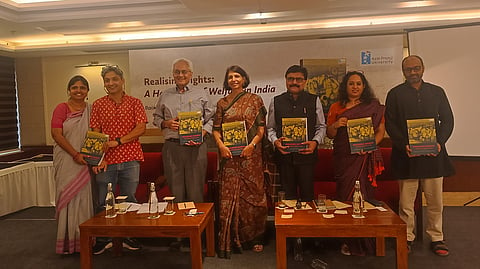


Azim Premji University’s new handbook examines how India’s welfare model is shifting from rights-based entitlements towards cash transfers, digital delivery and the language of “beneficiaries”.
Speakers at the launch said welfare schemes should be judged not only by delivery numbers, but by dignity, accountability and citizens’ rights.
The handbook says public spending on health, education, nutrition and social security remains below policy goals, despite the expansion of welfare schemes.
It flags growing exclusion risks linked to Aadhaar verification, e-KYC, weak grievance redressal and the weakening role of local democratic institutions.
India may run one of the world’s largest welfare systems, but access to quality education, healthcare, nutrition and social security remains uneven nearly eight decades after Independence, speakers said at the launch of a new handbook on welfare in India.
Realising Rights: A Handbook of Welfare in India, released by Azim Premji University at the India Habitat Centre on June 26, 2026, examines the achievements, gaps and future of India’s welfare architecture.
The handbook, prepared by the Centre for the Study of the Indian Economy at Azim Premji University, brings together 27 authors across 18 chapters. It looks at welfare not merely as a set of schemes, but as a question of rights, public accountability and the relationship between citizens and the state.
Dipa Sinha, associate professor at the Centre for the Study of the Indian Economy, said public spending on education and health continued to fall short of policy goals. Public expenditure on education has remained at about 4 per cent of GDP since 2010, below the policy target of 6 per cent. Public spending on health remains below 2 per cent of GDP, against the National Health Policy target of 2.5 per cent.
Speakers at the launch said India’s welfare model has expanded significantly over the years, but the language and design of welfare are changing. A key concern, they said, is the shift from citizens as rights-holders to people as “beneficiaries”.
Rajendran Narayanan, who teaches in the economics programme at Azim Premji University, said the term “beneficiary” has increasingly replaced the language of rights, creating a sense that people are receiving favours rather than claiming legal entitlements.
“Citizen identity has legally transformed from rights holders to beneficiaries over the last decade,” he said. He added that welfare delivery, earlier mediated through local institutions, is increasingly being replaced by cash transfers and digital dashboards, where accountability is often reduced to numbers.
Economist AK Shiva Kumar said India’s welfare system is going through a phase in which rights-based public systems are gradually being replaced by cash transfers and digital delivery systems.
“A rights-based framework was not just a set of schemes, but a political and institutional system in which citizen participation, state accountability and the concept of rights were central elements,” he said.
Shiva Kumar said welfare schemes should not be viewed only through the lens of benefit distribution, because they also define the relationship between citizens and the state. In debates over Aadhaar-based delivery, digital systems and cash transfers, he said, the important question is whether these systems expand dignity, citizenship and people’s capabilities.
Social security remains an unfinished agenda. According to International Labour Organization data cited at the launch, India spent only 4 per cent of GDP on social security in 2023. Brazil spent 17 per cent, Mexico 7.9 per cent, South Africa 5.4 per cent and Thailand 4.9 per cent.
The handbook says state governments now bear about 90 per cent of total public expenditure on the social sector.
The central government’s share in public social sector expenditure declined from 23.6 per cent in 2008-09 to 8.5 per cent in 2024-25, according to the handbook. Data from the Reserve Bank of India database shows that between 1996-97 and 2024-25, states consistently accounted for 75 per cent to 85 per cent of such expenditure, while the Centre’s share declined.
Sinha said the handbook excluded items such as fertiliser subsidies and pensions, and focused on welfare schemes that constitute entitlements.
“We found that these schemes consume a significant portion of the budget. The central and state governments together spend approximately 7 per cent of GDP and 21 per cent of total public expenditure on welfare sectors and schemes,” she said.
Responding to a question from Down To Earth, Sinha said the term “freebies” should not be used for welfare entitlements. “The term ‘freebies’ shouldn’t even exist. It’s a pointless debate. Many welfare schemes are linked to people’s right to life. This is their right,” she said.
Retired IAS officer Aarti Ahuja agreed, saying that calling people beneficiaries amounts to underestimating them.
The panel also discussed the rapid spread of cash transfer schemes, especially those aimed at women. Rajendran said monthly support varies widely across states, from Rs 1,000 a month to Rs 40,000 a year. Some states also provide lump-sum payments alongside monthly transfers.
The handbook identifies several state-level experiments that could offer lessons for national welfare delivery.
Rajendran said Rajasthan and Indus Action had made their management information system code public on GitHub. Delhi and Uttarakhand have adopted a lottery preference system for children with disabilities. Odisha and Chhattisgarh have decentralised verification through local authorities, while Andhra Pradesh and Tamil Nadu have used family databases for automatic verification.
In the context of income support for farmers, the handbook points to Andhra Pradesh’s Rythu Bharosa Yojana, launched in 2019, which benefits landless heirs. Odisha’s KALIA scheme also covers landless Scheduled Caste and Scheduled Tribe families, and provides insurance and interest-free loans.
The handbook says such examples show that technology and welfare delivery can be made more inclusive when local institutions and public accountability remain central.
The study documents several barriers in the implementation of social security schemes.
It says transparency mechanisms such as wall writings, social audits and local grievance redressal systems have helped improve accountability in the Public Distribution System. But digital verification has also created new obstacles.
Many women, for instance, do not have mobile phones and are unable to complete their children’s e-KYC because they do not remember the phone number on which the one-time password is sent.
In the case of MGNREGA, the handbook says the absence of clear protocols has led to workers being wrongly marked as “unwilling to work”, which it describes as a violation of the law.
Aadhaar-based verification has also created gaps in nutrition programmes. According to the study, the number of children verified through Aadhaar in the Integrated Child Development Services declined from 86.4 million in 2023-24 to 58.1 million in 2024-25. During the same period, Aadhaar verification of pregnant and lactating women declined from 10.3 million to 7.3 million.
This happened even though the number of registered children fell only slightly, from 89.1 million to 88.2 million, and the number of registered women from 10.7 million to 10.6 million. The handbook says this means many names remain on the register, but Aadhaar verification has not been completed.
At the same time, rights-based initiatives have significantly expanded welfare coverage. Following Supreme Court directions, the number of anganwadi centres increased from six lakh to 14 lakh. The number of people receiving subsidised foodgrains under the National Food Security Act rose from 36.3 crore to more than 81 crore. MGNREGA generates 200 crore to 300 crore person-days of employment each year, with women accounting for more than 55 per cent of total employment.
However, many key welfare schemes, including maternity benefits, nutrition programmes, pensions and health services, continue to face gaps in reach, funding and implementation.
Indu Prasad, president of Azim Premji University, said the Constitution embodies India’s commitment to dignity, opportunity and justice for every citizen.
“We hope this handbook will further public debates and strengthen our collective efforts to build a more just and inclusive India,” she said.
The panel said discussions on welfare must go beyond schemes and benefits, and be located within the Directive Principles of State Policy and the broader constitutional vision of social justice.
The handbook also stresses the role of local democratic institutions. It says panchayats and gram sabhas became central to rights-based welfare after the 73rd Constitutional Amendment, but their role appears to be weakening in the new digital delivery model, where decision-making is becoming more centralised.
Shiva Kumar said women’s education had improved and fertility rates had declined, but educated women still lacked employment opportunities. Public welfare schemes, he said, should have contributed more substantially to women’s employment.
Policy and governance expert PV Ramesh said delivery remained a major challenge, especially in remote areas where many people lack valid identification and are excluded from social programmes.
The handbook concludes that India’s welfare system has expanded considerably, but stronger public investment and institutional reforms are still needed in health, education, nutrition and social protection to build universal, accountable and responsive public services.
