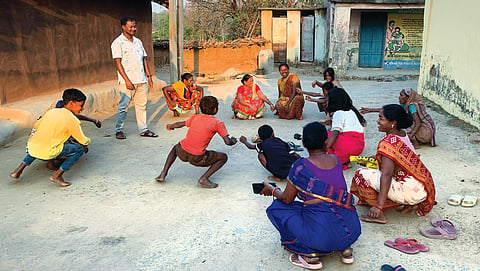


In a small room in Odisha’s Peruabhadi village, the word bounces off the walls. A group of 20-30 women sits inside, fully engaged in the game—not the classic kind, in which they must match numbers called out to 5x5 cards. Rather they react to scenarios they have faced: being harassed in a bus, insulted at work, or taunted at home. Grim as it sounds, the game sparks conversations about how common these experiences are and how women might respond.
In 23 villages across Subdega block, in the tribal-dominated Sundargarh district, such games are now played often in in women-led community centres that have sprung over the past year. Women gather at these centres, named Sanginidhar, at least once a week. The agenda is simple: play games such as kho kho, kabaddi or pithoo, organised by their “coach queens”, and during or after play, exchange informal thoughts on life and work. For some, the sessions are a return to childhood. “I used to love playing kho kho at school. It was a hobby that slipped away as I grew up,” says Punam Dhuria, a resident of Bhojpur village.
For others, the centre offers a rare source of strength to confront serious issues—mental and physical health, menstrual hygiene, or even abuse and harassment. “Earlier, all we did was stay home and work, and many of us faced constant violence. The centre gives us a chance to step away from these situations,” says Trupti Soreng, a resident of Madanbahal village and a coach queen at the Sanginidhar centre in her village.
The idea of engaging women through games resonates in Sundargarh, where most people belong to the Oraon tribal community and where sport, in particular hockey, is popular among men and women. Women, however, often lack the space or opportunity to play, says Lakshmi Bagh, a resident of Kiralaga village. Bagh works with Atmashakti Trust, a Noida-based non-profit that works in tribal belts of Odisha and six other states, and conceptualised the Sanginidhar centres. The first evening of games was in 2024, conducted by Atmashakti volunteers and the women of Peruabhadi village. The event became a regular affair and eventually, the women took over the empty community centre in the village and named it the Sanginidhar. Women of other villages followed, opening more such centres.
Women in the district also lack spaces to discuss or learn about issues affecting their health and well-being, says Anjana Khadia, a resident of Bhagapadi village. “I work as a jansathi (volunteer) in two panchayats of Subdega block, holding awareness talks among women on these subjects. Earlier, they rarely engaged. But now, all is discussed during gameplay,” says Khadia.
“The women laugh, play and realise they are not alone,” says Ruchi Kahsyap, chief executive officer of Atmashakti Trust. As participation in Sanginidhar centres grows, the women plan to hold competitions to take the initiative further.
This article was originally published in the February 16-28, 2026 print edition of Down To Earth