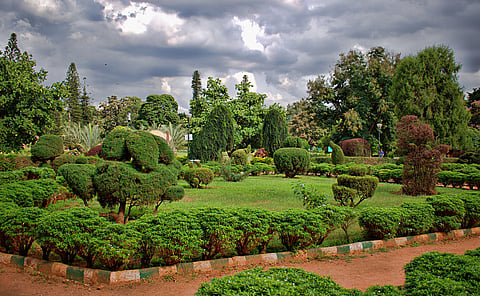

Indian cities close down their parks everyday as if public life expires with the setting of the sun. Gates clang shut in the late evening or, in many places, through the afternoon and then again at night. Most parks thus serve as manicured amenities for a narrow slice of residents rather than as democratic commons. Urban spaces must be read at the intersection of ecology, rights of access, and inequalities of convenience. As a key step in furthering infrastructure for public health, climate adaptation, and social inclusion, Indian cities must begin developing night parks. These should be well-lit, safe, climate-sensitive public green spaces designed to remain usable late into the evening, and in selected locations through the night.
The case begins with scarcity and restricted access. In Mumbai, a recent joint study found that only 30 per cent of mapped public open spaces in two wards were truly accessible. In Bengaluru, a 2024 study found that 19 of 198 wards had no park and 36 had only one, with inequitable access for low-income and Scheduled Caste neighbourhoods. Even where parks exist, timings are exclusionary. Mumbai’s municipal gardens have historically operated with afternoon closures and fixed evening shut times; Delhi’s NDMC parks page shows several parks closing by 8 PM or earlier depending on season; Bengaluru’s park-timing controversies have repeatedly shown how quickly access can be curtailed. These are far from neutral managerial choices. They privilege the retired morning walker, the nearby apartment resident, and the person whose life is organised around predictable leisure windows. They do not privilege the nurse on a late shift, the delivery worker, the domestic worker, the driver, the vendor, the security guard, or the factory hand returning home after dark.
Indian parks are also filtered through social power. Parks in Mumbai are often governed by an impulse “not to include but to exclude,” commonly pushing out the poor, lower castes, Muslims, hawkers, queer people, couples, the elderly, and disabled people by means of targeted rules, fees, fences, and policing. Entry fees segregate on the basis of class and residents’ groups enforce their aesthetic and moral codes to narrow the meaning of “legitimate” use. Bengaluru does not behave very differently, with neighbourhood parks becoming gated, landscaped, rule-bound, and tuned to middle-class expectations, often shutting out informal users and unstructured recreation. This local gatekeeping is part of a larger urban pattern. A recent large-scale study of 1.5 million neighbourhoods found that public facilities and infrastructure are systematically less available in Muslim and Scheduled Caste neighbourhoods. Elites, RWAs, police, and civic authorities acting as if the park next door belongs to them is essentially another manifestation of the socially deep-rooted architecture of caste, class, and communal exclusion through every day urban management.
The law does not bless this proprietary behaviour. In M.I. Builders v. Radhey Shyam Sahu, the Supreme Court treated the park as a public trust resource. The Bombay High Court, in the well-known Cuffe Parade matter, said the public cannot be deprived of open spaces. The Allahabad High Court has similarly held that there should be nothing that hinders the use of a park by the public at large.
India’s brutal summers, only exacerbated by climate change, provide a firm starting point to chalk out the necessity of night parks. The National Centre for Disease Control’s Summer 2025 advisory asks states to plan heat-health responses and explicitly consider public cooling and drinking-water facilities. In Bengaluru last summer, outdoor workers were using parks as refuge from heat when closures kept them out. The science is clear that heat suppresses outdoor activity. Green public spaces that remain accessible in the evening and night are essential for taking a rejuvenating refuge from the heat given that mid-day sun exposure is detrimental and considering that most work-routines do not spare any time for relaxation or recreation in the morning.
The public-health case is overwhelming. The WHO’s India physical activity factsheet estimates that 49.4 per cent of adults and 74 per cent of adolescents are insufficiently active, while for women, the adult inactivity figure rises to 57.2 per cent. A Delhi analysis presented to the WHO South-East Asia regional meeting showed that having parks, commons, and urban forests within 0.5 km is associated with 69 to 89 minutes of physical activity per week, alongside benefits for mental health, equity, cardiovascular risk, and heat-island reduction. Parks thus double up as basic preventive health infrastructure.
Studies show that ambient air pollution is significantly lower in and around parks than in areas surrounding them, in particular roadsides. Parks open during late evening and night offer individuals a more salubrious avenue to spend time for relaxation and recreation, serving as a substitute for seeking the same by the roadside in the form of an evening walk or roadside meetup, and thus reducing their exposure to particulate matter.
Women stand to gain disproportionately from better night parks, but only if cities reject the lazy idea that safety comes from exclusion. The way to make public space safer is not by keeping out the “undesirables” but by encouraging more users, more activity, and more openness through facilitation by design. As a 2009 essay in the Indian Architect & Builder magazine notes, Shivaji Park’s being open late into the night significantly helped women feel safer in and around it. A systematic review found that paths and lighting are consistently associated with park-based physical activity, and that lighting especially matters for female teens. Another review on women’s safety in public space found that street lighting and walking path conditions are important to women’s perception of safety.
The psychological case is as important as the physical one. Systematic reviews show that urban greenspaces benefit physical and mental health, and that physical activity in urban green spaces is associated with better mood, lower stress, improved self-esteem, social cohesion, and lower depression and anxiety. Reviews of children’s exposure to green space suggest benefits across mental health, cognition, behaviour, school performance, and outdoor activity.
Even for the economically privileged, night parks are of increasing importance. As evolving work and lifestyle patterns stretch indoor time deeper into the dark hours, it is essential to have freely-accessible safe green spaces that one could use to unwind and rejuvenate after a long day of work or as a much-needed refreshment recess during overnight work.
Well-equipped night parks would afford multiple benefits across groups of people. They would present an engaging alternative to high-expenditure socialisation activities which exert high exclusionary pressure on the economically underprivileged. Free-entry night parks would serve as a universal no-cost avenue to effortlessly relax, recover, and exercise, to spend recreational time with friends, family, and pets, and to explore new connections in one’s community.
Night parks would also serve to provide safe meeting spots for unmarried couples who lack the privilege of meeting and interacting in paywalled avenues such as late-night cafes, theatres, restaurants, and bars.
Night parks would also help pique interest in and raise awareness about the nocturnal urban ecosystem, enabling children and adults to explore the diversity and peculiarities of night-time fauna and their interaction with the local flora and with human-made elements of the habitat. This would further ecologically-responsible lifestyle and aid urban conservation efforts.
How do cities need to act? Summer pilots would be a sensible starting point. The first short-term step would be to keep selected neighbourhood parks open till 11 PM, followed by the longer-term measure of creation of larger transit-linked parks that remain open through the night. Another key short-term measure would be a regulatory prohibition on discriminatory fees and on arbitrary exclusions based on clothing, occupation, caste-marked appearance, religion, or presumed “respectability.” These regulations can be brought in at the municipal, state, and national levels.
In the long-run, derelict and barren urban spaces such as abandoned infrastructure sites, weed-invaded tracts, unutilised interstitial pockets, and empty marginal spaces can be repurposed as mini parks, built for daylong usage and inclusive by design. Installing basic amenities such as lighting, shaded seating, water points, toilets, and child-friendly areas would be the next vital long-term measure to enhance inclusivity and democratise convenience and utility. The final step would be to staff major municipal parks with trained personnel, including female members.
Freely and conveniently accessible and usable green spaces are essential amenities for the maintenance of physical, psychological, and social wellbeing of individuals as well as for the maintenance of integrity and inclusivity of communities. Parks are an indispensable component of the human habitat, especially in urban areas. They are vital tools of environmental, cultural, recreational, and public health management. Indian cities have spent decades building parks as visual relief. It is now time to recast them as democratic relief. After all, the right to the city does not end at sunset.
Pitamber Kaushik is a journalist, columnist, writer, strategy consultant, and independent researcher currently based out of Mumbai, India
Views expressed are the author’s own and don’t necessarily reflect those of Down To Earth
