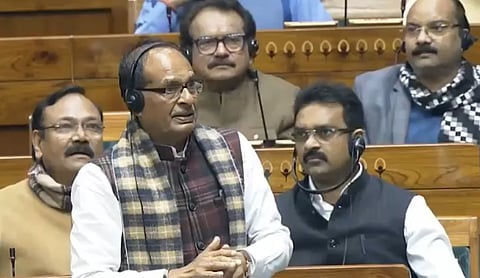


After chaos, ruckus and just eight hours of parliamentary debate, the Lok Sabha passed the controversial Viksit Bharat - Guarantee For Rozgar And Ajeevika Mission (Gramin) (VB-G RAM G) Bill, 2025, on December 18, 2025.
The Bill was introduced in the Lok Sabha on December 15 and was tabled for discussion on December 17.
Maansi Verma, founder of civic engagement initiative Maadhyam that closely follows and tracks parliamentary proceedings, said the discussions started around 6 pm on December 17 and continued until around 1.30 am on December 18.
Question Hour in Lok Sabha took place between 11 am and 12 noon. Around this time, Union Minister of Agriculture, Farmers Welfare and Rural Development Shivraj Singh Chouhan spoke for around 40 minutes. This was followed by a voice vote.
Verma said the voice vote, a norm in Indian parliamentary functioning, lasted for almost two minutes. Members of Parliament (MPs) expressed their disagreement, resulting in chaos.
A two-minute video on social media platform X (formerly Twitter) shows Speaker Om Birla asking protesting MPs to return to their seats to move amendments. However, the Speaker did not wait for the house to settle down and immediately proceeded to the voice vote.
“This means that several MPs who submitted the amendments could not become a part of the record,” Verma said. She added, “The voice vote is an unscientific method where the number of votes favouring or in disagreement cannot be counted.”
She told Down To Earth that the exercise becomes troublesome, especially when MPs are protesting and the number of MPs in disagreement is at a narrow margin.
“Any MP can challenge the voice vote and then recorded voting has to be done. However, the Bill was passed by voice vote amid chaos and protests, and no MP had an opportunity to challenge it. The House was immediately adjourned after it,” she added.
Purbayan Chakraborty, from the trade union Paschim Banga Khet Majoor Samity, said, “The unseemly haste and procedural disregard with which the Bill was pushed through reduces Parliament to a mere formality. When deliberation is replaced by speed, democracy is the first casualty.” Chakraborty has earlier raised issues regarding Mahatma Gandhi National Rural Employment Guarantee Act workers in West Bengal.
On December 17, Wayanad MP Priyanka Gandhi Vadra had asked the Lok Sabha to send the new Bill to the Standing Committee for its suggestions and changes. But the request was turned down.
Chairperson of the Standing Committee on Rural Development and Panchayati Raj, Saptagiri Sankar Ulaka, wrote to Birla stating the new Bill introduces far-reaching changes in the framework governing rural employment and livelihood support.
“Given the scale, scope, and potential impact of these provisions, particularly on rural, tribal, and economically vulnerable populations, it is my considered view that the legislation warrants detailed examination by a Parliamentary Standing Committee,” the chairperson said.
“I must place on record my deep concern and institutional discomfort at the prospect of a Bill of this magnitude being processed without the benefit of such scrutiny. Standing Committees are not procedural formalities; they are integral to Párliament’s legislative function, especially where laws affect statutory guarantees, decentralised governance, and the rights of rural workers,” the letter noted.
Observing that the Bill fundamentally alters the nature of statutory guarantees and rights-based entitlements, Ulaka noted that the Bill brings structural changes the implications of which carry long-term consequences for rural employment and livelihood security.
“As Chairperson of the Committee mandated to examine matters relating to rural development and Panchayati Raj, I find it institutionally anomalous that such a Bill is being advanced without being referred to the Standing Committee most directly concerned with its subject matter.”
Demanding complete and immediate withdrawal of the Bill, umbrella body of workers’ organisations the NREGA Sangharsh Morcha (NSM) alleged on December 17 that the Bill was drafted without consultation with workers, trade unions or other stakeholders.
Alleging that the Bill stripped workers of their right to work, reduced autonomy of the Gram Panchayat and concentrated control with the Centre, they said the Bill would do more damage than good with a rollback of constitutional guarantees.
The NREGA Sangharsh Morcha has announced a nationwide day of action on December 19, 2025. Protests are planned at national, state, district and local levels, with organisers urging the government to withdraw the VB-G RAM G Bill.
