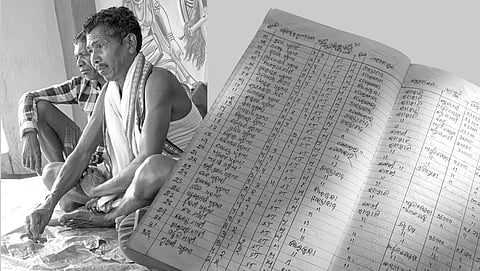


Arguably, Gawdekasgaon was a “rich” pocket within these poverty squares. It has now slipped back into poverty—ironically pushed by the railway lines—from which it would not be able to recover easily. It has lost its natural capital and access to it that once set the village apart and offered the residents a ladder to climb out of poverty.
This is the chemistry of chronic poverty. In the poorest districts of India, people fall below the poverty line every day, slipping deeper with the slightest nudge. So much so that they are now invisible in the country’s development radar, quite literally.
It is more than 15 years since India last counted poverty, and there is little sign of any intent to do so again. In 2011-12 (using a methodology adopted in 2009), the country last drew poverty lines at Rs 816 and Rs 1,000 per month for rural and urban areas respectively, and estimated the number of poor. The exercise proved so contentious that for three years several expert groups were set up to determine the “right” poverty line and the real level of poverty.
In 2014, the erstwhile Planning Commission set up another expert group, known as the Rangarajan committee, to review poverty estimation. The committee was chaired by former governor of the Reserve Bank of India C Rangarajan. The difference between these two estimates is glaring. Going by the 2009 methodology, 25.7 per cent of rural Indians and 13.7 per cent of urban Indians were poor in 2011-12. But the 2014 methodology found that 30.9 per cent of the rural population and 26.4 per cent of the urban population were poor in the same period. The then United Progressive Alliance-II government did not accept the Rangarajan committee estimates. Since then, we have simply counted the years without a poverty estimate.
India’s poverty landscape has another intriguing aspect: despite the poverty rate declining since 1973-1974, the absolute number of poor has remained broadly the same for several decades—hovering at 260-300 million till 2011-2012, out of which one assumes half are chronic poor. If one adds just Rs 10 to the last poverty line...
This article was originally published as part of the cover story Poverty’s own republic in the May 1-15, 2026 print edition of Down To Earth
