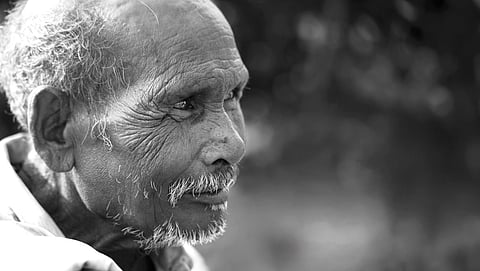


Sangu’s life traces India’s geography of poverty—a stubborn constant in one of the world’s fastest growing economies. Dhamtari (once part of Raipur district) has been identified among the country’s poorest regions since 1951, when the first five-year plan was rolled out. Sangu has officially been classified as poor since then—part of the nascent republic’s first cohort.
Some 25 years ago, he was reclassified as “Antyodaya”—or extremely poor, whose life is deemed at serious risk from hunger. India launched the Antyodaya Anna Yojana (AAY) in December 2000, after a national survey found that 5 per cent of the population went to bed without two square meals a day.
The scheme targeted some 10 million people from below-poverty-line (BPL) households like Sangu’s, entitling them to highly subsidised foodgrains of up to 35 kg a month (now provided free). But in effect, this marked a downward shift in Sangu’s status: from poor to among the poorest, with hunger being tagged to him as a threat to his survival.
Born poor, Sangu has lived with poverty and hunger and has passed these on to the next generations. His sons and grandchildren are also officially poor and “Antyodaya”. There is not a single above-the-poverty-line household in the village. “With birth, poverty is certain here. That is how the outside world identifies us, as we live and die in it,” says Dharmu.
As far as records go, from the rule of kings through the colonial era to the decades after Independence, India’s geography of poverty has remained largely unchanged. Whenever there has been an official attempt to identify districts of destitution, the same names reappear, as if, for reasons unknown, this geography has been consigned to remain poor forever.
India identified its 100 poorest districts in 1997. In 2003, it repeated the elaborate exercise to better target wage programmes aimed at easing acute distress and compiled a list of 150 most backward districts. Both lists featured largely the same districts, concentrated in central and eastern India—Odisha, Chhattisgarh, Madhya Pradesh, parts of Maharashtra, Bihar and Jharkhand. In pre-Independence era, these districts, whether under British-controlled states or princely states, were also among the poorest in their respective domains. Irrespective of the regime, the subjects were...
This article was originally published as part of the cover story Poverty’s own republic in the May 1-15, 2026 print edition of Down To Earth
