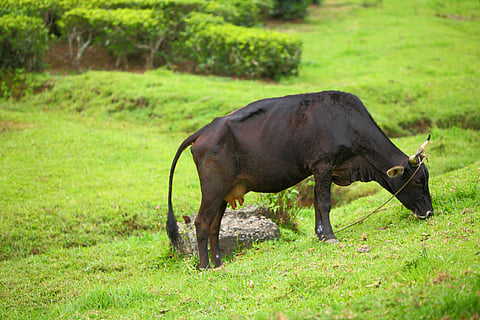


Livestock is a cornerstone of Indian agriculture. The sector contributes 4.1 per cent to India's gross domestic product (GDP) and 25.6 per cent to agricultural GDP, while supporting the livelihoods of about 70 per cent of the rural population.
Despite producing about 247 million tonnes of milk annually, India records an average milk yield of 1,777 kg per animal per year, compared with the global average of 2,699 kg. Several factors contribute to this gap, including breed characteristics, inadequate access to good-quality feed and fodder, and animal-health constraints. Indiscriminate antimicrobial use is another concern.
Preventing disease is generally better than treating it, and adequate nutrition is central to it.
Feeding a livestock population of 527 million animals is, however, not easy. India, with just 2 per cent of the world's geographical area, is home to an estimated 20 per cent of the world's livestock. The country's green fodder availability meets about 88.7 per cent of estimated demand, while dry fodder availability stands at 326 million tonnes against a requirement of 426 million tonnes. Livestock feed comes from cultivated forage crops, crop residues and naturally occurring grasses.
Improving both the availability and nutritional quality of these resources is therefore essential to raising productivity as well as reducing dependence on antimicrobial use.
Balanced rations can contribute about 50 per cent of improvements in milk yield or growth rates of up to 25 per cent. Good nutrition supports rumen function and, in turn, helps maintain the animal's immune system. Hence, choice of forage and its nutritional value are critical to formulating a balanced ration.
Daily dry-matter (DM) intake in cattle is generally 2-3 per cent of body weight. A typical ration may comprise two-thirds roughage, including green and dry fodder, and one-third concentrate, although the proportions vary with age, physiological stage, productivity and feed quality.
Green fodder supplies protein, carbohydrates and essential minerals, including calcium, phosphorus, magnesium, zinc and copper. Leguminous forages are particularly valuable because of their relatively high protein content. They can support muscle development, improve milk production and reduce the need for expensive concentrate feeds when properly incorporated into a balanced ration.
Access to good-quality pasture can also benefit livestock health and productivity. Grazing allows animals to select a variety of forage plants, while rotational grazing helps maintain pasture quality and supports its regeneration. Combining legumes such as alfalfa and clover with grasses can improve the protein content of forage and contribute to soil fertility.
However, grazing alone may not meet all nutritional requirements. Depending on pasture quality and the animal's needs, additional hay or silage may be necessary at certain times.
High-energy supplements such as maize, barley and beet pulp can support growth in young cattle and help restore body condition in undernourished animals. Protein supplements, including soybean meal and cottonseed meal, may be required for lactating animals and growing calves when forage protein is inadequate.
Several green forage crops are traditionally valued for their contribution to milk production. Alfalfa, berseem and oats are among the important options. Their suitability, however, depends on agroclimatic conditions, soil characteristics, water availability and the livestock production system.
In Uttar Pradesh, a range of cultivated forage crops can support year-round fodder availability. During the rabi season, berseem and oats are important options. Kharif crops include cereal forages such as sorghum (jowar), pearl millet (bajra) and maize, alongside legumes such as cowpea and guar. During the zaid season, sorghum, cowpea and multicut pearl millet can provide additional green fodder.
Perennial grasses offer another opportunity to ensure a more consistent supply. Guinea grass and Napier-bajra hybrids are productive, nutritious options that can provide green fodder throughout much of the year, subject to suitable growing conditions and management.
Selecting a combination of cereal and leguminous forages can improve ration quality, diversify feed resources and reduce dependence on purchased concentrates.
Conserving surplus production is equally important to ensure feed availability during dry periods and seasonal shortages.
Drying sorghum, pearl millet and maize residues, commonly known as kadbi or kadavi in different regions, is an established practice. Proper harvesting and drying are essential to retain feed quality and minimise spoilage. Berseem and oats can also be conserved as hay, particularly during March and April, by drying the harvested crop on a clean, suitable surface. Such hay can be mixed with crop residues and straw to improve the nutritional value of the ration.
Silage is another effective way to conserve surplus green fodder. Maize grown for grain, fodder or baby corn can be harvested at an appropriate stage and ensiled. Properly prepared silage retains much of the crop's nutritional value and provides a useful source of feed during periods when fresh forage is scarce. Its dry-matter content typically ranges from 28 per cent to 32 per cent, while protein content varies with the crop and stage of harvest.
Green forage contributes to animal health not only through its basic nutrients but also through naturally occurring bioactive compounds.
Several forage crops, including berseem, pearl millet, sugarcane, Napier grass and chicory, contain flavonoids and other phytochemicals that have been associated with antioxidant, antimicrobial, antifungal and other biological activities. Oats contain avenanthramides, compounds studied for their antioxidant and immunomodulatory properties. Berseem also contains compounds with reported oestrogenic and hepatoprotective activities.
Polyphenols found in pearl millet, sugarcane and Napier grass have likewise attracted research interest for their potential antimicrobial and antidiarrhoeal properties.
These findings point to the potential functional value of forage crops. However, laboratory evidence of biological activity should not be confused with proven disease-prevention or therapeutic effects in livestock. Their contribution to animal health needs to be assessed in the context of actual feeding practices and animal studies.
Nutritional deficiencies can undermine livestock health, productivity and reproductive performance. Phosphorus deficiency, for example, is common among grazing cattle and can reduce weight gain and fertility. Stored feeds and winter forage may also be deficient in vitamins A and E, while vitamin D status depends on feed composition, sunlight exposure and other factors. Supplementation may therefore be necessary where diets do not meet requirements.
Important nutritional and metabolic disorders include grass tetany, milk fever, bloat, mineral deficiencies and ketosis. Cattle require a balanced supply of macrominerals such as calcium, phosphorus and magnesium, as well as trace elements including copper, cobalt, selenium and zinc. These micronutrients support metabolism, tissue repair, reproduction and immune function.
Dietary changes also need careful management. Ruminal acidosis can develop when cattle move too quickly from forage-based diets to those rich in grain and starch. Feed transitions should therefore be gradual, allowing the rumen microbiome to adapt.
Hypomagnesemia and urinary calculi can also be associated with imbalances in dietary minerals. In some high-grain diets, the phosphorus content of feed ingredients can exceed calcium levels, increasing the risk of urinary calculi. Appropriate calcium supplementation, including feed-grade limestone where indicated, can help restore the mineral balance.
Preventing milk fever requires particular attention to the mineral composition of the pre-calving diet. Excessive dietary potassium can interfere with calcium mobilisation around calving. The potassium content of forage should therefore be assessed, and pre-calving rations formulated to minimise the risk of hypocalcaemia.
A ration should meet the nutritional requirements of the animal's species, age, physiological stage and production level. The balance between forage and concentrate must be adjusted accordingly.
The transition period around calving is particularly important for dairy cattle. During this time, diets must provide sufficient energy while maintaining adequate effective fibre to support rumen function. High-quality forage, appropriately formulated energy sources and carefully managed feeding schedules can help reduce the risk of metabolic disorders. Small, frequent meals may also help maintain a stable rumen environment.
Feed quality and storage matter just as much as feed composition. Forage should be fresh, free from mould and contamination, and stored under appropriate conditions. Poor-quality or contaminated feed can cause digestive disturbances and expose animals to toxins.
Nutritional requirements also differ among livestock species. Dairy cattle need carefully balanced energy, protein and mineral intake to sustain milk production and reproductive health while reducing the risk of ketosis and milk fever.
Sheep require diets suited to their growth, reproduction and wool or meat production. Selenium and iodine deficiencies, for example, can contribute to poor reproductive outcomes, weak lambs and increased stillbirth rates.
Goats have different mineral requirements from cattle and sheep. They generally tolerate and require higher dietary copper concentrations than sheep, which are particularly susceptible to copper toxicity. Adequate zinc is also important for hoof health and coat condition. In cattle, sufficient magnesium and phosphorus are essential for maintaining metabolic health and preventing nutritional disorders.
India's livestock sector cannot achieve its full productive potential without addressing the availability, quality and nutritional balance of animal feed. Better forage cultivation, diversified cropping systems, pasture management and fodder conservation can help close the nutritional gap.
Balanced nutrition is also a practical investment in animal health. By reducing nutritional deficiencies, supporting immunity and improving resistance to disease, good-quality green fodder can reduce avoidable treatment costs and dependence on antimicrobial medicines.
After all, an ounce of prevention is worth a pound of cure.