
Subscribe

What is the marker of a healthy adulthood? It is good nutrition at early childhood, particularly during the first 1,000 days of life—from conception to a child's second birthday—when the brain develops rapidly and the body requires adequate nourishment to support healthy growth.
Nutritional deficiencies during this formative period can have lasting impact on both physical and cognitive development. Ensuring right nutrition to children has therefore been a crucial development intervention in the health sector since the launch of planned development in the 1950s.
Yet malnutrition remains one of India's most persistent development challenges. The latest National Family Health Survey (NFHS-6) of the Union Ministry of Health and Family Welfare underscores the scale of the problem. While India has made progress on several indicators of child and maternal health, the survey of 2023-24 shows that many still do not have access to adequate nutrition during the crucial first 1,000 days of life.
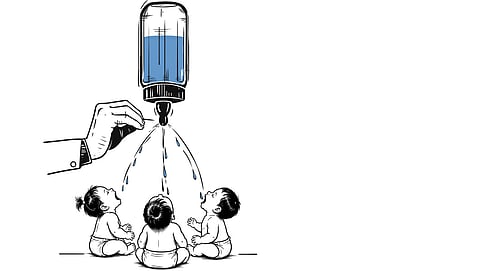
Only 15 per cent of breastfed children aged 6-23 months receive an adequate diet, shows the NFHS-6 finding. Among non-breastfed children in the same age group, the figure is 16 per cent. Overall, the figure hovers around 15 per cent. In other words, more than four-fifths of India’s young children are not receiving adequate diet.
Officially "adequate diet" is defined as: “Breastfed children receiving 4 or more food groups and a minimum meal frequency, non-breastfed children fed with a minimum of 3 Infant and Young Child Feeding Practices (fed with other milk or milk products at least twice a day, a minimum meal frequency that is, receiving solid or semi-solid food at least twice a day for breastfed infants 6-8 months and at least three times a day for breastfed children 9-23 months, and solid or semi-solid foods from at least four food groups not including the milk or milk products food group).”
The consequences are evident in other key health indicators, notably stunting (low height for age) and wasting (low weight for height). According to NFHS-6, 29 per cent of under-five children in the country are stunted, while 19 per cent are wasted.
These figures underscore not only the scale of the nutritional crisis the country is facing, but also the disproportionate burden borne by rural areas. Rates of both stunting and wasting are higher in rural India than in urban areas, despite the former being the focus of malnutrition and childcare programmes.
A state’s economic prosperity or reputation for good governance also do not influence the nutritional status of children. One might expect richer states to spend more on maternal and child welfare programmes and consequently, record stronger nutrition indicators.
But in Gujarat, one of India’s wealthier states, barely 8 per cent of children in the age group of 6-23 months receive an adequate diet; over a third of under-five children are stunted and a fifth are wasted. By contrast, Jharkhand, among the country's poorest states, records better outcomes, with over 13 per cent of children receiving an adequate diet.
In Andhra Pradesh, considered one of the better governed states with wide social welfare programmes, over 19 per cent of children receive an adequate diet. Madhya Pradesh, which has consistently recorded high levels of malnutrition, once again tops the list on several child-nutrition indicators.
More than 31 per cent of under-five children in the state are stunted. The proportion of underweight children has risen to 39.7 per cent from 33 per cent in the previous NFHS, while wasting has in-creased from 19 to 24 per cent. These figures raise questions about the effectiveness of existing interventions.
The costs of chronic childhood malnutrition extend far beyond physical growth. Research has linked poor nutrition in early childhood to lower educational attainment and reduced productivity in adulthood. In that sense, malnutrition is not merely a health challenge but also an economic one. The NFHS-6 findings suggest that policymakers need to focus less on expanding programmes and more on improving their effectiveness and reach.
This article was originally published in the June 16-30, 2026 print edition of Down To Earth
