
Subscribe

When the Centre finally notified the major provisions of the Social Security Code in November 2025, it did something many had long asked for: it named and placed gig workers, platform workers, and aggregators within a legal framework that can — at least on paper — deliver health benefits, accident coverage, and maternity support. The Code even requires aggregators to contribute to a social security fund (a levy in the order of 1-2 per cent of annual turnover, with caps tied to payments to workers).
That legal recognition is a milestone. But it is not the same thing as a rider being able to walk into an emergency room and get treated without a cash crunch, or a woman household worker being able to take paid maternity leave. The central Code creates a structure; the actual delivery — the clinics, claims desks, inspection teams and enforceable platform duties — will be largely shaped by the rules states write and the institutional muscle they build.
Two complementary facts make this a live health story for India today. First, digital registration has already made millions of previously “invisible” workers administratively visible: the e-Shram portal counted nearly 31 crore (310 million) registrations by August 3, 2025 — a database that could, if joined up sensibly, be the backbone for targeted health outreach and insurance enrolment. Second, several states are moving faster than the Centre in operationalising protections: Karnataka’s Platform-Based Gig Workers (Social Security and Welfare) Act, 2025, for example, creates a state welfare fund, grievance machinery and compliance duties for platforms — a model other states are watching.
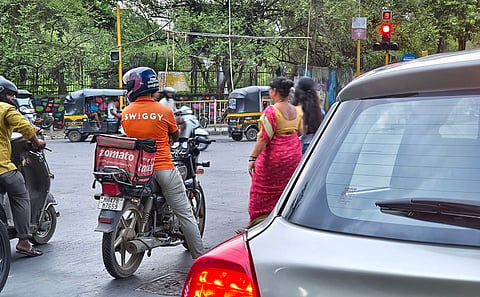
Why does this matter for health? Two-wheeler riders, the backbone of food and parcel delivery, face disproportionate road risk. India recorded about 1.7 lakh (170,000) road fatalities in 2023, and deaths among two-wheeler users have risen sharply over the past decade. For gig workers, this is a daily occupational hazard, not an abstract statistic.
So, the policy questions are practical. Does a social-security framework cover outpatient care, rehabilitation and timely cash for short-term lost wages after injury? Who pays for first-aid and protective gear? Are ambulance and empanelled hospital networks available during the odd hours when many gig workers operate? State laws like Karnataka’s try to answer some of these by mandating welfare funds and dispute redress, but the nuts-and-bolts — hospital empanelment, portability of benefits, quick claim settlement — will decide whether the Code makes a difference to health outcomes.
A curiosity worth pursuing on the ground: administrative visibility through e-Shram creates the rare policy opportunity to run registered worker health drives (vaccination, occupational screening, trauma response mapping) at scale. But registration is necessary, not sufficient: privacy protections, portability of claims, and simple enrolment procedures matter enormously — bureaucratic friction is an illness in itself.
Through a Marxian lens, platforms appear as contemporary sites of surplus extraction, where labour is commodified while economic and health risks are shifted onto workers. The new legal framework brings this structural tension into focus: whether regulation can meaningfully redistribute risk back to platforms and the state, or whether responsibility will continue to remain fragmented and informal.
Two practical signposts for reporters and policymakers to watch now. First, trace the money: follow the welfare-fund flows from aggregator levies to on-the-ground services (ambulances, cashless empanelment, rehabilitation). Second, audit access: Are registered gig workers actually using PM-JAY/other entitlements when injured or ill, and how long do claims take? On both counts, the answers will reveal whether the Code is a paper reform or a public-health intervention.
A rider’s broken wrist after a high-speed delivery is not just a labour dispute; it tests whether India’s new social security framework can deliver timely health care. The law now exists — but clinics, claims systems, and regulators must follow. Only then will the Social Security Code move from legal recognition to real care.
Muralidhar Majhi teaches economics at the School of Economics, Gangadhar Meher University, Sambalpur, Odisha
Sushanta Kumar Mahapatra teaches economics at ICFAI Foundation for Higher Education, Hyderabad
Madan Meher is a former Senior Research Fellow (UGC) at the School of Economics, Gangadhar Meher University, Sambalpur, Odisha
The views expressed are those of the authors alone and do not necessarily represent those of their affiliated organisations or Down To Earth