
Subscribe

Mother’s milk is the among the most familiar yet most enigmatic of substances. Public health authorities, including the World Health Organization (WHO), have long maintained that breastfeeding offers the safest and most complete nourishment for infants—one of the surest ways to safeguard child health and survival. In recent decades studies have also begun to unravel how this “living” fluid acts as medicine, adapts to an infant’s specific, evolving needs and shapes long-term health.
Honed by evolution, its composition—macronutrients and micronutrients, bioactive molecules and even stem cells—supports optimal growth, strengthens immune defences and aids neurodevelopment. In infants it dampens inflammation, neutralises pathogens and shapes the gut microbiome. By promoting the maturation of mucous membranes, it lowers the risk of allergies and autoimmune disorders and contributes to the proper development of the gastrointestinal, nervous, endocrine and immune systems. It also protects against obesity and respiratory infections.
In 2015, a long-term study published in The Lancet Global Health provided evidence that longer duration of breastfeeding is associated with higher intelligence in adulthood, more years of schooling and greater earnings. Small wonder, then, that components of breast milk are now being explored as potential therapies for adult conditions, from cancer and cardiovascular disease to arthritis and irritable bowel syndrome.
But what happens when that first food begins to reflect the burden of environmental contaminants?
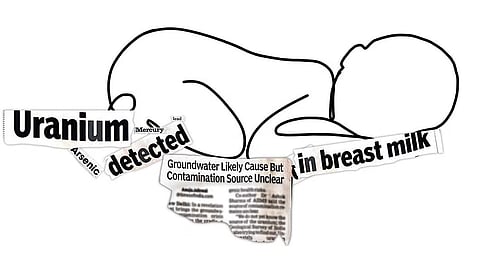
In parts of rural India scientists are detecting traces of pesticides and heavy metals in breast milk. The latest addition to the list is uranium. Exposure to contaminants, it seems, may begin not in adulthood or adolescence but in infancy itself. The quantities detected are often small and the long-term health implications remain uncertain. Even so, the findings raise unsettling questions.

Scientists though caution that the findings are model-based projections rather than evidence of confirmed harm Between 2021 and 2024, researchers from six institutions from across the country set out to assess the health risks posed by groundwater contaminated by uranium-238 (U238 is an isotope of naturally occurring radioactive element, uranium). These included Mahavir Cancer Sansthan and Research Centre in Patna, National Institute of Pharmaceutical Education and Research (NIPER) in Hajipur, All India Institute of Medical Sciences (AIIMS) in New Delhi and Geological Survey of India.
Their work followed a 2019-20 report by Duke University, US, conducted in collaboration with the Central Ground Water Board (CGWB) and state agencies. The report had found that 151 districts across 18 states were partly affected by uranium in groundwater exceeding WHO’s provisional guideline limit of 30 micrograms per litre (µg/l). The worst-affected states included Punjab, where 24.2 per cent wells were above WHO recommendation limit, and Haryana (19.6 per cent), followed by Telangana (10.1 per cent), Delhi (11.7 per cent), Rajasthan (7.2 per cent), Andhra Pradesh (4.9 per cent) and Uttar Pradesh (4.4 per cent). Smaller proportions of contaminated wells were recorded in several other states, including Karnataka (1.9 per cent), Madhya Pradesh (1.3 per cent), Tamil Nadu (1.6 per cent), Jharkhand (1.5 per cent), Chhattisgarh (1.3 per cent), Gujarat (0.9 per cent), Himachal Pradesh (0.8 per cent), Maharashtra (0.3 per cent), Odisha (0.4 per cent), West Bengal (0.1 per cent) and Bihar (1.7 per cent).
Against this backdrop, the researchers for the first time examined uranium exposure among residents in Bihar’s …
This article is part of the cover story First food under threat published in the March 1-15, 2026 print edition of Down To Earth