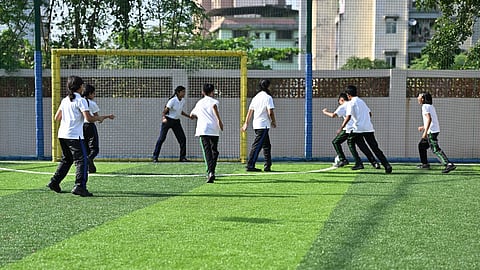


Nearly one in four adolescents aged 11–17 worldwide, or about 240 million teenagers, reported no days with at least an hour of physical activity in the previous week, according to recent estimates released by the World Health Organization (WHO) on November 4, 2026.
An active day is defined as one involving at least 60 minutes of moderate-to-vigorous physical activity.
Only 14 per cent of adolescents reported being active for at least an hour on all seven days, while the global average was 2.7 active days a week.
The findings, published in the journal The Lancet Global Health, draw on 389 population-based surveys covering more than 3.2 million adolescents across 140 countries and territories.
They reveal little progress in adolescent physical activity over the past 15 years, with girls consistently less active than boys.
In 2025, 28 per cent of girls reported no active days in the preceding week, compared with 22 per cent of boys. Girls were also less likely to be physically active every day.
"For 15 years, the world has made almost no progress in getting young people moving, and girls are being left furthest behind," said WHO Director-General Tedros Adhanom Ghebreyesus.
"The answer is not to tell adolescents to try harder. It is to build schools, streets and communities where moving, playing and being active is safe, easy and normal."
The WHO warned that unequal access to physical activity during adolescence could reinforce health inequalities into adulthood, particularly among girls.
Physical activity levels varied considerably across countries. In some, just 4 per cent of adolescents reported no active days, while in others the figure exceeded 40 per cent.
Serbia, Canada, Ireland, Kazakhstan and Finland recorded the highest average number of active days, ranging from 4.5 to 4.8 per week.
The lowest averages, between 1.7 and 1.9 days, were recorded in Cambodia, the Philippines, Timor-Leste, Vietnam, Nepal, Gabon, Liberia, Madagascar, Mauritania and Jordan.
Gender differences were particularly pronounced in several countries.
In Egypt, Brazil, Kenya and South Korea, the proportion reporting no active days was at least 15 percentage points higher among girls than boys.
Boys in Algeria, Egypt, Brazil, South Korea, Israel and Lebanon reported an average of 1.1–1.2 more active days per week than girls.
The study found that no country is on track to achieve the global target of reducing physical inactivity by 15 per cent by 2030.
Without faster progress, adolescent physical activity levels are projected to remain largely unchanged for the rest of the decade.
The WHO said activity levels are shaped by social, cultural and environmental conditions, including access to schools, community programmes, public spaces and safe walking and cycling routes.
It called for stronger policies and investment in environments that make physical activity safe, accessible and enjoyable for all adolescents, particularly girls.
