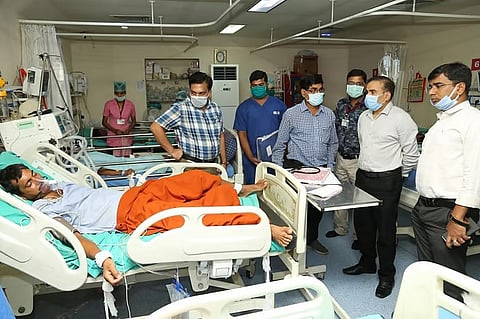


One in eight people in India is sick. In other words, 13 out of 100 Indians suffer from some kind of disease. The highest number of such persons are found among children and the elderly, according to the report titled Household Social Consumption:Health released by the National Statistical Office (NSO) on April 27, 2026.
The report is based on the 80th round of National Sample Survey or NSS (January-December 2025). It presents a comprehensive picture of disease, uses of treatment and health expenditure in the country.
During the survey, people were asked whether they had been sick in the last 15 days (two weeks). It was found that during the last 15 days in India, about 13.1 per cent of people reported illness. That is, about one out of every eight people was sick.
According to the report, the rate of disease in urban areas is higher than in rural ones. About 14.9 per cent of people in cities reported disease, while in rural areas the figure was around 12.2 per cent. There was also a difference on the basis of gender. Disease prevalence rate among women was 14.4 per cent, while among men it was 11.8 per cent.
In terms of age, disease was found to be highest in people aged 60 years and above. About 42 to 45 per cent of people in this age group reported themselves sick. This was followed by about 20 to 25 per cent of people in the age group of 45 to 59 years. At the same time, disease was lowest among young people in the age group of 15 to 29 years, where about 4 to 5 per cent of people reported disease. Among young children (0-4 years), this figure was about 9 to 10 per cent.
According to the assessment, infections and respiratory problems account for the largest share of diseases among children and adolescents aged 0-14 years, with fever, cough and throat infections being prominent. Infection still remains dominant in young people aged 15 to 29 years, although the share of psychiatric and gastro-intestinal problems begins to increase significantly.
Among the members of this age group, challenges related to physical as well as mental health also start emerging.
The percentage of cardio-vascular (heart diseases) and endocrine/metabolic (such as diabetes) ailments increases rapidly in the age group of 30-44 years, which is directly related to risk factors such as hypertension and diabetes.
The share of lifestyle-related diseases increases further in the 45-59 years group, making it clear that non-communicable diseases begin to pose major health pressures by the time people reach middle age.
Heart disease and metabolic diseases remain at the top at the age of 60 and above, and with these, the proportion of bone and joint problems also increases steadily.
At the same time, disease was lowest among young people in the age group of 15 to 29 years, where about 4 to 5 per cent of people reported an illness. Among young children (0-4 years), this figure was about 9 to 10 per cent.
The report also presents a comparative analysis of disease trends based on NSSs since 1995. While the proportion of people reporting illness in the last 15 days in the 1995-96 NSS (52nd round) was 5.5 per cent in rural areas and 5.4 per cent in urban areas, it increased to 8.8 per cent and 9.9 per cent in 2004 (60th round), respectively.
This was followed by 8.9 per cent (rural) and 11.8 per cent (urban) in 2014 (71st round) and 6.8 per cent and 9.1 per cent in 2017-18 (75th round).
In the latest 2025 (80th round), this proportion has increased to 12.2 per cent in rural areas and 14.9 per cent in urban areas, indicating both a rising disease-load and increased reporting of disease in the country. The rate of disease has more than doubled by 2025 from 1995-96.
