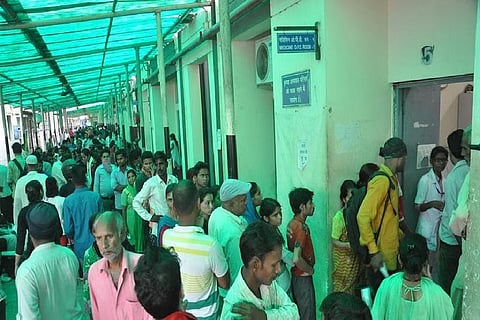


Treatment for the same illness can cost five to 10 times more in private hospitals than in government facilities, NSO survey finds
Out-of-pocket spending remains high, with childbirth and serious illnesses among the starkest examples of the divide
Findings raise concerns over healthcare inequality and the need to strengthen affordable public health services
Private hospitals in India are charging several times more than government facilities for the same illnesses, with childbirth and serious diseases among the starkest examples of a widening healthcare affordability crisis, a new official survey has shown.
Treatment for the same illness can be five to 10 times more expensive in private hospitals than in government hospitals, according to the latest report of the National Statistical Office, based on the 80th round of the National Sample Survey conducted between January and December 2025.
Healthcare costs are becoming an increasing source of financial stress for ordinary people, the report underlined. The NSO’s latest Household Social Consumption Survey on health shows that the cost of treatment depends not only on the nature of the illness, but also on whether a patient seeks care at a government or private hospital. The NSO report also found that one in eight people in the country was sick during the survey period, and that the rate of illness has doubled over 30 years.
The disparity is most clearly visible in hospitalisation data. The average cost of inpatient treatment for an illness in India is about Rs 37,858, while out-of-pocket expenditure is about Rs 34,064.
In government hospitals, the average cost is Rs 6,631. In private hospitals, it rises to Rs 50,508. This means treatment in private hospitals is several times more expensive than in government institutions. The gap widens further for serious illnesses such as cancer, heart disease and kidney failure. In many cases, the cost of treatment can exceed Rs 1 lakh, putting it beyond the reach of ordinary families.
The findings come as the NSO survey also points to a rise in the burden of illness in India, with heart disease increasing sharply over the past seven years and younger people aged 15 to 29 also increasingly affected.
The notion that only major treatments are expensive is challenged by the survey. Even the treatment of common illnesses varies sharply between public and private facilities. For outpatient treatment during the 15 days covered by the survey, the average cost of a single treatment was Rs 861. In government hospitals, it was Rs 289. In private hospitals, the cost rose to Rs 1,447.
This means even minor illnesses can cost three to five times more in the private sector.
Outpatient treatment is often considered routine, but the data shows it can still be expensive. The median cost of a single treatment in the previous 15 days was Rs 400. In government institutions, the average cost was only Rs 289 and, in many cases, close to zero, suggesting that services were either free or provided at a low cost.
By contrast, the average cost was Rs 1,447 in private hospitals and Rs 958 in private clinics. This shows that even reliance on the private sector for minor ailments can be costly.
The cost difference is most pronounced in childbirth. The average cost of a delivery in government hospitals is about Rs 2,299, while the combined average cost across all hospitals is Rs 14,775. In private hospitals, childbirth can cost between Rs 30,000 and Rs 40,000, or even more.
This means the cost of childbirth can rise by 10 to 15 times depending on where a woman delivers.
The burden is greater in urban areas, where the average cost is Rs 23,670, compared with Rs 11,609 in rural areas.
The growing use of private healthcare is also shaping these costs. In rural areas, about 35 per cent of people go to government hospitals, while 39 per cent choose private doctors or clinics. This trend is even stronger in urban areas, where more than 42 per cent seek treatment at private clinics.
This shows that access to, and use of, private healthcare services is increasing rapidly. With this shift, costs are also rising manifold. The trend raises wider questions about India’s dependence on private hospitals and the deepening of health inequality.
State-wise data shows that healthcare costs are not uniform across India, but vary significantly.
Treatment costs are higher in the south and in some more developed states. In Telangana, the total cost of hospitalisation reaches about Rs 55,000, while in Tamil Nadu it is around Rs 52,000. In Kerala and Karnataka, the cost ranges between Rs 40,000 and Rs 45,000.
Expenditure is also high in states such as West Bengal and Maharashtra, where total spending is recorded at or above Rs 40,000. In Uttar Pradesh and Haryana, the level also reaches about Rs 45,000.
By contrast, spending in the north-east and some less developed states is relatively low. In Odisha, it is around Rs 22,000, while in Mizoram and Meghalaya it is about Rs 25,000. In areas such as Ladakh, spending is recorded at only about Rs 8,000.
However, lower spending does not necessarily mean better conditions. It may also point to limited access to healthcare, lower use of services, or people being restricted to cheaper options.
The state-wise data also shows that where government health services are stronger, public spending on treatment remains lower. But where the private sector has expanded, spending rises rapidly.
For example, in southern Indian states, the role of private hospitals is greater and spending is also higher. In contrast, in the north-eastern states, there is greater reliance on government services, resulting in relatively lower expenditure.
Taken together, the data paints a clear picture: healthcare in India remains heavily dependent on out-of-pocket spending. Government hospitals remain the main source of relief for the general public, but their accessibility and quality need to be improved.
