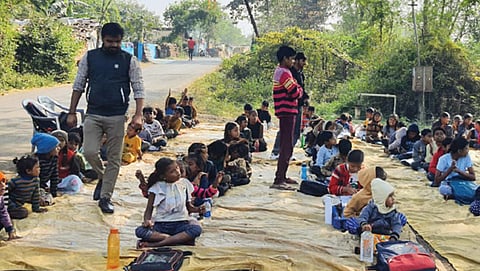


EVERY SUNDAY at 9 am, about 100 children gather under a large tree in Vivekananda Ward, a tribal settlement in Panagar town, Jabalpur district, Madhya Pradesh. These children come from Vivekanand Ward, as well as other tribal settlements like Jaiprakash Ward, Subhash Ward and Bisendi village, for three hours of lessons on Hindi, English, mathematics, science, social science and art. This open school, simply named Street School, is not like any other weekend tuition—it runs with the purpose of stopping children from succumbing to addiction to harmful narcotics.
“About 80 per cent of the children who come to Street School belong to the Kol tribal community, who mainly depend on fishing and daily wage labour. Most of the parents of these children are trapped in addiction,” says Anurag Mishra, who started Street School in 2020. “Moreover, in about 50 per cent of the households, men have died prematurely due to sub-stance abuse. In such families, children are considered a source of income. Through Street School, we only want children get some education and stay away from addictions,” he says.
Mishra, who lives in Panagar and works at a private financial services firm in Jabalpur, says he got the idea after meeting a five-year-old child working at a tea stall. The child, whom Mishra only knows as Daddoo, was smoking cannabis. Mishra learned that the child had lost his mother and was abandoned by his father, who struggled with drug addiction. It appeared that Daddoo had also picked up harmful habits.
Daddoo’s story spurred in Mishra an urge to save more children from falling into addiction, and he, along with a few friends, started teaching children by the roadside. “We went door-to-door to find children. It took some time to persuade their parents,” he says. Initially, many children who came to Street School consumed bidis, cannabis, cough syrup and alcohol, but with guidance, some shed the habit. “We also wanted to help Daddoo, but have not been able to find him again,” says Mishra.
The volunteers also teach art and craft to channel the children's creativity and energy. "My children especially look forward to the art and dance lessons; the school has discovered their hidden talents," says Ashish Kushwaha, a resident of Vivekananda Ward whose 10-year-old daughter and seven-year-old son attend Street School.
As more children joined, Mishra broadened the scope by creating a WhatsApp group to look for volunteers who could teach. The group now has 114 volunteer-teachers, including students of engineering, law and pharmacy. The volunteers have also gotten the children enrolled in regular schools. "When Street School began, only 10-15 per cent of the children went to school; now, all of them do," says Mishra. Vanshika of Vivekananda Ward, currently in class 12, studied at the Street School till last year. "I was one of two girls from my ward to pass the class 10 examinations," she says.
Recently, a couple donated land space in Panagar to Mishra to expand Street School. He plans to build a permanent building and a shelter for addiction support on it.
