
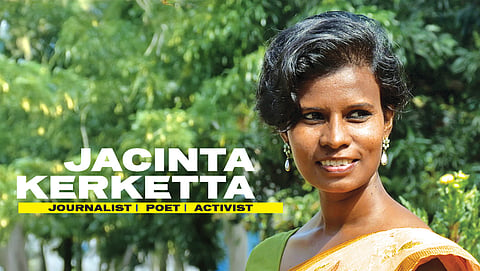
“Writing dispelled the fear within me”

In her journalism and poetry, Jacinta Kerketta blends the dispossession of her community, the Oraon adivasi tribe of Jharkhand, with the destruction of nature. Her work, known for its passionate advocacy of tribal rights, has been widely translated and taught in universities around the world. In an interview with Down To Earth’s Preetha Banerjee, Kerketta reveals that, for her, the greatest achievement has been avoiding ‘insanity’ by forging a deep connection with nature:
Preetha Banerjee (PB): Many of your poems touch upon the impact of capitalism on adivasi communities and their natural surroundings. What personal experiences inspired you to lend your voice to this cause?
Jacinta Kerketta (JK): I was in the eighth grade when I lived in Chakradharpur, a town in Jharkhand’s West Singhbhum district. My school was an hour-long train ride from my village in the district’s Manoharpur block. In this region, I often heard stories about the history of Kolhan State of the Ho adivasi people [Austroasiatic Munda ethnic group, known for their deep connection with land and nature, rich culture and unique traditional governance system]. Manoharpur falls within the Saranda forest, Asia’s largest sal forest, and the adivasi people worshipped the tree. Eventually, India’s largest iron ore mine was established here, at Chiria village, and the Howrah-Nagpur railway line was opened. Many people from Uttar Pradesh, Bihar, Rajasthan and Gujarat settled here. Railway tracks were laid by cutting timber from the Saranda forest. During this period, people from Gujarat established sawmills in Manoharpur. As an adivasi-majority area, many adivasi people worked in these sawmills. Earlier, traders from Marwar region had also arrived to conduct business. Over time, Manoharpur transformed into a town. However, power remained in the hands of those who came from Rajasthan; they became rajas and zamindars in this adivasi region.
The Manoharpur area was administered by a member of the Raja of Porahat’s family, who collected taxes from people. Even after the abolition of zamindari system and the monarchy, members of this family continued to conduct business in the area. Amidst all this, Manoharpur also became a hotbed of hooliganism and intimidation linked to mining, markets, timber and the tendu leaves trade. In this same town, my uncle was mob-lynched by powerful upper-caste individuals over a land disputes. My middle grandmother was imprisoned. The perpetrators falsely accused adivasis of practising human sacrifice for a good harvest, and this fabricated narrative was published in newspapers. When people from my village attempted to protest, the entire Kerketta clan was threatened with extermination from the area. During this conflict, some Naxalite groups from the Saranda forest region stepped in to defend the adivasis. They declared that if any further members of the Kerketta clan were killed, the upper-caste perpetrators would be driven out of the area. The atmosphere remained tense for several days.
At the time, I was writing stories and poems for a children’s magazine. These events deeply shook me. I realised that our people were not the ones writing about us, and that we lacked the means to create a counter-narrative to challenge the dominant discourse. It was during this period that I began to take writing seriously. This was the turning point at which I chose to use writing not as a hobby, but as a way to strengthen the voice of my people.
PB: How do poems help you channel your anger and emotions, while also inspiring others?
JK: If I had not picked up a pen, I would have definitely taken up arms. From a young age, I began working within myself. Back then, emotions would surge within me like a storm. I practised silence for years, but my words would burst forth, screaming on paper. The girls at school would say, “Your words are sharp, like arrows piercing the heart.” If I had a disagreement with someone at school, they would express their anger by speaking. I, however, would write something down and send it to them. The girls would say, “Fight by speaking, do not write. It hurts more.”
Both nature and writing have saved me. I was unable to respond to the violence around me with violence. Instead, I chose writing—a path that, like a river, reaches the ocean of hearts of many. Writing dispelled the fear within me. It helped me build a relationship with my body and the universe. It helped me become a better person. I believe that writing, or any art, is meaningless if it does not make us better human beings.
PB: How do adivasi communities perceive degradation of their surroundings and changes in the environment? Have you documented these experiences?
JK: Adivasi people are able to preserve their spontaneity, innocence, honesty, truthfulness and innocent laughter precisely because we live so close to nature.
However, the exploitation of nature and relentless displacement of adivasi communities are having devastating effects. We see a rise in corruption, hatred, anger, suicide, exploitation of women, gang rape and many other atrocities within adivasi communities. I attribute all of this to the refusal to integrate us into the mainstream, to the exploitation of our natural resources under the guise of development, and to neglect our territories in the name of national interest. In this process, adivasis are being transformed into the new Dalits of this country— relegated to the role of a labour force that builds the nation, cleans the sewers and lives in conditions that are far below human dignity.
Amid all this, my strength to survive comes from a deep connection with nature and working with its support. Being adivasi, always living in areas surrounded by nature, has been deeply healing for me. It has saved me from losing my sanity.
PB: You have commented on religion, gender inequality and social injustice through the assault on forests and rivers. How do you think these are related?
JK: We cannot view religion, gender inequality and social injustice in isolation—they are all interconnected. The way we treat nature reflects how we treat humans. From the moment humans began to see themselves as superior to nature, they also started seeing themselves as superior to some within humanity. The hierarchy created by this mindset ignores the fundamental truth that everything in nature is interconnected, and hu-mans survive only through mutual cooperation. So when I write against the attacks on rivers, mountains and forests—their plunder, and the occupation of nature by some—it is not just about nature; it is also about the people. It is about the communities that live in and are deeply connected to these areas, because they are the ones most affected by these assaults. Sooner or later, the entire human civilisation will feel the consequences.
PB: How effective is poetry in bringing about climate and social justice? What role do local languages play in driving social change?
JK: I have seen many people in India admit that they do not know much about adivasi issues. Through poetry, they are able to connect, even if only to some extent, with the adivasi world. Poetry allows them to feel, listen and understand from the heart. I have witnessed many people, both in India and abroad, cry after listening to poetry. It brings people together, creating a bond that transcends barriers. It certainly opens the path to social justice.
As for language, I write only in Hindi, although I can speak Santhali and, after years of effort, understand Kurukh. My book has been translated into Santhali. I find adivasi languages to be very different from Hindi. They are more gender-sensitive, deeply connected to nature and more expansive in their expression. Adivasi languages are imbued with wisdom, and if they disappear, mainstream society will lose a vital part of this knowledge.
PB: What, in your experience, is the role and status of adivasi communities of India in conservation and decision-making?
JK: Adivasi communities are constantly struggling to uphold their ancient rights to protect the forests, rivers and mountains in their territories. The demand by thousands of people in Ladakh to have their region included in the Sixth Schedule is a prime example of this ongoing battle. We see two contrasting philosophies in the country: one based on exploitation and profit, and the other rooted in the belief that the protection of humans is inseparable from the protection of nature. These two worldviews are in conflict, and the adivasi communities across the country are fighting this struggle in their own corners.
The adivasi people are the only ones who will remain rooted in this land, no matter the circumstances. They will continue to raise their voices against their own government, calling for the protection of nature and the rights of its people. Unlike a significant number of privileged upper caste individuals, they will never flee the country. The adivasi people have been here since the beginning. They are the only community that will continue to fight for the preservation of this land’s rich diversity.
This interview is from the January 1-15, 2026 special edition, Anxiety in a warming world, featuring exclusive interviews with Dia Mirza, Kalki Koechlin, Kiran Rao, Nila Madhab Panda, Sajana Sajeevan, Tsewang Chuskit, Manish Mehrotra and others, as well as columns by scientists, activists and journalists