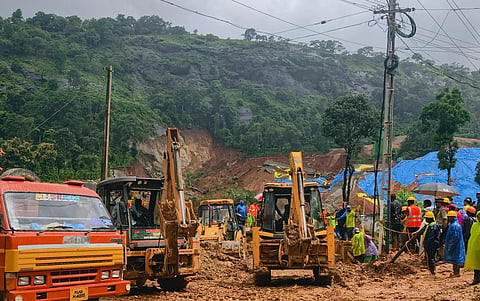


In the aftermath of the tragic landslide that occurred on July 7, 2026, at Kalladi in Kerala’s Wayanad district, a debate is raging over whether the state should go ahead with the ambitious Anakkampoyil-Kalladi-Meppadi twin tunnel project.
Until now, public debate centred on whether the Rs 2,134-crore tunnel project would reduce travel time between Kozhikode and Wayanad, ease pressure on the accident-prone Thamarassery Ghat Road and improve trade and tourism.
Now, the issue is no longer confined to engineering. It has become a test of environmental governance, institutional accountability and the ability of governments to pursue development in landscapes where climate change is making old assumptions increasingly unreliable.
The Kerala government has suspended all construction activities on the tunnel project until two separate investigations are completed. Chief Minister V D Satheesan said the inquiries would examine not only the immediate causes of the collapse but also whether the contractor complied with the environmental conditions attached to the project’s clearance. The government will also assess the geological risks in the area before deciding whether construction can resume.
The decision marks the first major interruption to one of Kerala’s biggest infrastructure projects and reflects growing concern that the disaster cannot be dismissed as an isolated construction accident.
The immediate trigger may eventually be identified through technical investigations. Yet the questions emerging from Kalladi extend well beyond one collapsed slope. They reach into the institutions responsible for monitoring environmental safeguards, enforcing safety standards and responding to warning signs before disasters occur.
Local residents insist warning signs were impossible to miss. Hamza Mandikkara, 70, remembers repeatedly asking the contractor to remove huge heaps of excavated earth piled up near the construction site. According to him, the spoil mound had grown to more than 100 feet high and became increasingly dangerous as the southwest monsoon intensified.
“I have lived here all my life and know these hills. I have never seen a landslip here. Had the hill not been cut and the portions covered with cement lining as part of the project, I don’t believe the landslip would have happened,” he said.
He believes rainwater accumulated behind the artificially modified slopes because adequate drainage had not been provided. Even after local residents repeatedly raised concerns, he says they were assured that nothing would happen because the company had successfully completed similar projects elsewhere. “A mound of excavated earth over 100 feet high remains at the site, posing a threat. We repeatedly asked the company to move it,” he recalled.
Whether these claims are eventually upheld by official investigations remains to be seen. But they underline an important weakness that has surfaced repeatedly in mountain disasters across India. Communities living in fragile landscapes often notice subtle environmental changes before formal monitoring systems do. New seepage, unstable spoil dumps, changing drainage patterns and cracks on hill slopes are frequently observed first by people who live with these mountains every day. Yet local knowledge rarely becomes part of official decision-making. Kalladi suggests that this gap between community experience and institutional response may itself have become a significant risk.
Scientific evidence released after the disaster has added another layer of concern. A recent Geological Survey of India study, conducted with Banaras Hindu University after the devastating 2024 landslides, identified Vythiri taluk as Wayanad’s most landslide-prone region. Large parts of the taluk, including Meppadi where the tunnel project is located, fall within high landslide susceptibility zones because of steep slopes, weathered geology, dense human activity and changing land use. The study reinforces what geologists have long argued. Wayanad’s mountains are naturally fragile, and even relatively small changes in slope geometry or drainage can increase their vulnerability during periods of intense rainfall.
Geologist Sajin Kumar K S of the University of Kerala says slopes exceeding 20 degrees are inherently vulnerable to landslides. In plateau regions such as Wayanad, thick layers of weathered soil absorb rainwater that gradually penetrates deep into fractured rock. During intense rainfall, the saturated soil loses stability and entire slopes can collapse, carrying enormous quantities of debris downhill. “The impact is therefore far more devastating,” he observed while stressing that engineering safeguards and effective early warning systems are indispensable in such terrain.
If science had identified the risks, the next obvious question is whether the institutions created to manage those risks actually functioned. That question has now turned attention towards the Environment Management Committee, one of the most important safeguards attached to the tunnel project’s environmental clearance. The committee was expected to monitor vulnerable slopes, oversee compliance with environmental conditions, supervise automated ground vibration monitoring systems and regularly report emerging risks to local authorities and disaster management agencies.
Instead, it appears to have remained largely inactive. M A Johnson, a member of the committee on the Kozhikode side, admitted that it had met only once since being constituted nearly a year ago. “Though the committee has been entrusted with crucial responsibilities, it has not been able to function effectively,” he said.
Environmental groups argue that a properly functioning monitoring mechanism could have detected dangerous construction practices before they turned into a disaster. For them, Kalladi is becoming not only a story of a collapsing hillside, but also of institutions that failed to perform the role they were created to play.
The apparent failure of the Environment Management Committee has become one of the most disturbing aspects of the post-disaster debate. The committee was never intended to be a ceremonial body. Under the environmental clearance conditions, it was entrusted with monitoring critical stretches of the project, identifying actions that could aggravate land instability, supervising automated ground vibration monitoring systems and communicating its findings to local bodies and the district disaster management authority. If these mechanisms had functioned as intended, experts say, warning signs could have been detected much earlier.
Environmental activist N. Badusha, president of the Wayanad Prakrithi Samrakshana Samiti, believes the committee existed largely on paper. “The EMC was supposed to be the cornerstone of environmental monitoring. Had it functioned effectively, it could have flagged ground-level risks arising from construction practices such as slope cutting or the dumping of excavated earth. Unfortunately, it has remained only a paper committee,” he said.
His organisation has opposed the tunnel project from the beginning, arguing that the alignment passes through an ecologically fragile landscape that has repeatedly demonstrated its vulnerability to landslides. The Kalladi tragedy, he says, should not merely lead to technical corrections but to a comprehensive review of the project itself.
Interestingly, similar concerns are now emerging from within the official monitoring system itself. M A Johnson, a member of the Environment Management Committee, has publicly argued that the suitability of the tunnel project deserves a fresh evaluation in the light of the Kalladi disaster and the scientific studies that have emerged after environmental clearance was granted.
That observation carries significance because it shifts the discussion beyond contractor negligence. It suggests that the central question is no longer simply whether safety norms were violated during construction, but whether the project should continue in its present form through one of Kerala’s most unstable mountain systems.
This is perhaps the biggest change brought about by the tragedy. Until last week, the debate was largely between those who supported the tunnel as an essential infrastructure project and those who opposed it on environmental grounds. Kalladi has altered the terms of that debate. Even people who once viewed the project as inevitable are now asking whether fresh scientific evidence, repeated landslides and changing climatic conditions warrant a complete reassessment before work resumes.
The Kerala government’s decision to suspend construction until the completion of two investigations therefore assumes significance beyond this single project. One inquiry will examine the immediate causes of the collapse, and another will investigate whether the contractor violated environmental conditions attached to the clearance. But many scientists and environmentalists now expect the government to go further. They argue that the findings should be used to undertake a comprehensive geological, hydrological and climate-risk review before any decision is taken on restarting construction. Merely removing dumped soil or strengthening retaining walls may address immediate concerns. They may not answer the more fundamental question of whether the present alignment remains appropriate under changing environmental conditions.
Kalladi demonstrates that development and environmental security cannot be treated as competing objectives. In mountain ecosystems, they are inseparable. A road that destabilises the very landscape through which it passes ultimately undermines the development it seeks to promote.