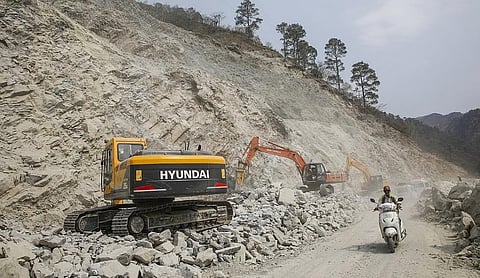


A coalition of 60 civil society groups under the People for Himalaya campaign has urged that high-altitude and trans-Himalayan regions be declared no-go zones for high-risk mega infrastructure after the deadly August 26, 2026 ice-rock avalanche in Nepal.
The statement demands bans on large dams in sensitive areas, strict tourism and urbanisation controls, community-led recovery, worker protections and a climate liability framework.
An umbrella grouping of civil society organisations has demanded that the Himalayas be made a ‘no-go zone’ for high-risk mega infrastructures in the wake of the ice-rock avalanche in Nepal on August 26, 2026, that has claimed thousands of lives, with hundreds unaccounted for.
The People for Himalaya campaign, an initiative of 60 progressive groups, civil society organisations, and activists from the Indian Himalayan region, was launched in March 2024 to address escalating climate disasters and advocate for ecological justice.
In a statement released over the weekend, the group noted that, “For many of us from the region, the irony is that with each disaster that is considered as exceptional, this reality is normalised, becoming a recurring feature of life in the Himalaya. Events are returning with greater frequency and intensity across a region already shaped by extraordinary tectonic and geological sensitivity.”
It listed a number of key demands in the wake of the tragedy in Nepal. “The high altitude and trans-Himalaya are declared no-go zones for high-risk mega infrastructures. In geologically sensitive areas and cryospheres hydropower dams and other large-scale infrastructure should be prohibited, based on the evident cumulative, cascading and climate-related risk,” the statement noted.
Also, as an immediate action, it called on Himalayan countries and states to work urgently towards regional cooperation and solidarity. “By respecting and establishing transparent mechanisms and institutions for transboundary resource sharing, data sharing, mutual assistance during disasters. This also means building trust and bringing resolution on long-standing conflicts over transboundary issues.”
People for Himalaya also urged strict regulation of tourism and urbanisation. This includes bringing tourism, construction and urban growth within the ecological and climatic limits of mountain landscapes through enforceable participatory land-use planning and locally determined thresholds.
“Community-centred recovery and climate governance ensuring just distribution of relief, compensation, relocation and rehabilitation towards long-term livelihood restoration and mental health and psychosocial support for affected communities and families. Affected people must have meaningful decision-making power over reconstruction, livelihoods, land and future well-being,” according to the statement.
It stressed on transparency and accountability in all climate information and knowledge production including developing early warning systems that draw on both science, lived experience and local knowledge. “Combine real-time monitoring with community knowledge, memories of past disasters and systematic localised learning from earlier events is imperative rather than relying on technologies alone. We condemn the lopsided allocation of resources towards top-down and expert centric knowledge production,” the coalition said.
The statement also emphasised that the safety and rights of workers, including migrant workers, employed in tunnels, hydropower projects, construction sites and other high-risk infrastructure should be protected through mandatory risk assessments, emergency preparedness, evacuation protocols, communication systems and safe working conditions.
“We support Nepal’s stance that the catastrophe of 26 August is a matter of climate liability, not charity. For decades, global climate discourse has treated Himalayan disasters as tragic acts of nature to be mitigated by international aid, charity, and emergency relief. We, as People for Himalaya, reject this patronizing framework. We demand a legally recognised framework for direct compensation as part of climate loss and damage at the global and country levels. We urge the people of the region to stand in solidarity and work towards collectivising for the future of this region. We believe that climate justice demands transformative action by the people of Himalaya, for the Himalaya,” the statement concluded.
