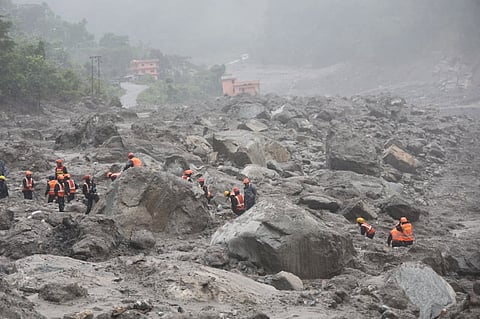


Seismic activity might have played a critical role in the unfolding of the major flash flood that struck Nepal’s Rasuwa district on August 26 morning killing at least 734 so far, said a UN glacier expert in an exclusive interview with this correspondent on August 27. The expert also pointed out the possible climate linkage to the development, referring to an UN-led paper that is in pre-publication stage.
The UN expert told this correspondent that the impact on India cannot be ruled out as such flash floods are known to affect hundreds of kilometres downstream, warning that there may be “cascading effects” to follow.
Dipesh Chapagain, a senior scientist in the Global Mountain Safeguard Research (GLOMOS) programme at United Nations University Institute for Environment and Human Security (UNU-EHS), pointed out that the relationship between seismic activity and the avalanche is not yet clear. “Seismic activity might have triggered the avalanche, but according to United States Geological Survey reports it may be the other way around, with the avalanche triggering seismic activity. We cannot rule out both working in tandem; the findings are evolving,” said the UN expert from Bonn.
According to Chapagain, a major part of an unnamed evolving glacier on the Nepal side of the Himalayas had collapsed, causing ice melting, which in turn blocked the river for some time and triggered the avalanche and flood.
The observation tallies with the International Centre for Integrated Mountain Development (ICIMOD) report late August 26 night. “Preliminary analysis of seismic records has identified unusual signals recorded during the period of the disaster. Data from a seismometer in Jilong, approximately 12 kilometres from the affected area showed anomalous signals, while a second station in Zhangmu also recorded unusual activity … Scientists are examining whether these signals are connected to the suspected ice-rock avalanche,” says the report.
Chapagain, who warned of “cascading effects,” noted that another GLOF is apparently building up close to the Nepal and China border leading to the formation of another lake that may burst and trigger another spell of avalanches. The development has also been echoed by other glacier experts from China and Nepal.
“Preliminary assessment based on video footage and information from affected areas suggests that a large volume of ice and rock debris may have entered the Lhende Khola, a tributary of the Bhote Koshi river. Researchers say the event could have generated a sudden surge that carried water, sediment and large boulders downstream,” reads the ICIMOD report, a copy of which is with this correspondent.
“The same site was devastated by last year’s Rasuwa flood is once again under threat,” said Qianggong Zhang, head of climate and environmental Risks at ICIMOD. “An ice avalanche in the Lhende Khola is the suspected trigger, but the cause remains unconfirmed. With a blockage still lodged upstream on the Nepal-China border, authorities warn a second flood is imminent and evacuation orders are now in place for Jilong port,” added the expert.
According to reports, China issued a high-risk 72-hour alert warning Nepal that a newly formed transboundary barrier lake could breach, with peak water flow expected around September 1, 2026. However, the immediate risk of a catastrophic sudden breach has significantly waned as the lake has begun naturally overflowing and draining safely.
“Climate change, particularly rising temperature, has long been contributing to Glacial Lake Outburst Floods (GLOF). An on-going study of ours, which analysed nearly 500 GLOFs in the Hindu Kush Himalayas (HKH), shows that the rate of such incidents has risen fivefold since 1950,” pointed out the UN expert.
The HKH covers over 4.2 million square km across eight countries: Afghanistan, Pakistan, India, China, Nepal, Bhutan, Bangladesh, and Myanmar.
“A marked acceleration in GLOF frequency became evident after 1950. The post-1950 average rose sharply to approximately 34 events per decade — a fivefold increase compared to the pre-1950 period,” reads the paper. Data accessed by this correspondent shows that the decadal GLOF frequency crossed 40 in recent decades.
The study categorically pinpoints climatic factors as the trigger though non-climatic ones also piggyback.
“The observed dominance of ice avalanches (50%) and intense rainfall (25%) as primary triggers is consistent with this climate-driven pathway. The concentration of 70% of events during the summer monsoon months, when temperatures and precipitation are simultaneously at their peak, further corroborates the coupling between climatic drivers and GLOF occurrence,” reads the paper.
It further points out that “…The predominance of moraine- and ice-dammed lakes in HKH GLOF events — accounting for around 80% of observed outbursts and almost all recorded fatalities — reflects the inherent instability of these dam types under warming conditions”. Moraine- and ice-dammed lakes are bodies of water those are being held back in mountain valleys by natural barriers made of leftover rock debris or solid glacial ice.
The study explains that “ …The continuous inflow of melt-water and sediment load, amplified by increasing temperature, raises water levels which leads to an elevated hydrostatic pressure on the natural dams. This makes these dams more susceptible to breaches, which can be triggered by additional processes such as ice or snow avalanches, landslides or seismic activity,” exactly the phenomena being suspected by experts in recent Nepal disaster.
As of 2020, the HKH had over 64,000 glaciers across 12 major river basins. Additionally, there are over 23,344 glacial lakes, out of which approximately 407 are potentially dangerous. The report says that “ …The highest GLOF risks are centered in the eastern Himalaya, particularly along the China-Nepal border.
India recorded the highest number fatalities from Glacial Lake Outburst Flood (GLOF) events, like the one that happened in Nepal on August 26 killing around 734 so far with 2,498 missing and over 200 injured, despite having the third highest number of such floods within the eight countries sharing the HKH region, finds a UN led global report prepared by a consortium of experts belonging to at least six countries.
The paper, Glacial Lake Outburst Flood Risks, Response Strategies and Adaptation Gaps in the Hindu Kush Himalaya Region, which is in pre-publication stage and covered data from 1835 to 2025 also says that “India has experienced the most severe GLOF-related displacement, followed by Nepal and Pakistan”. A copy of the paper is with this correspondent.
According to data analysed by the paper, India and Nepal experienced comparable numbers, with 62 and 58, third after China which had 199 and Pakistan that experienced nearly 152 such events; but India had 6,119 fatalities while China recorded 625 and Pakistan 1,991 fatalities. According to the study, India has also “experienced the most severe GLOF-related displacement, followed by Nepal and Pakistan”.
“India, Nepal, and Pakistan also identify GLOFs as a critical challenge due to the high risk of earthquakes, which exacerbate the risk of GLOFs and flash floods. Changes in glacier mass balance are also considered a key indicator of climate change in the HKH region,” it adds.
The paper points out the inadequacy of anti-GLOF measures in India, which explains the high mortality in the country despite having a lower number of GLOF incidents. India’s GLOF adaptation measure has been put into the “moderate” category with the country listing only seven measures within 62 undertaken in the area.
Incidentally India’s quantum of international finance received to undertake glacier adaptation, has been put into “low” category.
“We have not learnt lessons from the earlier incidents like Chamoli incident in 2025 or Teesta River flash flood in Sikkim and West Bengal in 2023. Nepal’s latest incident is again a stark warning that unless we start to leapfrog our glacier adaptation, sooner or later we are going to have a mega massacre like Nepal; or even bigger as the population exposure is higher,” explained a climate expert on August 28 evening.
“India, which claims to be moving towards the 5 trillion economy, should not wait for international funding, and use its own resources,” added the expert.
