
Subscribe

I met Fathima on a rainy afternoon in Lakdi, Wayanad. Her small roadside hotel had two wooden tables, a kettle always boiling, and a silence heavier than the mist outside. Last year, during the Chooralmala floods, she lost her husband. The river took him away quietly. Now she runs the hotel alone.
While speaking about tourists and uncertain seasons, she paused and said something that stayed with me. “The media came here and turned everything into a festival. Cameras arrived before rescue operation teams. Politicians arrived before compensation. Images travelled far, but help did not travel fast enough.”
That brief remark compelled me to look back at how the Wayanad floods were narrated by mainstream media. Not as a detached academic exercise, but as a reflection grounded in lived experience.
To do this, I revisited a purposive sample of English-language digital news reports published between late July and early October 2024. The sample included widely read national and international platforms such as The Indian Express, BBC News, The Hindu, NDTV, Times of India, CNN-News18, The Guardian and The New York Times. These reports were examined for headline framing, visual emphasis and narrative focus, drawing on established media framing approaches (Entman, 1993).
Across platforms, a striking narrative consistency emerged. Headlines frequently foregrounded shock, scale and emotion. The Indian Express described how “entire villages were washed away in a midnight tragedy” (The Indian Express, 2024). BBC News framed the event around a rising death toll “ravaging God’s Own Country” (BBC News, 2024). NDTV led with evocative imagery of “bodies, mud and tears”, while CNN-News18 foregrounded “heartbreaking scenes” of survivors searching for loved ones (CNN-News18, 2024).
Such language is not merely descriptive. Headline framing shapes how audiences make sense of disasters. In this case, the dominant emphasis on horror and immediacy positioned Wayanad as a site of sudden devastation rather than a landscape shaped by long-standing ecological vulnerability. Repeated references to “nature’s fury”, notably in The Guardian’s coverage (The Guardian, 2024), subtly removed human responsibility from the narrative. Environmental mismanagement, unregulated tourism and ignored expert warnings appeared, at best, as background details rather than central explanations.
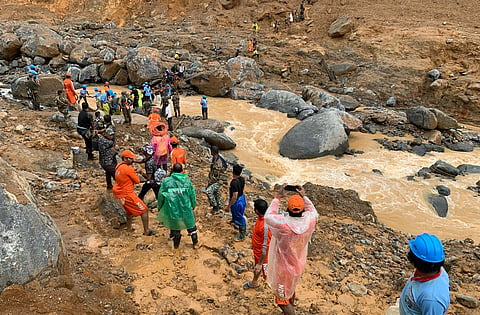
Visual storytelling reinforced this framing. Most reports relied heavily on large, emotionally charged images of grieving families, rescue teams and mud-covered settlements. While such visuals convey urgency, their repetition risks transforming suffering into spectacle. Scholars caution that excessive exposure to traumatic imagery can desensitise audiences and reduce complex crises into consumable visuals (Bakhtin, 1968; Neria & Sullivan, 2011).
Another empirical pattern was the event-centred nature of coverage. Media attention peaked during rescue operations and daily death toll updates. The Hindu and The New York Times offered detailed live updates and explanatory reports in the immediate aftermath (The Hindu, 2024; The New York Times, 2024). However, once rescue operations slowed, sustained coverage declined. Long-term concerns such as displacement, psychological trauma, livelihood loss and delayed rehabilitation received only sporadic attention.
Political visibility further shaped news values. Several Times of India reports foregrounded visits by national leaders and public figures (Times of India, 2024). In contrast, survivor protests and questions of accountability struggled to achieve similar prominence. Disaster space thus became performative, where visibility often mattered more than vulnerability.
From a research perspective, this aligns with what media scholars describe as disaster spectacle. Emotional intensity and visual drama dominate coverage, while structural analysis and follow-up reporting remain limited (Ulmer, Sellnow, & Seeger, 2007). Human-interest stories appear briefly, spotlighting exceptional moments of survival or loss, but everyday resilience and prolonged suffering remain largely invisible.
Fathima’s words return here with clarity. When she said the disaster felt like a festival, she was naming this transformation. Grief became content. Loss became imagery. Attention arrived in waves and receded just as quickly.
As climate-related disasters become more frequent, this moment demands institutional reflection. India urgently needs clear standard operating procedures for disaster reporting. These must prioritise context over spectacle, survivor dignity over visual excess, and continuity over event-driven storytelling. Disaster journalism cannot remain dependent on newsroom instinct alone.
When I left Lakdi, Fathima was serving tea to a customer. No cameras. No headlines. Just life continuing in the shadow of loss. Journalism, if it is to matter, must learn to stay there.
* The name of the woman mentioned in this essay has been changed to protect her privacy.
Anto P Cheerotha is Assistant Professor (On Contract), Department of Journalism & Mass Communication, Kunnamangalam Government Arts & Science College, Kozhikode
Views expressed are the author’s own and don’t necessarily reflect those of Down To Earth