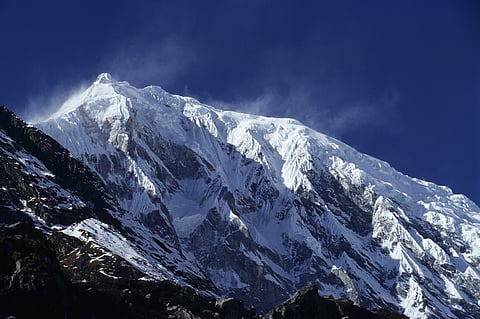


We are living through another great crisis in the Himalaya. On August 26, a mass of rock and ice collapsed high above the Nepal-Tibet border and became a devastating debris flow along the Bhote Koshi-Trishuli river system. Homes, roads, bridges and hydropower facilities were swept away, while hundreds of people were killed or remain missing. The exact sequence is still being reconstructed, and scientists have cautioned that there is not yet evidence to call it a conventional glacial-lake outburst flood or GLOF. What is clear is that this was not one event in the ordinary sense. It was a cascade: collapse, acceleration, entrainment of debris and destruction far downstream.
The disaster is therefore not only a warning about a changing mountain. It exposes a deeper failure: societies repeatedly struggle to act on risks they already understand. We possess growing knowledge about fragile slopes, retreating glaciers, unsafe construction and settlements exposed along river corridors. Yet knowledge remains separated from the institutions and collective choices capable of changing what is built, where it is built and who has the authority to say no.
Part of the difficulty is that human beings are not very good at understanding non-linear processes. We are comfortable with proportional stories. A little more warming should cause a little more melting; one more road should create one more manageable disturbance; another building near a river should add only one building’s worth of risk. Ecological systems do not always respond proportionately. Pressure accumulates quietly, feedbacks reinforce one another, and a system may absorb disturbance for years before crossing a threshold beyond which change becomes rapid and cascading. Non-linearity is the difference between a system that bends and one that breaks.
We should not convert this insight into a convenient causal slogan. It would be scientifically irresponsible to claim, before investigation, that a particular road, building or felled tree caused this collapse. Nor can every Himalayan disaster be attributed directly to climate change. Yet it would be equally irresponsible to ignore the changing background. Glacier mass loss in the Hindu Kush Himalaya was 65 per cent faster in 2011-2020 than in the previous decade, while retreating ice and thawing permafrost are altering slope stability. Climate change may not provide the immediate trigger in every case, but it is changing the physical system within which triggers operate.
Local development then determines how a hazard becomes a disaster. Roads cut into unstable slopes, construction pushed towards river corridors, poorly regulated extraction, tree loss and infrastructure placed in narrow valleys increase exposure and reduce ecological buffers. Nepal has known this for years. A World Bank assessment identified deforestation, road construction, water leakage and infrastructure failure among the activities that intensify flood and landslide risk. The central problem is therefore not a simple lack of information. It is the distance between knowledge and action, and between professed values and actual choices.
That distance persists because the choices producing risk are dispersed across many actors. A municipality that restricts construction may fear losing investment to another. A developer receives the immediate gain from building, while much of the downstream risk is shared by others. A household may protect its own plot but assume that the river, slope or forest is the government’s responsibility. Upstream and downstream communities often experience the same watershed as different political worlds. The fragmentation of decisions is not simply administrative. It produces a structure of incentives that makes dangerous outcomes more likely even when no single actor intends them. This is a classic collective-action failure: everyone fears that restraint will merely allow somebody else to benefit without changing their own behaviour.
But we must not flatten this into the claim that everyone is equally responsible. The capacity to free-ride is distributed unequally. A national highway authority or a hydropower developer can transform an entire valley system; a family on a riverbank has typically moved there because every safer location was already priced beyond reach or occupied by someone with more leverage. The accumulated debris on a slope may reflect decades of decisions made by contractors, planners, lenders and elected officials who will not be in the flood’s path. Those who make the smallest contribution to accumulated risk may carry its greatest cost — losing their home, their livelihood or their life in an event shaped by choices in which they had no voice. Collective responsibility is not meaningless; but it must be joined to an honest account of differentiated power and accountability. Responsibility without power is simply another burden placed on those who already carry the most.
The scale at which decisions are made compounds the problem. A ministry in Kathmandu, a lender elsewhere or a project office working to a deadline cannot fully perceive the lived ecology of every slope, stream and settlement. Information travels upward as a report and returns downward as a rule. In between, uncertainty, local memory and disagreement are compressed. At the same time, residents rarely have sustained spaces in which to understand the cumulative changes around them and deliberate about what should or should not be built.
This does not mean that the state can withdraw. Only governments can enforce no-build zones, regulate hydropower and road construction, finance early-warning systems, mandate cumulative risk assessments and negotiate transboundary data sharing. But expecting the central government to anticipate and manage every interaction is equally unrealistic. Decentralisation without finance, scientific support and legal authority would merely become abandonment.
Knowing that this kind of governance is necessary does not make it easy to build. There is a deeper obstacle that is less often named. The same developmental model that has made Himalayan slopes more dangerous has also been reshaping what people understand themselves to be and what they expect from one another. Consumer culture and the aspiration for material self-sufficiency constantly press individuals toward establishing themselves as autonomous, self-providing units — the household with its own generator, the family with its own water tank, the building with its own private wall above the flood line. This is not personal selfishness. It is what a particular kind of modernity produces: people who are increasingly individuated but decreasingly practiced in collective life — able to consume alongside one another, but less accustomed to deliberating together, sharing risk, or accepting limits that benefit those they may never meet. A society of isolated consumers does not easily become a society of deliberating citizens. The institutions that governance at valley or watershed scale requires — the standing risk institution, the shared map, the negotiated limit — presuppose people who understand themselves as genuinely interdependent, whose choices affect others and whose fates are shared. Rebuilding that capacity is not only an institutional question. It is also a cultural one.
What is needed is a layered process of public reasoning at progressively smaller scales: river basin, municipality, ward and settlement. Each vulnerable valley should have a standing risk institution where residents, local governments, scientists, engineers, disaster-response teams and project developers examine the same maps and evidence together — not once, before a project is approved, but continuously, as the physical system changes and new proposals arrive. Himalayan communities in Uttarakhand have occasionally managed something like this through van panchayats and local watershed committees; Nepal’s community forestry programme created genuine governance capacity at the local level before it was gradually marginalised by centralising pressures. These are not templates to copy, but they demonstrate that ordinary people can manage complex ecological systems when given sustained legal authority, financial support and access to relevant knowledge. What is needed is institutions with the authority to question location, design, evacuation routes, warning protocols and the cumulative burden of multiple projects.
Dialogue, however, cannot rest on goodwill alone. If a community is asked to conserve a forest, forego construction or accept restrictions for downstream safety, it needs a material stake in that decision: adaptation funding, secure livelihoods, compensation, shared infrastructure and a real share in governing local resources. Otherwise, restraint becomes a moral demand imposed on those with the fewest choices. Dialogue without material support is consultation theatre. Material investment without dialogue becomes another project imposed from above.
The Himalayan crisis is also transboundary. Water, debris and risk do not stop at customs posts. Real-time data on glaciers, slopes, river levels and temporary blockages must move across China, Nepal and India faster than floodwater does. Yet data alone will not produce preparedness unless it reaches people in forms they trust, through institutions they recognise and through decisions they have helped shape.
The tragedy in Nepal is another warning. Warnings do not automatically become collective learning. The knowledge-to-action gap cannot be closed by another report alone, and the value-to-action gap cannot be closed by asking individuals simply to behave better. Both require institutions that allow people to recognise a shared risk, confront unequal responsibility and negotiate limits before ecological systems impose those limits violently. A mountain collapse may not be preventable; its transformation into mass death is not inevitable. In a non-linear world, dialogue is not an optional democratic virtue. It is part of the infrastructure of survival.
Soumyajit Bhar teaches sustainability and ecological economics at BML Munjal University and directs its Community Transitions Research Centre. Views are personal.
Views expressed are the author’s own and don’t necessarily reflect those of Down To Earth