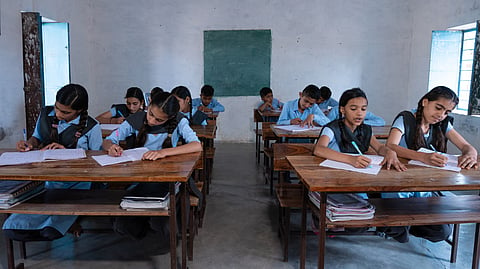


Excessive noise near schools disrupts students' learning and health, with studies linking it to higher failure rates during exams.
Experts recommend soundproofing classrooms, better building designs, and comprehensive noise assessments.
UNICEF calls for coordinated actions, including traffic-calming measures and retrofitting schools, to protect children from environmental noise hazards.
Under India’s Noise Pollution (Regulation and Control) Rules, 2000, an area of 100 m around an educational institution may be declared a silence zone, with noise limits of 50 decibels during the day and 40 decibels at night. But can such silence zones actually protect schoolchildren from noise?
Areas surrounding school often do not meet the silence zone noise limits. In March 2026, a Unicef report described environmental noise as a preventable health hazard affecting children’s sleep, learning and emotional well-being, and identified school as important settings for reducing exposure. “School settings often lack soundproofing and are frequently located near traffic corridors or other industrial/anthropogenic noise. Internal sources, such as overcrowded classrooms and poor acoustics, also contribute to noise,” says the report. A study in India linked ambient noise data with class 12 examination outcomes across six Indian cities and found that daytime noise near schools in India exceeded 55 dB on nearly 87 per cent of days during board-examination preparation and examinations.
The study, published in the Journal of the Association of Environmental and Resource Economists in August 2026, also shows the debilitating effect noise can have on learning. It finds that a 10-percentage-point increase in the share of noisy days during the examination quarter is associated with a 2.3 per cent increase in the failure rate among boys. (The study did not find the same association outside the examination period or among girls, but that is a subject of a separate study.) “The result should be interpreted as a robust association consistent with a cognitive disruption mechanism, while cautioning that cofounding cannot be fully ruled out,” Arzi Adbi, associate professor at National University of Singapore, and a coauthor of the paper, tells Down To Earth (DTE).
Environmental noise does not usually affect attention or listening, but it can become a source of distraction when it is too loud, says Amit Keshri, head, department of head and neck surgery at Sanjay Gandhi Post Graduate Institute of Medical Sciences, Lucknow. A child with normal hearing can, therefore, find excessive classroom noise distracting. Clinically detectable hearing damage generally requires prolonged exposure to sufficiently high noise levels, Kesahri tells DTE. More sensitive tests such as high-frequency audiometry and Distortion Product Otoacoustic Emissions may detect early changes, but are not routinely used for environmental-noise exposure.
Average noise measurements around schools may not capture the full exposure inside classrooms, says Anil Sood, president of Delhi-based non-profit Society for Protection of Culture Heritage Environment Traditions and Promotion of National Awareness, tells DTE. Such measurements can miss intermittent peak disturbance and noise generated within school premises, including from generators and fans. He argues that classrooms should also be designed to absorb sound, using measures such as acoustic panels, tiles and curtains.
The measurement problem has another dimension. Avnish Shukla, a postdoctoral fellow in the environmental science and engineering department at Indian Institute of Technology, Bombay, tells DTE that outdoor measurements alone cannot reliably represent children’s classroom exposure. Take the case of IT College in Lucknow, Uttar Pradesh. Here, a real-time noise monitoring station sits within the campus, close to the college boundary facing the road. It records ambient noise for comparison with the applicable silence-zone standard. But that cannot by itself tell what a student and children hear inside a classroom. Shukla, therefore, argues that assessment should combine indoor and outdoor measurements, while accounting for building design, acoustics, and intermittent events such as horns.
In classroom experiments on 10 roadside schools, Shukla found that cognitive-test scores differed significantly between prevailing noise and controlled silence, with test scores improving by about 14-15 per cent in two schools when transitioning from noisy to silent condition. He cautions that establishing long-term academic effects would require longitudinal and intervention studies.
A real-time noise monitor at a school or college boundary records ambient noise at the monitoring location, but cannot by itself establish student’s exposure inside classrooms, Satish Lokhande, senior technical engineer at the Council of Scientific and Industrial Research-National Environmental Engineering Research Institute, Nagpur, tells DTE. Exceeding the silence-zone limit indicates a potential environmental noise concern, he says, but assessing classroom exposure would require measurements in representative classrooms and other occupied areas, or validated noise modeling.
In an earlier study, Lokhande and colleagues probed the impact of traffic noise pollution on an educational institution near Nagpur–Aurangabad Highway and proposed a feasible noise assuaging measure. They combined on-site measurements with noise modeling to assess mitigation options and found that noise barrier of 4 m height along the college boundary couldreduce traffic noise by up to about 6 decibels. The study was published in the Springer Nature journal Sustainable Communication Networks and Application in 2021
A school’s location and the building’s architectural design is crucial in shaping the noise that reaches the students. A 2026 field study covering 19 naturally ventilated urban schools in Jaipurexamined noise exposure at school façades and inside buildings, and found that roadside noise and distance from roads influenced exposure at school façades, while corridor type, openings, courtyard configuration and floor level were associated with differences in noise transfer.
The study was published in the Journal of Building Engineering.The researchers also developed a framework to identify schools needing greater attention to noise mitigation and a Classroom Noise Transfer Index (CNTI) to quantify noise transfer, published in Elsevier’s journal Engineering.
“Addressing noise as a children’s health issue requires coordinated action at multiple levels, from caregivers to national policymakers,” states the Unicef report, and suggests the following community- and school-level solutions:
• Design and retrofit schools to reduce interior noise through sound-absorbing materials and better
insulation.
• Locate schools and childcare facilities away from major roads, airports, railways, and industrial zones.
• Incorporate noise assessments into school health and safety inspections.
• Advocate for community-wide quiet zones or traffic-calming measures near schools and residential areas.