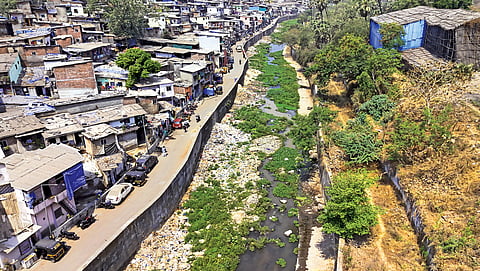


Peter, 63, is trying to catch fish with his dip net near the Munambam beach in Kerala’s Kochi district since 6:30 am. But for almost seven hours, he catches only litter, mostly plastic. “People should stop dumping plastics into water; else there may be a situation where more plastic is caught than fish,” he says. Some days, he catches 5-10 kg of fish and on other days there is only litter. In the seven hours Peter has been fishing today, he has collected 1 kg of plastic. During low tides and when dams are opened, large amounts of plastic arrive at the beach from the eastern side where the Periyar river flows into the Arabian Sea. After rains or flood, Peter collects 10-20 kg of plastic in a week. He says plastic in the sea has increased significantly in the past five-six years. Earlier he would burn the plastic and other litter but now he keeps it so that non-profits, such as Plan@Earth, can collect it.
Peter’s fishing net is just one among the millions in India and around the world catching plastic instead of fish along rivers, coasts or in the sea. In March 2026, Down To Earth (DTE) travelled to four coastal cities and spoke to fisherfolk, activists, scientists, policy experts and government officials to understand the origin of the plastics in the ocean, the scale of the problem, impacts on biodiversity and human health and what can be done to manage and mitigate the problem.
Plastics are the largest component of human-generated solid waste entering the seas and oceans known as marine litter. The United Nations Environment Programme (UNEP) defines marine litter as “any persistent, manufactured or processed solid material discarded, disposed of or abandoned in the marine and coastal environment.” Organisations such as UNEP and national governments recognise marine litter as a major threat to coastal and marine ecosystems, as well as to human health. Since the larger mega and macro plastic (2.5 cm to 1 m) items persist and disintegrate in the waterbodies into smaller particles or mesoplastics (5 mm to 2.5 cm), microplastics (<5mm) and nanoplastics, they can remain in the ocean environment for a long time and reach even the remotest locations on the planet such as the Arctic and Antarctica. They can also enter the bodies of most species, including humans. Microplastics have now been detected in almost every major organ of the human body, though their exact impacts are not clearly known.
The world produces about 400 million tonnes of plastic every year, as per UNEP. Of the total plastic produced, only 10 per cent gets recycled, states UN’s latest “World Ocean Assessment” (WOA) report released on June 8. The rest of the plastic enters the environment, eventually reaching waterbodies such as lakes, ponds, rivers and the oceans. “Every day, the equivalent of 2,000 garbage trucks full of plastic are dumped into the world’s oceans, rivers, and lakes,” says UNEP. The WOA report says that 52 million tonnes of plastic waste enters the world’s oceans, becoming a threat to some 4,000 marine species. Once in the ocean, the currents and gyres—large system, of rotating ocean currents—take them around the world, highlighting the transboundary nature of the problem. At the core of these gyres, there is a slow accumulation of litter which has now grown to enormous garbage patches. There are five of these garbage patches in the world’s oceans. In 2014, it was estimated that there could be “a minimum of 5.25 trillion plastic particles weighing 268,940 tonnes afloat in the sea, but this figure does not include debris on the seafloor or beaches,” states the book Marine Anthropogenic Litter, published by Springer Open in 2015. This is only the plastic floating on top of the oceans. What happens underneath is largely unknown.
The UN Environment Assembly recognised the importance of this issue in five resolutions on the subject in 2022, namely 1/6, 2/11, 3/7, 4/6 and 5/14. “Resolution (5/14) requested the Executive Director of UNEP to convene an Intergovernmental Negotiating Committee (INC) to develop an international legally binding instrument on plastic pollution, including in the marine environment, which is to be based on a comprehensive approach that addresses the full life cycle of plastic, including its production, design and disposal,” as per UNEP. “In 2025, INC came up with a draft solution for plastics but many countries have not agreed on the document,” S R Marigoudar, head of Marine Litter and Micro Plastics programme at the government’s National Centre for Coastal Research (NCCR), Chennai, tells DTE. Currently, there are no polices or other legal binding documents in place at either the global or national level to combat marine litter.
For all the marine litter that humanity dumps, the oceans sometimes send some of it back. This is what happened in 2025, when a sea of plastic objects came ashore along the Thumba and Kovalam beaches …
This article is part of the cover story “Known unknowns”, originally published in the July 1-15, 2026 print edition of Down To Earth