
Popular distrust

The world seems to be going through a period of stasis despite facing an unfathomable polycrisis. Key surveys on people's perception of the world in 2026 reveal uncerta-inty about the future and near collapse of trust in governance structures. A few years ago these risk assessment reports showed environmental meltdowns as the biggest risk; not this year. People seem to be in shock from the geoecono-mical developments and the world splitting into multiple poles with strong isolationism.
The World Economic Forum’s “Global Risks Report 2026” puts “uncertainty” as its defining theme. Its “Global Risks Perception Survey”, synthesising views of over 1,300 global leaders and experts, says that 50 per cent of them anticipate a turbulent or stormy outlook in the next two years, and the figure goes up to 57 per cent for the outlook for the next 10 years. “A further 40 per cent and 32 per cent, respectively, view the global outlook as unsettled over the two- and 10-year time frames, with only 1 per cent anticipating a calm outlook across each time horizon,” the survey says. Nearly every fifth respondent flagged geo-economic confrontation as the top risk, potentially triggering a material global crisis in 2026. For the first time in many years, environmental concerns have been displaced as top risks in the short term.
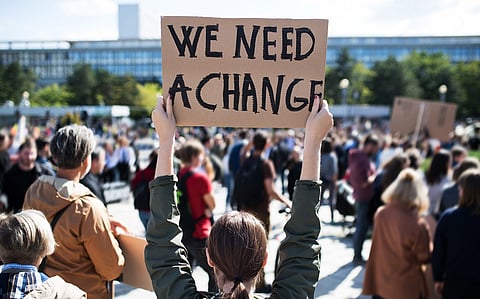
“Rules and institutions that have long underpinned stability are under siege in a new era in which trade, finance and technology are wielded as weapons of influence,” says the report. Extremism in all aspects—social, political and cultural—and polarisation seem to have led people’s distrust of the governance structure, including government and leaders. The survey captures a precipitating “streets versus elites” narrative that “reflects deepening disillusio-nment with traditional governance structures, leaving many citizens feeling excluded from political decision-making processes and increasingly sceptical that policy-making can deliver tangible improvements to livelihoods”.
This polarisation and fast-breeding new isolation can be gauged from the “2026 Edelman Trust Barometer” findings. It warns: “A world retreating towards insularity.” Richard Edelman, the CEO of Edelman, says, “We are choosing a closed ecosystem of trust that mandates a limited worldview, a narrowing of opinion, intellectual stasis, and cultural rigidity. Distrust is the default instinct.” The Edelman Barometer survey found that 70 per cent of its 33,938 respondents across 28 countries (including developed, developing and poor countries) were hesitant or unwilling to trust “someone who has different values, information sources, approaches to societal problems, or backgrounds than them”. Only 33 per cent of the respondents said that they trusted “most people”. Forty-five per cent of the respondents said “insularity” is a “large or crisis-level problem”. In a scary finding, the Trust Barometer says that, “The majority believe it is a problem that people in their country distrust those with differences so much that they actively try to make things worse for one another.”
Recent societal events have greatly contributed to people losing trust in institutions—some 95 per cent of respondents said so. Of these, 40 per cent said they have lost trust in their national governments. For the future, the perception is grim. To the question “Compared to today, will the next generation be better off?”, only 32 per cent responded in the affirmative. The figure is 53 per cent in the case of India, and it is an increase of 13 per cent compared to 2025.
This decline in trust and becoming insular is an outcome of recent years’ developments. The Trust Barometer has been in its 26th edition, reflecting the 21st century trust landscape. Edelman says, “Last year, the Edelman Trust Barometer documented a descent into grievance, with six in 10 of our respondents telling us that they feel business and government actions harmed them, served the interests of only some, and that the system unfairly favours the rich.”
This article was originally published in the the February 1-15, 2026 print edition of Down To Earth