
.jpeg)
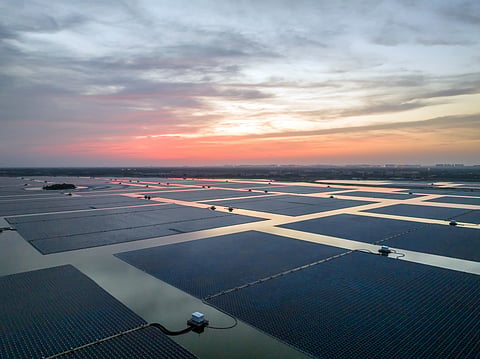
The Union Cabinet has approved the Pradhan Mantri Surya Sarovar Yojana, a Rs 5,070 crore scheme to build floating solar plants on reservoirs and ponds.
The scheme targets 5,000 megawatts of floating solar capacity, paired with at least two hours of battery storage.
India’s floating solar potential has been estimated at about 102.18 gigawatt-peak, but the technology remains largely untested at scale in the country.
Environmental impacts, fishing livelihoods, technical standards, site selection and financing remain key questions as India prepares to scale floating solar.
The Union Cabinet on July 31, 2026 approved a new scheme to build floating solar power plants across the country’s reservoirs and ponds, backing the sector with Rs 5,070 crore over the next several years, even as the technology remains largely untested at scale in India.
The Pradhan Mantri Surya Sarovar Yojana, cleared by the Cabinet chaired by Prime Minister Narendra Modi, targets 5,000 megawatts of floating solar capacity paired with battery storage of at least two hours, translating to 10,000 megawatt-hours of storage nationally.
Projects will be sanctioned between 2026-27 and 2030-31, with financial support continuing until 2032-33.
The scheme draws on a recent assessment by the National Institute of Solar Energy, which estimated India’s total floating solar potential at about 102.18 gigawatt-peak across reservoirs and other inland water bodies. The estimate is based on a geospatial study that assessed water availability, depth, sunlight and proximity to roads and substations. It has become the reference point for the new policy push.
Under the scheme, developers will receive central assistance of Rs 1 crore per megawatt once a project is commissioned. A separate allocation of up to Rs 50 lakh per project will be available earlier in the process to support feasibility work, including bathymetry and hydrography surveys and environmental studies before construction begins.
The government said the scheme would increase the country’s floating solar capacity by 5,000 megawatts, from about 700 megawatts currently installed, reduce the sector’s dependence on land and cut nearly 10 million tonnes of carbon dioxide emissions a year. It expects the programme to generate 16,000-17,000 job equivalents across the project value chain and encourage local manufacturing of floats, modules and storage equipment.
The push into floating solar comes at a time when the industry is still working through basic questions about how these plants should be built. Developers and officials noted that no global technical standard exists yet for floating solar, and that countries have largely adapted land-based solar codes for use on water.
That gap has already appeared in actual projects. In France, the 22-megawatt O’Mega 1 plant on the Piolenc reservoir caught fire in January 2022 after a storm with gusts of 80 kilometres an hour caused a short circuit. Prolonged wear at the site was also flagged as a contributing factor. The case is often cited in industry discussions as a reminder that cable sizing and structural design must properly account for wind and wave stress, a lesson still being absorbed by newer markets such as India.
Germany offers a different lesson. Regulation there caps floating solar coverage at 15 per cent of a water body’s surface, which pushed Sinn Power to develop vertical panel mounting to fit more capacity into less surface area. The National Institute of Solar Energy’s assessment allows up to 20 per cent coverage of a reservoir in India, a threshold still being debated globally.
India’s own experience centres on the Omkareshwar project in Madhya Pradesh. At 600 megawatts, it is the country’s largest floating solar plant and is being built on the Narmada reservoir under the ministry’s solar park scheme. Power from its first phase was tendered at Rs 3.21-Rs 3.26 per unit, while the second phase came in higher, at Rs 3.79-Rs 3.89 per unit, reflecting shifts in the market as more capacity has come online.
Developers on the project also worked out detailed land and storage norms for module launch platforms, guidance that could feed into how feasibility funding under the new scheme is used elsewhere.
Environmental and social questions remain largely open. Floating panels block sunlight from reaching the water below, which can affect aquatic plants and fish habitats. The structures can also attract algae and barnacles, adding to maintenance requirements over time.
Fishing communities that depend on reservoirs for their livelihoods may find their usual areas obstructed, forcing longer trips and higher costs.
A 70-megawatt project in Anhui, China, took a different route around some of these concerns. It was built on a flooded former coal mine rather than a working reservoir, and local coal miners were retrained as panel assemblers and maintenance staff.
Few of these questions have settled answers in India yet. The Pradhan Mantri Surya Sarovar Yojana’s Rs 50 lakh per project allocation for environmental and feasibility studies suggests the government expects assessments to happen project by project, rather than through one national framework applied uniformly.
Approvals from water resources, forest, tourism and pollution control departments, along with grid interconnection rules and charges, remain areas where clearer guidance will be needed before floating solar can scale the way ground-mounted solar has over the past decade.
Financing is another area still taking shape. Globally, floating solar projects have drawn on project finance, corporate finance, green bonds and crowdfunding, alongside tax credits in markets such as the United States and incentive schemes linked to carbon savings in the Netherlands.
In India, a flat Rs 1 crore per megawatt subsidy will apply regardless of a site’s depth, distance from the grid or engineering complexity. How well that structure holds up will depend on the mix of easier and more difficult sites that developers choose.
Taiwan’s approach points to one alternative worth watching. It offers a higher feed-in tariff for floating solar than for rooftop or ground-mounted systems, building the incentive directly into pricing rather than delivering it as upfront capital support. Whether India eventually needs similar differentiation, given that floating solar systems cost more to build and maintain than land-based ones, is a question the new scheme leaves for later.
With sanctions running through 2030-31 and disbursement continuing two years beyond that, the scheme gives India about six years to work through these questions on the ground.
Reservoirs in Maharashtra, Madhya Pradesh, Karnataka, Odisha and Telangana account for much of the country’s floating solar potential, according to the National Institute of Solar Energy’s assessment.
How the sector answers questions on site selection, anchoring in varying water conditions, grid evacuation capacity and equitable benefit-sharing with local communities will determine how much of that 102.18 gigawatt-peak potential is eventually built.
