
Maharashtra’s energy efficiency plan aims to help Kolhapur’s foundry cluster cut energy use and emissions by 2031.
Foundry owners say poor awareness, limited access to subsidised finance and weak implementation of government schemes are slowing the transition.
Many small foundries believe switching from coal to electricity is enough, but auditors say energy efficiency requires furnace optimisation, equipment repairs and better operating practices.
Industry owners say changing solar banking rules and grid charges have made renewable energy investments less attractive and extended payback periods.
Omkar Bhagat, who runs Kohinoor Metallics, a foundry in Maharashtra’s Kolhapur district, had not heard of energy efficiency until a private agency approached him in mid-2025. His foundry, spread across 1,000 sq m in Shirol Industrial Area, manufactures 400 tonnes of iron castings a month and has an annual turnover of Rs 45 crore. About 50 tonnes are exported every month to Germany, the United States and Canada.
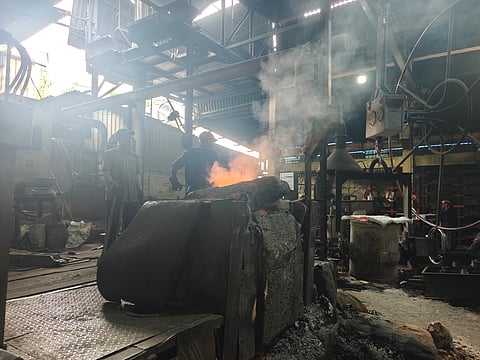
Inside the plant, amid heat, noise and the smell of burning metal, Bhagat said he had invested Rs 10 lakh to repair and upgrade machinery to make it more energy efficient. He has also invested Rs 6 crore, through a private bank loan at industrial interest rates, in a 6 megawatt (MW) open-access solar plant. He said the decision was influenced partly by clients in Europe, where the Carbon Border Adjustment Mechanism (CBAM), has begun applying to some carbon-intensive imports.
CBAM does not currently apply to his products, but Bhagat said he is already worried about the return on his investment in energy efficiency and renewable energy.
The State Energy Efficiency Action Plan for Maharashtra, prepared by the Bureau of Energy Efficiency in 2024, aims to cut industrial energy use by 13.15 million to 17.62 million tonnes of oil equivalent by 2031.
The plan identifies three industrial clusters, including foundries in Kolhapur, for deployment of energy efficiency and renewable energy measures. Across these clusters, the state aims to reduce energy use by 1.12 million to 1.29 million tonnes of oil equivalent and greenhouse gas emissions by 3.50 million to 4.05 million tonnes of carbon dioxide equivalent by 2031.
For foundries, the plan sets a target of reducing energy consumption by 0.066 million to 0.088 million tonnes of oil equivalent by 2031. The Maharashtra Energy Development Agency is responsible for implementing the plan through awareness campaigns, policy support, energy audits and incentives for electrification.
According to the Institute of Indian Foundrymen, Kolhapur chapter, Kolhapur and Sangli together have between 350 and 400 foundries. They produce about 0.8 million tonnes of castings a year, accounting for 7-8 per cent of India’s casting production.
About 75 per cent of the units have a monthly capacity of 50 to 200 tonnes, while larger units produce up to 2,500 to 3,000 tonnes a month. The cluster exports castings worth about Rs 550 crore a year to Europe, the US and West Asia.
The foundries manufacture metal castings used in engines, pumps, automobiles, textiles, construction and power generation. Their clients include government departments such as the railways and companies including Ashok Leyland, Tata, Mahindra & Mahindra, Eicher and Maruti.

The foundry sector is energy intensive because of processes such as metal melting, heat treatment and core baking. The sector has significant scope for energy efficiency improvements and cleaner fuel alternatives, according to a September 2025 report by research and advocacy group Asar Social Impact Advisors Pvt Ltd.
Asar carried out detailed energy efficiency audits at three foundries in Kolhapur to help them prepare for possible future carbon compliance requirements. “Most foundries follow sand casting to create metal components by pouring molten metal into sand moulds. Sand is recycled and reused,” said Rahul Patil, chairman of the Institute of Indian Foundrymen’s Kolhapur chapter.
Most foundries now use induction furnaces, moulding machines, pouring equipment, die-casting machines and finishing equipment that run on electricity. This marks a shift from coal, which was more widely used 10 to 15 years ago.
But electricity use itself is a major source of emissions. “Scope I emissions, or direct emissions at the foundry, account for 8-10 per cent, while Scope II emissions, caused by electricity consumption, account for about 90 per cent,” said Vishwajit Poojary, an auditor with Asar.
A 2020 Bureau of Energy Efficiency report says induction-based foundry units in India consume 700-2,000 kilowatt-hour (kWh) per tonne of finished casting. Induction furnaces emit 3-5 kilogrammes of carbon dioxide per tonne of steel.
More than 200 foundries in the cluster are small units, with annual turnover not exceeding Rs 10 crore. Interviews with more than 15 foundry owners suggest many believe they are already saving energy because they have shifted to electrical machinery such as furnaces, motors, pumps and fans.
But energy auditors say electrification alone does not amount to energy efficiency. “Switching to electricity does not mean energy efficiency,” said Aditya Govinda Prabhu, an independent energy efficiency auditor. He audits energy efficiency in Pune, Maharashtra.
“Measures such as furnace and transformer optimisation, following standard operating procedures, improving how metal is poured and repairing old equipment can save 9-45 per cent energy. This can reduce annual bills by a few lakh rupees and cut emissions. But foundries lack awareness,” said Prabhu.
Patil said most foundries were either unaware of energy audits or lacked funds to carry them out and implement the recommendations. Around 30 to 40 foundries, mostly larger ones with clients in the US and Europe, have adopted energy efficiency and renewable energy measures because of customer demand. Smaller units said they saw little reason to invest large sums without incentives or pressure from buyers.
Several owners said they were unaware of subsidised and collateral-free loans for green transition. Most units that have adopted energy efficiency or renewable energy have done so through their own funds or private bank loans at commercial rates.
The Small Industries Development Bank of India (SIDBI), which provides loans under government schemes to Micro, Small and Medium Enterprises (MSME), including foundries in Kolhapur, did not share details on loans given to foundries for green transition. SIDBI offers subsidised loans, including collateral-free credit for energy audits, renewable energy and technology upgrades under the End-to-End Energy Efficiency (4E) scheme.
Many foundry owners said the government should establish a dedicated foundry hub to create awareness about decarbonisation, technology access, shared facilities, subsidies and loans. They also said the process of accessing subsidised loans should be simplified.
MEDA conducted one awareness workshop on energy efficiency for 500 MSMEs in Kolhapur in 2024. However, it does not have exact figures on how many foundries participated.
A MEDA official said the agency had conducted walk-through energy audits at more than 40 foundries and detailed audits at five. “We have installed cooling water pumps with energy efficient pumps at two foundries that save 69,800 kWh energy per year and reduce carbon dioxide emissions by 59.33 tonnes per year,” the official told this reporter.
MEDA has also set up an Energy Management Centre, run by the Centre of Excellence, a private body in Kolhapur. In July 2025, MEDA handed over energy auditing instruments worth Rs 50 lakh to the centre. However, an Energy Management Centre official said it had conducted detailed audits at only two foundries so far because it did not have a dedicated energy auditor.
Some exporters say they have not yet faced losses because of CBAM. Shahuraje Pawar, who runs Mahalaxmi Ferro Cast Pvt Ltd, manufactures 200 tonnes of castings a month and exports 50 tonnes to Europe. “I have fixed leakages in machines such as compressors and motors as advised by experts. Because of budget constraints, it is not possible to attach meters to each machine to measure emission reduction and power savings. However, my products are outside the CBAM category, and I have not suffered losses,” he said.
Bhagat, who also exports to Europe, said he had not yet lost clients because of CBAM. Ajay Srivastava, founder of the Global Trade Research Initiative, said not all foundry products are currently covered under CBAM.
Since electricity consumption accounts for most emissions from foundries, renewable energy deployment will be critical. However, rooftop solar is not always practical for foundries. Most units use sand casting, which can lead to dust and sand accumulation on solar panels. A few foundries have still installed rooftop solar systems.
Sumit Chougule, who runs Chougule Steels, has installed rooftop solar that generates about 700 units against a monthly requirement of 2,100 units. He said the decision was driven by cost savings, not green transition.
“I buy the remaining 1,400 units from Maharashtra State Electricity Distribution Co Ltd (MSEDCL) at state industrial rates, which are among the highest in the country. No government or private agency has created awareness about energy audits, renewable energy, green transition or government schemes. Besides, clients such as Indian Railways or Bharat Forge do not ask for green products. So it does not make sense to invest lakhs or crores. That is the case with most small-scale foundries,” he said.
Pawar said he had not installed a solar plant despite having European clients because of unclear MSEDCL policies and lack of funds.
Changes in solar rules by Maharashtra’s power authorities have made long-term investment planning difficult, according to foundry owners.
In March 2026, the Maharashtra Electricity Regulatory Commission modified multi-year tariff rules and revised time-of-day banking rules for solar consumers. Under the revised rules, rooftop solar consumers, including industries, can use banked energy only during the same or lower tariff period. Solar energy generated between 9 am and 5 pm can be used during the same period or other non-peak hours, but not during the peak period from 5 pm to midnight.
The order applies to existing open-access agreements and long-term transmission contracts, although new tariff rules are usually applied prospectively. The same order imposed grid support charges of Rs 1.96 per unit until 2026-27, rising gradually to Rs 2.32 per unit by 2029-30, for rooftop solar projects above 10 kW.
In February, MSEDCL linked the total sanctioned rooftop solar capacity for consumers to their consumption pattern over the previous 12 months. Foundry owners said this was also applied retrospectively.
Many MSME owners said excess solar generation, which was earlier fed into the grid and adjusted against bills, would no longer work in the same way. They said this could extend the payback period for solar investments by two to three years.
Owners of 10 to 15 foundries in Kolhapur said such retrospective changes undermined investments worth crores of rupees and weakened the purpose of reducing emissions. Some said foundries with solar plants were now facing 10-20 per cent higher bills.
Bhagat said his expected payback period for solar investment had increased from five years to seven or eight years.
Bharat Pawar, public relations officer of MSEDCL, said only 2 per cent of the utility’s 445,000 industrial consumers and 0.55 per cent of its 2.33 million commercial consumers had to pay grid charges. He said MERC had in 2023 ordered grid charges to be applied after 5MW deployment of rooftop solar.
Patil said industrial policies, including solar policies, should be designed after discussions with industries that will be affected.
This story was produced with support from Internews’ Earth Journalism Network.