
Subscribe

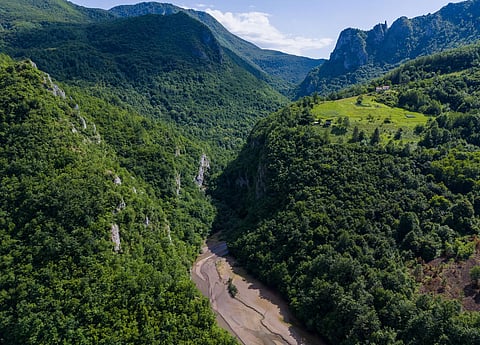
The last free-flowing and ‘truly wild’ rivers of Europe are under siege. A new assessment has found that pristine stretches of rivers across the Balkan Peninsula have dropped from 30 to 23 per cent since 2012, a staggering loss of 2,450 river kilometres.
Albania’s rivers have especially deteriorated faster than those of any other Balkan country, according to the study published by NGOs Riverwatch and EuroNatur. The reasons for this are hydropower and river regulation, according to a statement by EuroNatur.
The Hydromorphological Status of Balkan Rivers 2025 report has been authored by Ulrich Schwarz of Fluvius Vienna and commissioned by EuroNatur and Riverwatch as part of the Save the Blue Heart of Europe campaign.
The Save the Blue Heart of Europe campaign, coordinated by EuroNatur and Riverwatch, aims to protect rivers of high natural value in the Balkans that are threatened by over 3,000 hydropower projects.
The study assessed 83,824 km of rivers across 11 countries, revealing that the percentage of nearly natural rivers has declined from 30 per cent in 2012, to just 23 per cent in 2025 or 2,450 river kilometres (rkm), while severely modified river stretches have increased.
Of the larger rivers assessed, only 23 per cent remain nearly natural, while 43 per cent show slight modifications. Moderately to extensively modified rivers account for 27 per cent, and severely modified stretches, primarily impoundments, represent seven per cent of the network.
According to the statement, the most significant alterations were recorded on the Drina, Neretva, Vardar/Axios, Devoll, and Drin basins.
It added that while this decline is alarming, the remaining percentages of nearly natural and slightly modified rivers remain significantly higher than in the rest of Europe. This underscores the Balkans’ unique status as Europe’s last major stronghold of pristine rivers.
“The long-term trends documented in this study show a clear decline in near-natural river stretches across the Balkans, driven primarily by impoundments and large-scale river modifications. While the region still retains a comparatively high share of intact rivers, these trends point to a growing divergence between current development practices and the environmental standards required under EU accession frameworks and sustainable river management principles,” said the study’s author, Ulrich Schwarz of Fluvius Vienna.
No other Balkan country has lost as many pristine or slightly modified river stretches in the past decade as Albania, according to the study. Hydropower development, uncontrolled river regulation, water abstraction, and extensive floodplain alteration have reshaped Albania’s river landscapes at unprecedented speed.
“While Albania successfully protected the Vjosa and some of its tributaries, more river stretches were degraded over the past decade than in any other Balkan country. These findings should serve as a wake-up call for the Albanian government to safeguard rivers nationwide, not only in a single basin, particularly given the country’s aspirations to join the European Union,” said Ulrich Eichelmann, executive director of Riverwatch.
The report said all is not lost. Recent conservation efforts have successfully protected about 900 rkm by halting hydropower projects, establishing new protected areas, and establishing a policy prohibiting small hydropower plants. The declaration of the Vjosa Wild River National Park remains the region’s most important conservation achievement.
The analysis called for a number of measures.
The remaining intact rivers should be protected through national and international legislation and policies, protected areas should be expanded, and protection strictly enforced.
Destructive hydropower development should be halted particularly in Albania and Bosnia and Herzegovina, where river degradation is increasing most rapidly.
All Balkan countries must implement harmonised hydromorphological assessments as a prerequisite for EU accession.
Damaged rivers must be restored. There should be a shift away from infrastructure-heavy river regulation towards ecosystem-based flood and drought management.
“As this region’s rivers continue to lose their natural character, the window for meaningful protection is rapidly closing,” said Annette Spangenberg, Head of Programme Fresh Water at EuroNatur. “The Balkans still hold some of Europe’s last wild rivers, but safeguarding them now requires political courage, science-based decision-making, and a clear shift away from destructive practices. The data shows what is being lost and what will be lost if we do not act,” Spangenberg added.
