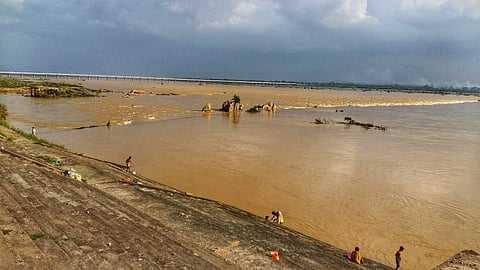


The Mahanadi, my mother river, must wait for almost another year to see a resolution to the water conflict between its two major riparian states. After two full terms, the Mahanadi Water Disputes Tribunal has been granted another 9-month extension to deliver its verdict. The goal remains to formulate a water-sharing mechanism that will help both Odisha and Chhattisgarh manage the river in a way that prevents future disputes. After 13 technical committee meetings and various efforts to resolve the dispute amicably, stakeholders remain hopeful. My advice regarding the unique opportunity of a “triple-engine sarkar” may yet be heeded. But the fact remains: the Mahanadi still awaits justice.
Before the Hirakud Dam was built, and for several decades afterward—even as mining, urbanisation, and industrialisation gradually prowled into the basin—the Mahanadi flowed through central India not as a subject of dispute, but as a shared lifeline binding communities, cultures, and economies across what are today Chhattisgarh and Odisha. For about a decade now, however, the river has found itself caught in a slow-moving legal and political gridlock. This delay leads to a deeper tragedy: every passing day is not just postponing justice; it is quietly eroding the river itself. As the baton of jurisprudence passes from communities and their elected governments to a tribunal, the river’s fate hangs in the balance. Each day of delay in delivering justice is a meter of death for the river.
Officially, states rule the rivers as their subjects. But the Tribunal has now taken over, as is standard for inter-state river disputes in India. The Tribunal, constituted to resolve disagreements over water sharing, is naturally at the heart of this impasse. Yet, years into its existence, its pace has raised serious concerns. Hearings stretch on, technical submissions pile up, and interim clarity remains elusive. Meanwhile, on the ground, the river continues to change—flows fluctuate, ecosystems degrade, and communities grow increasingly anxious. Local media and civil society voices tend to wake up only when Tribunal members visit the states or when deadlines are extended. Through it all, the river, its ecology, and the vulnerable communities primarily dependent on it suffer silently.
To me, this delay cannot be dismissed as a neutral administrative lag; it is an active contributor to uncertainty. Farmers in downstream Odisha worry about lean-season flows, while upstream communities in Chhattisgarh question their own developmental needs. In between, the river is subjected to competing extractions, fragmented governance, and ecological neglect. States are in talks, but the people still await results.
Ironically, this prolonged delay comes at a time when the political environment may be more conducive to resolution than ever before. The idea of a “triple-engine Sarkar”—a concept I had previously floated—presents a unique opportunity where the same political party rules both the states in dispute and at the Centre.
When the Bharatiya Janata Party government took charge of Odisha’s administration in June 2024, I wrote and shared with higher ranks in the government that the river has its best opportunity yet to break the deadlock through dialogue rather than dispute, giving the Mahanadi a new lease on life. Governments and their ministers responded positively. Informal and formal talks beyond the Tribunal’s official mandate were indeed initiated. This is no small development. For a river dispute often marked by sharp rhetoric, even the willingness to talk signals progress, providing a glimmer of relief to millions of vulnerable people and species.
Yet, while political dialogue inches forward, the Tribunal’s slow pace casts a long shadow. This creates a paradox: the conditions for resolution exist, but the mechanism mandated to deliver it appears stuck. This raises a fundamental question—if not now, then when?
Every delay in resolving the Mahanadi dispute has real, measurable consequences.
First, it deepens hydrological uncertainty. The lack of clarity on water-sharing norms means that infrastructure plans in the river basin—dams, barrages, industrial allocations—continue to be based on each state’s independent assumptions. This risks over-extraction and mismanagement, especially during lean seasons when flows are already highly stressed.
Second, it fuels public distrust. Communities living along the river may not have been involved in the dispute redressal processes to the extent many of us would prefer, but they are not passive observers. They are the ones witnessing the fluctuating water levels, the altering river channels, and the growing competition for resources. When institutions meant to resolve disputes appear ineffective, it erodes faith not just in the Tribunal, but in governance itself, leaving a lingering state of mass anxiety.
Third, and most critically, it accelerates ecological degradation. Rivers neither recognise administrative boundaries nor wait for legal verdicts, yet they have no voice of their own. The humans supposed to represent them mostly understand the language of grey-infrastructure development. As decisions are delayed, reduced flows continue to negatively impact sediment transport, fisheries, and deltaic health. In downstream Odisha, lower freshwater discharge exacerbates salinity intrusion in coastal aquifers. Upstream, altered flow regimes severely affect riverine ecosystems and groundwater recharge.
In this sense, justice delayed is not just justice denied—it is ecology denied.
Over the years of observing the Tribunal’s functioning, a key criticism has been its limited engagement with the people who depend most directly on the river. While this remains a valid concern, there is an equally pressing issue: the pace and methodology of its technical assessments.
I have repeatedly questioned why generating technical data takes so long. While I am not privy to the exact methodologies used by the Tribunal’s technical teams, we are no longer living in an era where water availability must be estimated solely through fragmented, ground-based observations. Today, satellite imagery, remote sensing, and advanced hydrological modelling can generate highly accurate, near real-time data on river flows, reservoir storage, and basin-wide water availability.
Globally, river basins are increasingly monitored through powerful combinations of satellite-based technologies that estimate river discharge and overall water availability—even in ungauged or politically sensitive regions. These technologies are being applied everywhere: from virtual gauging stations in India’s Krishna and Indus basins to flood monitoring on Australia’s Darling River, daily flow tracking using CubeSats in Brazil’s Araguaia basin, width-based discharge estimation in the Mississippi and Yangtze, and real-time hydrological forecasting in the UK’s Thames basin.
These advancements demonstrate that integrated satellite data can provide accurate, scalable insights without relying solely on ground infrastructure. While budgets dictate operations, India should strongly consider leveraging its formidable space and remote-sensing capabilities alongside local, participatory field evidence to gauge our river basins. It would vastly simplify the resolution of disputes.
While advanced technologies exist—and India is a global leader on several of these fronts—it is difficult to justify prolonged timelines for technical reporting. Moreover, with a cooperative political environment emerging, there is immense scope for joint technical committees, real-time data sharing, and coordinated reservoir management between the states and the Centre. The technology exists. The political will appears to be emerging. What remains is the urgency.
As I have always maintained, a river is not a pipeline to be divided; it is a living system. A tribunal, constrained by its legal scope, can only address the primary question of allocation: who gets how much water? While undeniably important, this approach is inherently limited.
As new stakeholders emerge—particularly in sectors like eco-tourism around the Hirakud Dam—there is a growing recognition that the river’s value extends far beyond extraction. The vast reservoir and its surrounding landscapes are becoming hubs of biodiversity, recreation, and local livelihoods. What the Mahanadi basin urgently needs is not just a water-sharing formula, but a joint River Conservation and Management Plan.
Such a plan could address the compounding woes of industrialization, urbanisation, chemical farming, and unabated deforestation. It must include strategies for ensuring environmental flows year-round, restoring degraded catchments, regulating industrial water use, promoting sustainable agriculture, and, crucially, establishing a cooperative mechanism to operate dams and barrages across both states. Only through a collaboratively developed conservation plan can the river’s health be restored. It is a shared responsibility, and politically, there is no better time to push for it.
Without intending to undermine the immense complexity of interstate river water disputes, it must be said that a tribunal meant to be an instrument of resolution should not become an instrument of delay. Tribunals deal with technically and legally intricate issues, but complexity cannot be an excuse for inertia—especially when the ecological consequences are immediate and irreversible. The Mahanadi does not have the luxury of time.
The river is under severe stress. With every passing day, the ecological, social, and economic costs continue to mount.
Ultimately, the moot question for all of us is this: Will we continue to debate how to divide the Mahanadi, or will we come together to save it? I urge everyone, especially the leadership within the “triple-engine sarkar,” to answer this by working toward a coordinated resolution. Looking at the difficult times ahead for the river, its people, and its wildlife, urgency in conservation must replace complacency.
Because if the river is lost, there will be nothing left to share.
Ranjan Panda is a convenor at Water Initiatives. He writes on water, environment, and climate change issues concerning the vulnerable communities, including youth, women & indigenous peoples.
Views expressed are the author’s own and don’t necessarily reflect those of Down To Earth
