
Subscribe
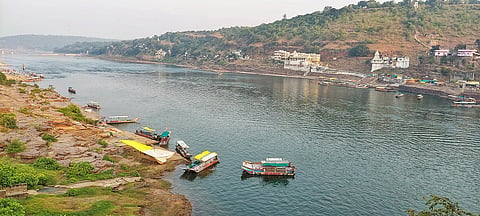
In the Sehore district of Madhya Pradesh, a ritual unfolded that would soon attract the attention of many and spark online debate: 11,000 litres of milk were poured into the Narmada river during a 21-day religious program organised at the Pataleshwar Mahadev Temple in the Satdev area of the Berunda region. Devotees gathered to offer prayers and chant hymns and watched as the milk flowed into the river’s current. This act was framed as an offering to Maa (Mother) Narmada as a gesture of devotion, purification, and reverence. The moment was recorded and shared widely. With a viral video, a familiar divide emerged between faith and logic, between tradition and science. But this debate misses the larger question, not whether this act was right or wrong, but rather what it reveals about the relationship between devotion and ecological responsibility in contemporary India.
Devotees defended it as an act of love, a way to seek blessings and honour the river they call Mother. Whereas critics, including scientists and environmentalists shown concern: a biological disaster in slow motion. They argue milk contains fats, proteins, and lactose, which, when dumped in large volumes, reduce oxygen levels in water. This biochemical oxygen demand (BOD) can disrupt ecosystems and suffocate fish and other aquatic life. The Madhya Pradesh Pollution Control Board has already highlighted that BOD levels in several stretches of the Narmada exceed safe limits, indicating serious organic pollution even before events like this one. The irony is that the ritual meant to purify the river ends up poisoning it. This is not the only act of misguided devotion. Offerings were mostly symbolic since ancient times, when the people were fewer, and rivers ran fuller. The accumulated weight of these rituals has become environmentally significant in the modern day, when the Narmada is already under stress from sewage, agricultural runoff, and industrial effluents. The real question is not about the recent act, but what this moment reveals — a single event reflects a pattern.
Over the past decade, the Narmada river has become a site of growing ritual economy. Every year, thousands gather in the Narmada Jayanti celebrations, the Bhoot Mela in Harda and the Shivratri Mela in Amarkantak. Each pilgrimage, each idol immersion, each offering adds burden to the river. Scientific studies recorded a high value of coliform bacteria during festival seasons. The highest recorded value exceeded the safe limits for bathing and drinking, reaching 2,400 MPN per 100 ml. Researchers have also found that religious activities, public gatherings, and domestic effluent discharges are among the primary threats to the Narmada’s water quality between Amarkantak and Hoshangabad. Yet the response from the institutions has been fixed to spiritual framing rather than ecological reality. The river is framed as a goddess to be appeased, not an ecosystem to be protected.
Consider the Narmada Sewa Mission, launched by the Madhya Pradesh Government with the tagline “Namami Devi Narmade”— “I bow to Goddess Narmada.” The campaign mobilises masses through religious sentiment organising rallies, processions, and mass awareness programs. But what does it serve? It promotes the idea of the river as divine, which means a “Goddess” to be worshipped. The river’s spiritual purity is prioritised while its biological health is frequently sidelined and rarely addressed issues such as unchecked mining, industrial effluents, untreated sewage, dams and development projects, forest cutting, tourism industry, etc. Similarly, organisations like Narmada Samagra reframe traditional rituals to save the river. For instance, the “Hariyali Chunri Initiative” replaces the traditional practice called Chunri Manorath (a sacred veil/saree offering ritual to the river) with planting trees along the riverbank to prevent soil erosion. It also involves an eco-friendly idol immersion campaign that urges Parikarmawasis (circumambulators) to use clay idols and take a holy dip without using soap. These commendable gestures are undoubtedly symbolic and performative when the ritual of offering a clay idol replaces the demand for a functioning sewage treatment plant. Symbolism has become an alternative to accountability. They offer a version of conservation without confronting real threats, such as deforestation, unregulated tourism, and dams.
The true paradox lies here: they are mobilising the masses through religious sentiments to save the river while ignoring the political, industrial, and developmental systems. And inviting the deeper crisis that has turned environmentalism into a ritual rather than a revolution. When a government uses the rhetoric of devotion, when NGOs reframe the idea of “spiritual purity,” and when civil society is asked to believe that offering milk is more sacred than treating sewage, we are protecting a myth, not the river. A user wrote on this incident, “Blind faith like this is harming the nation under the guise of nationalism.” This line exposes a dangerous conflation of religion and nationalism. When nationalism is rooted in a single religious identity, then blind faith-driven nationalism thrives on emotions, excludes citizens in the name of identity, and silences dissent in the name of loyalty. This reflects how the sacred is being instrumentalised to justify pollution.
What is true devotion, then? True devotion cannot be measured by the number of idols immersed and litres of milk poured in the river. The rituals must be reimagined as an act of moral responsibility, care, and protection. What if the greatest act of devotion is a commitment to not dump waste, demand accountability, and to treat the river not as a resource but as a “living entity”? The idea of recognising rivers as “living entities” is not new. In 2017, the Uttarakhand High Court judgement recognised rivers like the Ganga and Yamuna as living entities, though later stayed by the Supreme Court of India. The Narmada’s “living entity” status may still be debated. But the responsibility of the state, NGOs and devotees who claim to love and honour her. That cannot wait for a verdict.
Akanksha is a Visiting Research Scholar at Leipzig University, Germany
Views expressed are the author's own and don’t necessarily reflect those of Down To Earth
