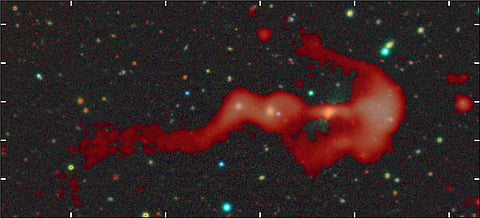


A citizen scientist spotted a bow-and-arrow-shaped radio galaxy during a weekend online class run by India’s RAD@home network.
The object, named BAARG, has a wide radio arc on one side and an S-shaped tail on the other, forming a structure scientists say has not been clearly seen before.
Researchers believe the shape was created as the galaxy moved at supersonic speed through hot gas in a dense cluster of galaxies.
The discovery highlights how the human eye can still catch unusual patterns in telescope data that automated systems may miss.
A citizen scientist has helped identify a galaxy shaped like a bow and arrow — a structure scientists think has never been clearly seen before in space.
The discovery was made during a weekend online class run by RAD@home, an Indian citizen science network that trains volunteers to study telescope data. The finding has now been published by the journal Monthly Notices of the Royal Astronomical Society.
The object has been named BAARG, short for Bow-and-Arrow-shaped Radio Galaxy.
At the centre of most large galaxies lies a supermassive black hole. When matter spirals into it, the black hole can release two powerful beams of energy in opposite directions. These beams, known as jets, glow in radio waves — a form of light that cannot be seen by the human eye. Such jets usually spread out in broadly symmetrical structures on either side of a galaxy.
But BAARG is different.
On one side, its jet flares into a wide arc nearly 560,000 light years across. On the other, it extends into an S-shaped tail. Together, these features resemble a bow and arrow.
Scientists say the shape may have formed because the galaxy is moving at supersonic speed, between 1,000 and 3,500 kilometres per second, through a dense cluster of other galaxies. Picture holding a sparkler and sprinting through the wind. The flame bends backward, the sparks trail behind.
As BAARG ploughs through the hot gas that fills the space between galaxies, it creates a shockwave ahead of itself, much like a supersonic aircraft produces a sonic boom. The galaxy’s radio jets are caught in this shockwave, with one compressed into a broad arc and the other stretched into a curved tail.
Scientists had long predicted that such bow shocks should form when a galaxy falls into a cluster at high speed. Simulations had shown the possibility, but a clear detection in radio waves had remained elusive — until now.
What makes BAARG especially valuable is what it reveals about its surroundings. The glowing jets act as a tracer, like dye dropped into a river, making visible the otherwise invisible pressure gradients and shock boundaries in the gas around the galaxy.
Perhaps the most striking detail in the paper is how BAARG was discovered — and, just as importantly, what failed to find it — highlighting the crucial role of citizen science.
Automated machine-learning systems had previously catalogued the object as an ordinary giant radio galaxy. Its unusual morphology went unnoticed. But a human volunteer, trained to read and compare shapes and positions across multiple datasets, spotted something the algorithm had missed.
The volunteer who spotted BAARG was attending a RAD@home weekend session on 24 May 2025.
Future surveys — including data from the Square Kilometre Array, the most powerful radio telescope ever built — are likely to reveal similar objects.
