
Subscribe

One morning later this year, a new morning star will appear some 625 kilometres above us, heralding a weird retail business: “sunlight on demand”. As someone severely deficient in vitamin-D, I might rush to place an order, perhaps through another rapid-delivery service dealing with celestial goods. Communities that live without sunlight for long periods might do the same, using it to generate solar energy. In a disaster-struck place, people could call for its service to continue rescue and relief work at night. When one is sold “day” at night, the imagination quickly races ahead, conjuring up countless possibilities built on the idea of this retail business. For a species that has nearly altered the planet’s natural rhythms, this idea comes as if to disrupt the last frontier—the day-night cycle has been going on unabated as if testing humans’ power to destroy anything natural.
"We're here because, for some reason, people just accept the Sun goes down at night," declared Ben Nowack, founder of the California-based start-up Reflect Orbital in a media interview in 2025. This July, the US Federal Communications Commission approved the start-up’s proposal to send its low-Earth satellite—Earendil-1, or morning star in Old English—with a 60-foot (18-metre) mirror made from super-thin reflective aluminised mylar to reflect back sunlight on demand. This will be a demo launch, to be carried out later this year.
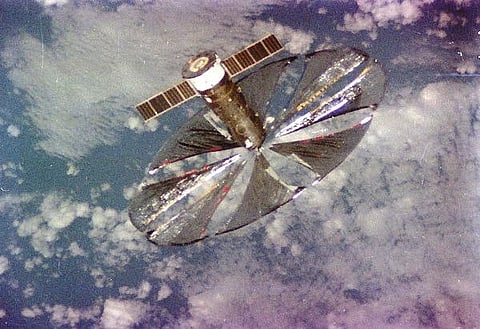
The debut satellite mirror can light nearly 5-km-wide areas with illumination four times brighter than a full moon, but in the future, with many such satellites, the area would widen. "We can basically sell the sunlight like it's a resource." The start-up wants to sell sunlight at night for US $5,000 per hour. "Farmers will grow more food per acre [0.4 hectare] to feed more people, more reliably; cities will have safer, evenly lit streets without carbon emissions," the start-up said in a statement. The idea of reflecting sunlight back to Earth had been experimented with earlier, notably by the erstwhile USSR in the 1990s. It demonstrated that the concept was technically feasible. But delivering enough reflected sunlight to harness solar power or maintain daylight-like illumination requires a massive constellation of space mirrors. The start-up plans to deploy 50,000 such mirror-equipped satellites by 2035.
When the Federal Communications Commission put the start-up’s application for comments, it reportedly received around 1,800 comments and most of them were negative. Broadly, the licence has been contested on two counts: the ethical ground of keeping the ways of a natural world, and the great disturbances this would cause to other space-faring and satellite-driven activities. Artificial lighting at night is already a significant form of pollution, disrupting natural ecosystems and interfering with humans’ circadian rhythm. The American Astronomical Society (AAS) has been vociferous in its opposition to this.
"It is clear that the activities that Reflect Orbital is proposing will have an impact on the Earth environ-ment, including on human health, agriculture and wildlife, in addition to astronomy," said Roohi Dalal, director of public policy at AAS in a public statement. The Society in a letter to the federal regulatory body in June wrote: “The proposed satellite would be intentionally reflecting sunlight to Earth and is designed to be as bright as possible, making impacts on astronomical research extremely challenging to mitigate.” After breaching all natural planetary boundaries, the tossing of another dice to win against the planet will not be desirable. Rather it will be suicidal.
This article was originally published in the August 1-15, 2026 print edition of Down To Earth
