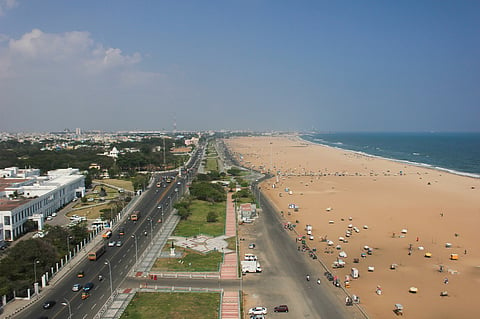


Chennai has been the manufacturing capital of India for years now. Today it’s vying to be the country’s artificial intelligence (AI) and data centre capital. Chennai is seeing crores of rupees in investments in its digital infrastructure, from hyperscale cloud facilities to AI-ready campuses. With its large undersea cable access, existing IT ecosystem and affordable land, the city is banking on being the foundation of India’s AI economy for global technology giants, colocation providers and infrastructure investors. This is seen in recent investments by operators like Sify and renewed interest from overseas investors. But underneath the promise of digital change is a growing environmental crisis.
Every AI model you train, every cloud service you access, every streaming platform you use runs on physical infrastructure — enormous warehouses filled with servers that consume huge amounts of electricity and give off a lot of heat. These facilities need to be cooled constantly, with reliable power sources and ever more sophisticated infrastructure. Further study is needed on the environmental fallout from this digital explosion in a city which has suffered disastrous floods, crippling droughts and repeated water shortages over the last decade. It is no more a question of whether Chennai can attract data centres. The question is, can the city support them.
The world’s race to build AI has redefined the economics of data centres. In conventional data centres, the main application was storage and routine computing. In contrast, AI facilities rely on high-performance graphics processing units, or GPUs, which use far more electricity. AI-ready racks require multiple times the electricity of traditional server architecture, forcing operators to rethink power distribution and cooling, industry analysts say. The trend is already affecting energy planning all over the world.
New research says concentrated AI data centre expansion is becoming a major source of electricity demand, putting new pressure on grids and making it harder to integrate renewable energy. The implications for Chennai are especially important. During summer heatwaves, the city already experiences a surge in electricity consumption as residential and commercial cooling loads increase. Adding clusters of energy-intensive AI facilities could increase pressure on an electricity infrastructure that also has to support industrial and transit uses, and rapidly growing urban populations. Data centres are unlike traditional businesses, where power outages can be temporary. They need a constant power supply from huge battery systems and diesel generators, which add to the costs and environmental issues of the infrastructure.
Electricity is only part of the equation. The other one is water. Data centres produce huge amounts of heat. Cooling that heat often requires massive amounts of water, especially in buildings using evaporative cooling technology. Across the globe, communities are asking whether cities experiencing water scarcity should continue to approve water-intensive digital infrastructure. Mayors of large cities are beginning this year to coordinate efforts to deal with the huge strain that data centres are placing on electrical grids and water supplies, saying that AI-powered infrastructure cannot grow without stronger environmental safeguards. This argument carries much weight in Chennai. In 2019, the city nearly ran out of water and had to ship in supplies by train from afar, narrowly missing what was called “Day Zero.” Successive monsoons have raised storage levels but Chennai continues to rely heavily on erratic rains, desalination plants and extraction of ground water. Climate change makes all the work more complicated. The hydrological cycle of Chennai is becoming more volatile with severe floods and long dry spells. That makes it increasingly unreliable to predict future industrial water demand based on past averages.
Some modern data centres use air-cooled systems, liquid cooling or recycled wastewater to reduce freshwater use, but not all facilities offer precise water-use data. There is a need for more transparency so that cities can consider the cumulative environmental impacts, rather than each project in isolation.
Chennai has a special geographical location. The Bay of Bengal is nearby and the city is threatened by sea-level rise, cyclones, storm surges, heatwaves and urban flooding. The same coastal geology that makes it attractive for submarine cable landings also makes it more vulnerable to climate risk. Extreme downpours have frequently exposed design flaws in cities. Flooding episodes in 2015 and later showed how increasing urbanisation, wetland loss and poor drainage can exacerbate climate disasters. Large scale digital infrastructure is a new component of urban development.
Data centres require large areas of land, substations, transmission infrastructure and transportation connectivity. Without careful planning they threaten to conflict with other urban goals such as housing, ecological restoration, and flood-resistant land use. So environmental planning is not just about allowing new facilities, but also about where they should be located, how they should be fueled, and what cumulative impacts they will have on nearby communities.
Supporters say data centres are critical for India’s digital future. Cloud computing is the engine for banking, e-commerce, digital governance, AI and telecommunications. In a global economy increasingly fuelled by AI, India will find it difficult to compete without domestic infrastructure. There is a bit of logic in this.
Data centres also stimulate investment in construction, electrical equipment, fibre networks and procurement of renewable energy. But critics highlight a disturbing fact. Hyperscale data centres use up a lot of land, electricity and water, but create relatively little long-term employment compared to manufacturing companies. The debate is already having an impact on policy. Concerns around resource consumption, environmental sustainability and very low job creation have led Tamil Nadu to revisit some aspects of its earlier data centre incentive scheme. Instead of broad-based subsidies, policy makers are looking increasingly at location-specific incentives that drive the integration of renewable energy. The shift is indicative of a broader realisation that digital infrastructure cannot be measured by investment announcements alone.
One answer could be clean electricity. Many multinational IT firms have pledged to power their operations with renewable energy. India is installing solar and wind capacity at a record pace, with Tamil Nadu still leading the way in renewable energy. Renewable energy can’t fix every problem by itself, though. Solar power generation varies over the course of the day, while AI workloads often need to run 24/7. Meeting growing demand will require battery storage, smarter grids, flexible demand management and more robust transmission infrastructure. Proper investments in grid resilience are needed to avoid rapidly growing AI clusters becoming more reliant on fossil-fuel backup generation during peak demand.
Chennai’s digital ambitions should not come at the expense of environmental resiliency. But that would require a different model of development. Future permits should require mandatory disclosure of electricity and water consumption, increased use of treated wastewater for cooling, higher procurement of renewable energy, transparent environmental reporting and cumulative impact assessments that look at clusters, not individual facilities.
Urban planners also need to ensure that data centres are integrated into broader climate adaptation strategies and not considered as isolated industrial projects. Most citizens do not know the environmental impacts of the digital economy. As India positions itself to be an AI powerhouse, Chennai gives a glimpse of a dilemma that many cities will soon face: how to build the infrastructure of tomorrow without exhausting the resources needed for survival. Ultimately, the city’s success will hinge not only on how many data centres it attracts, but whether it can power the AI revolution without exacerbating its vulnerabilities to water scarcity, energy stress or climate change.
Anusreeta Dutta is a columnist, political ecology researcher with prior experience as an ESG analyst
Views expressed are the author’s own and don’t necessarily reflect those of Down To Earth