
Subscribe

Metro rail systems across Indian cities have often struggled with lower-than-projected ridership and recurring financial stress.
Many projects depend on government support, concessional finance, land monetisation and foreign loans to remain viable.
Weak first- and last-mile connectivity limits who can realistically use metro networks, especially informal workers, small traders and low-income commuters.
The article argues that metro expansion should be assessed as a national pattern, not only as separate city projects, before the model is repeated more widely.
Every metro rail network in India has incurred financial losses for as long as it has been in operation. Delhi Metro, held up for two decades as proof that the technology works in Indian conditions, reported a net loss of about Rs 5,104 crore in 2023-24. Its annual report also showed outstanding Japan International Cooperation Agency loans of Rs 30,835.39 crore as of March 2024, underlining the continuing dependence of India’s flagship metro system on periodic intervention from the Delhi and central governments to keep servicing its loans.
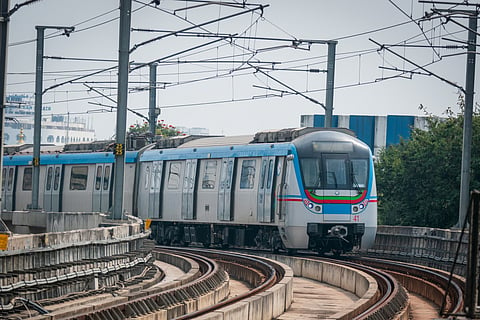
Mumbai Metro, Bengaluru’s Namma Metro, Kochi Metro, Chennai Metro and Hyderabad Metro have faced similar challenges: ridership has often fallen short of projections, fare revenue has struggled to meet operating costs and capital servicing requirements, and many systems have continued to depend on government support, concessional finance or land monetisation to remain financially viable.
This is not a Hyderabad problem or a Delhi problem. It suggests a structural problem in the way India plans, finances and evaluates metro rail projects. The remarkable thing is how rarely this pattern is treated as a finding that should change anything.
With metro proposals now being considered in roughly 50 cities. India is committing several lakh crore rupees of public money to a model that still needs closer scrutiny. Each new project is often assessed on its own projected benefits, rather than against the financial and ridership performance of metro systems already built.
One reason the economics of metro rail needs closer examination is the programme’s dependence on imported technology, foreign financing and long-term specialised contracts.
Signalling systems, rolling stock and technical operations contracts are overwhelmingly supplied by foreign companies, financed substantially through foreign loans from agencies such as Japan’s international cooperation arm and various European and Asian development banks. Hyderabad’s continued dependence on Thales as its signalling supplier — a condition written into the terms of the state's takeover of the network, come what may — illustrates how deeply this dependency runs even 17 years after the first Indian metro lines opened. So does the French operations contract that has run the network since its first day of service, with no published plan anywhere in the country’s metro programme for building the domestic capacity that would eventually end this reliance.
The dependency runs deeper still in the hardware itself. Hyderabad's rolling stock was supplied by a South Korean manufacturer, built to that company’s own specifications — a design choice repeated across nearly every Indian metro, and one that quietly locks each city into a single foreign supplier for decades.
Once a city commits to one supplier's coach design, it is likely to rely on that supplier for subsequent procurements, because rolling stock from other manufacturers cannot easily be substituted onto track engineered around one manufacturer’s specifications.
Re-engineering the track to accept an alternative is not an option any transit authority will consider once a line is running, so the original vendor gains a long-term advantage in future contracts rather than into any contract that could later be renegotiated. Every Indian city that selects its rolling stock vendor at the design stage is essentially locking in its procurement costs for the working life of the asset, a decision that draws essentially no public attention at the one moment it could still be questioned.
The financing compounds this dependency rather than reducing it: loans denominated in yen or other foreign currencies, taken to fund construction and now, in Hyderabad's case, to fund the buyout of a departing private partner, expose the project to a currency risk that rises and falls with exchange rates rather than with ridership. This places exchange-rate risk on the public exchequer, a factor that deserves clearer discussion when projects are approved.
None of this would be quite so troubling if metro rail expansion were more openly debated, with political parties taking different positions on whether this is the best use of public money. Instead, there has been a broad consensus around metro projects across party lines. Metro rail is easy to present as a visible marker of development: it produces ribbon-cutting moments, large construction contracts and an image of urban modernity, while the less glamorous work of improving bus systems receives far less attention.
Such a consensus deserves closer scrutiny. The media, too, has often treated metro projects as separate city-level stories rather than as part of a national pattern. Inaugurations, fare changes and route extensions receive regular coverage, but there has been far less sustained reporting on why metro systems across India struggle financially, why ridership is often lower than projected, and whether adding new lines is the best response before existing problems are addressed.
Part of this may be because such reporting requires patient scrutiny of project reports, financing structures, land deals and operating contracts, rather than event-led coverage. Whatever the reason, the public has not been given a clear national picture of what India’s metro programme costs, who it serves and whether its benefits justify the scale of investment.
There is a further cost to this pattern that rarely enters the public conversation at all, which is what the physical infrastructure itself does to a city independent of whether anyone ever rides it. A metro line is several hundred kilometres of concrete viaduct and thousands of reinforced pillars sunk into road medians, permanently narrowing the surface space available to buses, cars, and pedestrians, regardless of how many people eventually use the elevated line above.
This permanently changes the street, narrowing surface space available to buses, cars and pedestrians in cities where roads are already congested. The trade-off deserves closer scrutiny because affordability remains a major barrier to mass metro use. A 2026 Infravision Foundation study found that, in most of the 329 Indian cities surveyed, fewer than 5 per cent of residents could afford daily public transport while keeping spending within 10 per cent of income. A 2018 Centre for Science and Environment study found that the average Delhi Metro rider spent 14 per cent of household income on rides, with nearly a third spending closer to 20 per cent.
Even among that minority, the system is designed in ways that quietly narrow who it serves further. Station layouts are built around a single, lightly burdened commuter moving briskly between security check, ticket gate, and platform: long stairs and limited lifts, narrow gates that struggle with a parent and small children, and luggage rules that make the system difficult to use for those carrying tools, goods or stock.
A street vendor who would benefit enormously from a city-wide rail network is, in practice, designed out of it before any fare is charged. What remains is a system calibrated for the office commuter travelling light and alone, a description that fits a narrow slice of any city’s workforce and excludes the much larger population of informal workers and small traders. This leaves out a large share of informal workers, small traders and low-income commuters, even when routes pass near them.
This exclusion is compounded by the weak presence, across virtually every Indian metro city, of first and last mile connectivity: a metro line only serves the narrow band of population within a short walk of a station, and the feeder buses and shared autos needed to reach it have everywhere been treated as an afterthought rather than a precondition. A system that cannot get people to its own stations is not a network, however many kilometres of track it reports. This is one major reason ridership remains below projections, alongside fares, route choices and land-use patterns.
Even the engineering choices often disregard urban realities that have nothing to do with transport at all. Metro alignments and depot sites have, in more than one city, been routed through land that forms part of the urban watershed and natural flood-drainage system, the channels that let monsoon rainfall move through a city without flooding it. Concretising these areas removes that drainage capacity permanently, just as Indian cities face increasingly severe monsoon flooding.
Metro projects also need to be judged against their wider impact on cities. If alignments damage drainage channels or floodplains, they can weaken a city’s ability to handle heavy rain. These costs are rarely counted before construction begins.
The same money could also support cheaper and faster transport options, such as low-floor buses, better feeder services, improved suburban rail and safer walking infrastructure. Better land-use planning would help too, by allowing more workers to live closer to where they work.
India’s metro programme now needs to be assessed as a national pattern, not just as separate city projects. Persistent losses, low ridership and limited access for informal workers raise questions that deserve closer scrutiny before the model is repeated in more cities.
Narasimha Reddy Donthi is a public policy expert and consultant at the Pesticide Action Network India and a visiting faculty (honorary) at Delhi-based Impact and Policy Research Institute. Views expressed are the author’s own and don’t necessarily reflect those of Down To Earth.