

The Union environment ministry is set to roll out a common Extended Producer Responsibility (EPR) portal, a move aimed at streamlining compliance, improving traceability and scaling India’s recycling ecosystem, even as industry and policymakers flagged persistent gaps in implementation and institutional coordination.
The upcoming unified portal, under development by the Union Ministry of Environment, Forest and Climate Change (MoEFCC), is expected to integrate multiple waste streams and address operational bottlenecks identified through extensive stakeholder consultations, an official said, at a conference on May 4, 2026. The platform is being designed to be more user-friendly and responsive to challenges faced by producers, recyclers and regulators.
The announcement comes as India deepens its reliance on EPR as a central policy tool to transition from a linear to a circular economy. According to Bharat Sharma, member secretary at Central Pollution Control Board (CPCB), the EPR framework now spans plastics, e-waste, batteries and tyres, with digital certification systems improving transparency and tracking of recycling outcomes. Under the E-Waste Management Rules, 2022, the regime has shifted from a collection-based approach to a recycling-based system, covering over 100 categories of electronic equipment.
The proposed common portal is also expected to significantly expand participation, with estimates suggesting it could onboard up to 50 lakh (5 million) users across the solid waste management ecosystem, marking a major step in digitising compliance and market mechanisms.
Shobhit Srivastava, programme manager (industrial pollution), Centre for Science and Environment (CSE), says the CPCB’s move toward a common portal for seven sectors is a positive step to resolve industry concerns. The incorporation of GST and EPR integration is a welcome move that aligns with CSE’s recommendations.
“However, the portal’s success hinges on transparency. It must provide public access so that researchers and think tanks can independently assess progress and identify implementation challenges,” he adds.
While welcoming policy progress, the Material Recycling Association of India (MRAI) called for a dedicated national framework or nodal authority to address structural inefficiencies in the sector.
“India has developed some of the most forward-looking policies in the recycling space… however, the real challenge lies in ensuring consistent and effective implementation on the ground,” said Sanjay Mehta, president of MRAI.
He pointed to issues such as frequent administrative transfers, fragmented governance across ministries and inconsistent regulatory interpretation as key barriers to effective execution. The industry body argued that a centralised institutional mechanism could improve coordination, accelerate decision-making and ensure continuity in policy implementation.
MRAI also cautioned against a uniform approach to EPR across materials, noting that high-value recycling segmentssuch as non-ferrous metals may require more tailored regulatory frameworks to avoid disrupting efficient market-driven systems.
Echoing the need for stronger systems, Priyavrat Bhati, programme head at NITI Aayog, described the circular economy as a “strategic lever” for resource efficiency and industrial competitiveness, stressing the importance of institutionalising the sector.
He highlighted the need for stable demand for recycled materials, better enforcement and stronger integration of the informal sector — a recurring challenge across waste streams. NITI Aayog has been working on sector-specific strategies, including end-of-life vehicles, waste tyres and e-waste, to improve coordination and implementation.
Stakeholders broadly agreed that while India’s policy architecture on recycling is robust, the next phase must focus on execution, enforcement and ecosystem development.
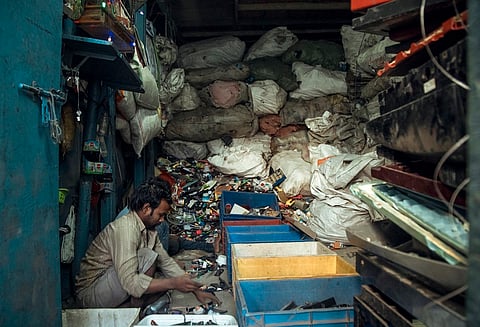
Officials emphasised that beyond compliance, the sector must move towards efficient and value-driven recycling, including recovery of critical materials and deeper integration of informal waste collectors into formal systems.
Challenges remain in verification systems, infrastructure expansion and ensuring consistent regulatory signals. However, the proposed common EPR portal is seen as a key step towards addressing fragmentation and improving accountability across the recycling value chain.