
Subscribe
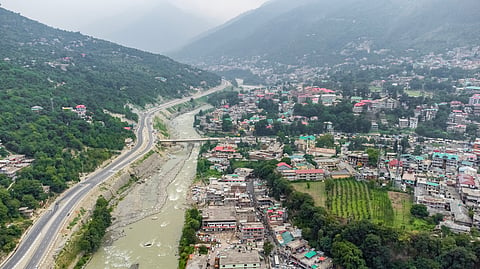
On May 8, 2026, the National Green Tribunal (NGT) again had to rule on garbage management issues in the picturesque Kullu Valley of Himachal Pradesh. The case, Sanjeev Kapoor vs the Municipal Council of Kullu, related to the public place called Nehru Park in Kullu being used to set up a material recovery facility (MRF) for waste management. The NGT called on the administration to halt all activities taking place in the public park, as they are illegal. According to the Waste Management Rules 2016, as stated by the applicant Sanjeev Kapoor in his petition, the law provides that MRF plants can’t be situated within 100 metres of a river point. The MRF in question was being created within 30 metres of the Beas river in the Sarvari ward of Kullu.
This is not the first time that the NGT has had to step in on waste management issues in Kullu. The village of Pirdi, Balh and adjoining panchayats had filed a case against a biomedical waste management plant established in the 1990s, demanding that it be shut down because the site lies on their common land and causes significant pollution. In 2017, the NGT ruled against the plant as it lay within a 30-metre radius and hence foregrounded the 2016 Waste Management rules.
Another case concerned the Rangri plant in Manali district, where the NGT levied a fine of Rs 4.6 crore on what it termed was ‘a waste management disaster’ in Rangri village in 2025, which caused health hazards for the village residents.
The NGT should be the last resort, and the policies already laid down by the government should serve as the final mechanism. The garbage crisis occurs only when administrative implementation is slow and negligible in mountain tourist regions. Many village residents in Kullu, where door-to-door waste collection is still a far-fetched concept, still rely on old ways to dispose of household garbage. First, the wet waste goes to their cattle, which is a sustainable way to manage garbage. Second, the plastic waste produced is burned because there is no alternative solution available to them. All the left-bank villages of the main township, Kullu, face the same crisis, as do some villages on the right bank.
The NGT repeatedly called on the district administration to find a solution as quickly as possible, only to see it derailed. Over the years, the district administration has failed to secure land for the much-needed MRF upgrade to process waste in the Kullu Valley. This is because they always plan plants near villages or forest sites that face constant opposition and tribunal calls.
All this calls for a well-managed plan, as outlined in the Solid Waste Management Rules, 2026, which the central government has asked to be implemented from April 1, 2026.
For a tourist mountain town like Kullu, the challenge is not only to frame policy but also to ensure that it is enforced through decentralised, locally suitable waste systems, rather than through repeated tribunal intervention.
The rules assign clear duties to local bodies, district collectors, and state agencies to translate policy into action, including mandatory four-stream segregation, online tracking of waste movement, and time-bound remediation of legacy dumps. For Kullu, this means the district must first map seasonal waste flows and identify cluster-level sites for composting and small transfer stations, away from rivers and commons, rather than attempting to build large centralised facilities in parks or on village land, which invite legal challenges.
Equally important is making bulk waste generators such as hotels, resorts, event organisers, and large vendors legally responsible for treating their organic waste on-site or paying certified processors, while using user fees and visitor levies to finance the operations and maintenance of decentralised systems. Civil society and panchayats should be contracted to run ward-level collection and segregation, linking livelihoods to recycling and ensuring community consent for site selection. This approach reduces conflict and keeps facilities socially legitimate rather than perennially contested. If implemented, these measures would shift Kullu from reactive litigation to proactive governance, with the NGT remaining a last resort rather than the primary planner. The 2026 Rules provide the tools; now, the administration must follow the map rather than redraw it after every tribunal order.
The test of Kullu’s governance will lie in how quickly it stops treating land as an endlessly available resource and begins to read tourism growth within the Valley’s ecological limits. The 2026 rules require not just cleaner plants and smarter segregation but a shift in mindset: waste is not a municipal nuisance to be dumped out of sight but a visible sign of how tourism is structured, priced and regulated. If the district administration can align land use, visitor fees and institutional responsibility with this logic, NGT orders will no longer be the main driver of change in Kullu. What ‘Devbhoomi’ (Land of the Gods) Kullu needs now is not another NGT intervention, but a durable waste system suited to the valley’s land, people and ecology.
Aanchal Seth is a Resident of Kullu and a Research Scholar at the Department of Political Science, Panjab University, Chandigarh
Views expressed are the author’s own and don’t necessarily reflect those of Down To Earth
