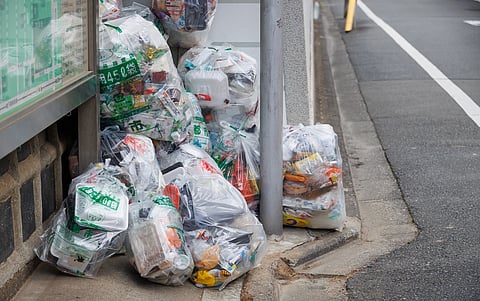


In 2023, Japan threw away 7.69 million tonnes (MT) of plastic. Households meticulously clean and divide waste in up to 20 separate categories, only for most of it to be incinerated.
About 1.7 MT of that was recycled into new material. Around 1.25 MT was loaded onto ships and sent to other countries. That leaves around 460,000 tonnes, roughly six per cent of the total, which Japan turned back into new products within its own territory.
So where does the rest go? Into the furnace. Japan boasts an 89 per cent effective utilisation rate — a clever statistical illusion powered by burning almost three-fourths of its plastic in incinerators and calling it ‘thermal recycling’. Strip that greenwashing, and Japan recycles barely 20 per cent of its household plastic.
If you use the definition Organisation for Economic Co-operation and Development (OECD) and the United Nations use, only about a fifth of Japan’s household waste is recycled. The OECD average is 24 per cent. Both figures are correct. The difference between them is the real story. And it is not about culture or discipline. It comes from a fee schedule written in 1995 that nobody has changed since.
Japan’s packaging law is one of the oldest examples of extended producer responsibility (EPR). The idea is simple. The company that sells the packaging should pay for what happens to it after the customer throws it away, instead of leaving the bill with the city.
But Japan did not build this system to fix plastic. It built it to fix a landfill problem.
By the early 1990s, packaging made up about 60 per cent of household waste by volume, and cities were running out of space to bury it. So, Japan passed the Containers and Packaging Recycling Law in 1995 and brought it into force between 1997 and 2000.
Manufacturers and importers pay a fee to a body called JCPRA, the Japan Containers and Packaging Recycling Association. It selects recycling companies through open bidding every year, so the price comes from a tender rather than a negotiation.
Cities kept the rest of the job: collecting the waste, sorting it, cleaning it, pressing it into bales and storing it.
For the purpose it was built for, the law worked. Japan produces about 330 kg of municipal waste per person per year. The OECD average is 531 kg. Landfill use has fallen sharply.
The biggest design flaw in Japan’s system has nothing to do with the fee. It is about how much packaging a company is held responsible for in the first place.
That amount is not based on how much the company sells. It is based on the collection plans that local governments file, stating how much they intend to collect separately. And if recycling companies do not have enough capacity, the number is reduced further.
If a city does not run a separate plastic collection, then companies owe nothing for the packaging sold in that city. The packaging is still sold there. The waste is still created there. But the obligation does not exist.
So, in Japan, producer responsibility depends on how ambitious the local government is. If a city decides separate collection is too expensive, the cost does not move to producers. It simply disappears.
This is the most important warning for any country setting up EPR now. If you link what companies owe to what the government manages to collect, the total will always be smaller than the problem and it will be smallest exactly where the system is weakest.
Companies pay JCPRA by weight and by material type. In 2024 the rate was about ¥62 per kilogram for plastic packaging. That is roughly Rs 35.
The fee does not change with design. There is no extra charge for using multi-layer laminates.
Multi-layer pouches are a recycling nightmare, but they weigh practically nothing. By taxing weight instead of recyclability, Japan’s fee structure actively subsidised unrecyclable trash.
Japan added the Plastic Resource Circulation Act in 2021, in force from April 2022. It brought in design guidelines and a certification scheme for good products. But guidelines are only advice. The fee is the only part with real force, and the fee does not care about design.
The law also does not reach very far. It applies only to household packaging. Packaging used between businesses shrink wrap, transport crates, pallets, bags around bulk ingredients sits completely outside the system.
The expensive part of managing packaging waste is not recycling. It is collection, sorting and cleaning. Delhi-based Centre for Science and Environment (CSE) measured this in five Indian cities and found that 80 to 90 per cent of what a city spends on plastic goes on those first two steps.
Two more costs never show up anywhere. The first is household work. Washing, drying and sorting to Japan’s standard takes hours per household per month, and nobody is paid for it. The second is export. Japan still sends more than a million tonnes of plastic waste a year to other Asian countries. Some becomes another country’s landfill, while Japan records it as recovered.
In 2019, Japan set six plastic targets. Cut single-use plastics by 25 per cent by 2030. Make all packaging reusable or recyclable by 2025. Reuse or recycle 60 per cent of packaging by 2030. Produce two million tonnes of bio-based plastic by 2030. Double the use of recycled material. And the one that matters: effectively utilise 100 per cent of used plastic by 2035, through reuse, recycling, or thermal recovery.
That last phrase is doing the work. It means Japan can meet its main 2035 plastic target by burning everything it fails to recycle, and the target will still count as achieved. A country that burns about 80 per cent of its household waste has written its incinerators into its own circular economy goal.
The danger for India is copying Japan’s metrics instead of fixing its incentives. Blaming civic discipline is a convenient excuse for weaker policy. India’s market is already suffocating under multi-layer sachets. If India adopts flat weight-based fees or lets waste-to-energy burning count as ‘recycling’, it will recreate Japan’s illusion, which is pristine statistics on paper and mountains of burning plastic in reality.
1. A single body. JCPRA gives every company one place to register, one price list and one audit trail. That is why compliance is high and free-riding is rare.
2. Open bidding for recycling contracts, which has kept costs down for twenty years.
3. A published fee table for every material. Anyone can look up what a kilogram costs.
That third point leads somewhere uncomfortable. A Japanese company pays about Rs 35 a kilogram for plastic packaging. An Indian company meeting the same obligation through EPR certificates pays a lot less. The government’s own notified ceiling is Rs 7.90 (Category III). The actual cost to a city is much higher than this, a gap CSE’s latest report, Cost of Managing Plastic Packaging in India, sets out city by city.
1. A flat fee based on weight. It pushes companies towards laminates, and India’s waste stream is already full of multi-layer sachets.
2. A rule that covers only household waste.
3. A definition of recovery that counts incineration, cement kiln burning and export as recycling.
Japan’s numbers look remarkable until you ask what “effectively utilised” includes. India will face the same temptation to write a flattering definition and then meet it.