
India’s GOBARdhan scheme commits Rs 23,731 crore to scale compressed biogas nearly tenfold, finally assuring buyers, prices and credit for developers.
Yet city waste, the feedstock that needs this support most, remains the weakest link.
Without reliable segregation, collection and municipal guarantees, urban Bio-CNG plants risk running half empty despite strong policy and financial backing.
On August 6, the Union Cabinet cleared GOBARdhan, the National Circular Bioenergy Scheme, with Rs 23,731 crore to be spent between 2026-27 and 2035-36. The Union Ministry of Petroleum and Natural Gas will run it, and the goal is to raise India’s production of compressed biogas nearly ten times over.
Compressed biogas (CBG), the same gas that we call Bio-CNG when it is made from city waste, is what you get when organic matter is broken down by bacteria in a sealed, oxygen-free tank, and the resulting gas is cleaned and compressed. It burns exactly like the CNG in a bus, and it can be pushed through the same pipelines.
Six things, and it is worth being clear about each, because together they solve a real problem.
There is now a guaranteed buyer: city gas distribution companies must purchase CBG to meet a blending target that rises to 5 per cent by 2028-29. There is a guaranteed price Rs 2,110 per metric million British Thermal Units (MMBTU), fixed for at least ten years, so a developer can finally show a bank a revenue line it will believe. There is capital assistance of up to Rs 2 crore for every tonne per day (TPD) of plant capacity. There is money for pipelines to carry the gas out. There is a credit guarantee so smaller firms can borrow without pledging everything they own. And there is a district-level Challenge Fund to map feedstock and build local supply chains.
For years, the sector’s problem was never the technology. It was that nobody could tell you who would buy the gas, at what price, or which bank would lend against it. GOBARdhan answers all three questions at once. Together with the Union Budget 2026 decision to exempt blended CBG from excise duty calculations, developers finally have the certainty they have been asking for since Sustainable Alternative Towards Affordable Transportation (SATAT) was launched.
The scheme accepts five kinds of raw material: crop residue, cattle dung, press mud from sugar mills, municipal organic waste, and other biomass.
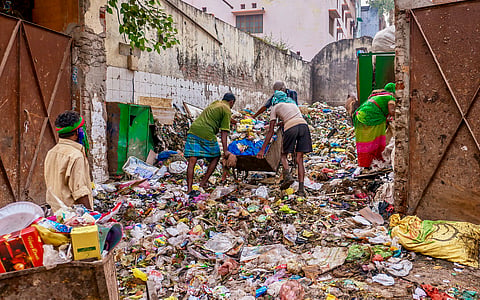
Four of these arrive at the plant gate reasonably clean, and the plant pays a price for them. The fifth arrives mixed with silt, coconut shells, sanitary waste and broken glass and somebody has to be paid to bring it there in the first place. City waste is the feedstock that needs this scheme the most and is least ready to make use of it.
The numbers show how far behind it is. Urban India throws out about 1.62 lakh or 0.162 million tonnes of waste every day, and 40 to 60 per cent of that is wet organic matter. Our estimate at Centre for Science and Environment, New Delhi, is that this could yield around 2,523 TPD of Bio-CNG. We are currently getting 2.26 per cent of it. Across the country, some 217 CBG plants run at a combined 1,773 TPD using all feedstocks and only about 57 TPD of that comes from municipal waste. And of the 1.36 lakh TPD of wet waste capacity cities report, bio-methanation is just 5,524 TPD. Nearly all the rest is composting which require twice the land of a Bio-CNG plant, and produce low-value product, and rarely able to recover running cost back.
The strange part is where the gap is widest. It is not the small towns that are missing. It is our biggest cities like Delhi, Mumbai, Hyderabad, Pune, Patna and many others that generate the largest and most concentrated volumes of wet waste, struggle the most visibly to manage it, and yet contribute almost nothing to this scheme. They have the feedstock, they have the land pressure that makes composting impossible, and they have the CNG bus and truck fleets that could burn the gas the same day it is made. The problem is understood and the incentive now exists. The potential still sits unused.
A guaranteed supply of waste. The 40-to-60-per-cent figure is a national estimate. It is not a promise to any single plant. What matters at the digester is not how much wet waste a city generates, but how much of it actually reaches the plant and in what condition. The two numbers are rarely the same, for two reasons. Most cities do not know precisely how much organic waste they generate in the first place, so the tonnage written into a contract is often a guess. And of what does arrive, only a fraction is clean enough to feed a digester. So, there are cities with more than enough wet waste on paper whose plants still run half empty, because the waste is never routed to them or does not meet the quality the process needs. The plant then loses money, the operator loses interest, and the next tender in that city attracts fewer bidders. This loop, not a shortage of capital, is what has held back garbage-based CBG in India.
Clean waste at the gate. A bio-methanation plant needs source segregation above 90 per cent to work properly. Swachh Survekshan 2024 found only Madhya Pradesh and Chhattisgarh crossing that line, and CPCB puts national segregation at 30-35 per cent. The Solid Waste Management Rules, 2026, in force since April 1, now require four-stream segregation at source. That requirement, far more than the Rs 2 crore per TPD, will decide whether city plants run at full capacity or half. Indore is worth studying because it got the order right: it first secured 550 TPD of properly segregated waste, and only then built the plant to use it. Most cities try it the other way round and pay for the mistake for the next twenty years.
An answer to who pays for collection. This single question decides whether a project lives or dies. Our analysis in Bio-CNG from Municipal Solid Waste report of a 5 TPD plant shows that when the municipality collects and delivers the waste, monthly running cost stays around Rs 40 lakh and the investment is recovered in about five years. When the developer has to collect it himself, that cost crosses Rs 91 lakh and payback stretches to 29 years — no bank will fund it. GOBARdhan says nothing about who collects. Maharashtra’s CBG Policy 2026 does: it states plainly that the municipality, not the developer, must bring the waste to the plant. That one line is what makes a project bankable, and other states should copy it.
The full cost of building. A plant costs Rs 6-7 crore per TPD, so a standard 5 TPD facility needs about Rs 35 crore, and 20 per cent more in hilly or cold places. And remember the ratio: it takes 25 to 30 tonnes of properly segregated organic waste to make one tonne of Bio-CNG. That 5 TPD plant therefore needs 100 to 150 tonnes of clean waste delivered every single day, for years. Very few urban local bodies can honestly promise that today.
GOBARdhan is run by the petroleum ministry. But segregation, collection and the SWM Rules are the business of the Union Ministry of Housing and Urban Affairs or MoHUA, the states and some 4,000 urban local bodies. Unless these two sides work together, the money will go to the easier rural feedstocks, and our cities will carry on composting.
Three practical fixes follow.
For the Centre: ring-fence a share of the outlay for municipal organic waste and build the Challenge Fund’s district plans on city-wise wet waste and segregation data not crop-residue mapping alone.
For states and ULBs: make eligibility for city projects conditional on a written feedstock guarantee from the municipality, covering assured tonnage, assured quality and municipal collection. A plant should not be sanctioned before the waste stream behind it is.
For those writing contracts: move public-private partnerships from input-based to outcome-based terms. Before that, do the groundwork — a waste characterisation and composition study to establish how much organic waste the city actually generates and where it comes from, and an honest assessment of how well it is segregated on the ground. Only then can a plant be sized to run at its installed capacity, which is the whole point of building it.
The energy shock of 2026 settled the argument about whether India needs gas of its own. In June, the country used 197 million standard cubic metres a day and imported 110 of it more than half our supply, bought at LNG prices that touched $18 per unit. The city gas network, which is where compressed biogas goes, uses about 58 MMSCMD. So, the 5 per cent blending requirement due in 2028-29 means finding roughly 2.9 MMSCMD, or about 2,080 tonnes of gas a day. The entire CBG sector today makes 0.4 MMSCMD. The wet waste in our cities could make 3.5 on its own more than the whole requirement, from garbage alone. It currently makes 57 tonnes. GOBARdhan has answered the question of money. The question of raw material will be answered in our cities, ward by ward.
