
Subscribe

MCD’s Karol Bagh Zone implemented the Dust Free Delhi campaign across major Public Works Department roads more than 60 feet wide.
The 41-day campaign covered about 122 km of road network and removed 228 MT of roadside dust.
The initiative combined mechanised sweeping, manual kerb-edge cleaning, water sprinkling, pressure washing, greenbelt maintenance and debris removal.
The model shows why road-dust control requires repeated cleaning, field monitoring and coordinated municipal action, rather than one-time cleanliness drives.
Air pollution has become a critical environmental and public health challenge in rapidly urbanising cities, with road dust contributing substantially to particulate matter, including PM10 and PM2.5. In Delhi, vehicular movement, construction activity, damaged road shoulders and legacy waste deposits accelerate the resuspension of dust.
The Dust Free Delhi Initiative, implemented by the Municipal Corporation of Delhi (MCD) in Karol Bagh Zone, offers an integrated municipal framework for road dust mitigation. The initiative combined mechanised road sweeping, manual kerb-edge cleaning, central verge and greenbelt maintenance, pressure washing, water sprinkling, construction and demolition waste removal and legacy waste management.
A structured standard operating procedure, risk-based road prioritisation, dedicated sanitation squads, field inspections and continuous monitoring were used to sustain dust-free road conditions. During the 41-day campaign, approximately 122 kilometres of major road network was scientifically cleaned, 228 tonnes of roadside dust was removed and 150 tonnes of garbage and debris was cleared.
The experience shows how proactive, engineering-based municipal dust management can improve road hygiene, reduce dust accumulation and provide a practical and replicable model for urban air-quality management.
The quality of air in urban environments has become an important indicator of public health, environmental quality and sustainable development. Rapid urbanisation, increasing motorisation, intensive construction and high population density create multiple pathways for particulate pollution. Among these pollutants, PM2.5 and PM10 are of particular concern because of their impact on human health and urban liveability.
Road dust is one of the significant and locally manageable contributors to particulate pollution. Dust deposited on carriageways, kerb edges, footpaths, central verges and road shoulders is continuously disturbed by vehicular movement, tyre friction, wind turbulence and human activity.
In Delhi, high traffic volumes, construction activity and inadequate roadside maintenance further increase deposition and resuspension. Scientific municipal action at ground level is therefore an essential part of integrated urban air-quality management.
Road dust originates from soil particles, construction and demolition waste, loose construction materials, tyre and brake wear, roadside vegetation and legacy waste. These deposits are resuspended by traffic and wind, increasing particulate exposure along major roads and intersections. Effective control therefore requires a complete dust-mitigation cycle, rather than isolated cleaning.
Mechanised sweeping removes loose material from carriageways, while manual scraping addresses kerb edges, shoulders, footpaths, bell mouths and central verges. Collection and timely disposal prevent re-deposition, while water sprinkling and pressure washing help suppress fine particulate matter.
Construction and demolition waste and unauthorised dumping must also be addressed because they continuously create new dust loads.
As an urban local body responsible for sanitation, road maintenance, solid waste management, construction and demolition waste management, horticulture and environmental services, the Municipal Corporation of Delhi has a direct role in controlling locally manageable sources of particulate pollution.
The Dust Free Delhi Initiative integrates these municipal functions rather than treating road cleaning as a routine sanitation activity.
The framework combines construction and demolition waste collection and transportation, scientific processing and enforcement against unauthorised dumping with mechanised sweeping, manual kerb-edge cleaning, water sprinkling, pressure washing, central verge maintenance and legacy waste removal.
Karol Bagh Zone implemented a 41-day Dust Free Delhi campaign covering major Public Works Department roads exceeding 60 feet in width. These roads included wide multi-lane arterial corridors with central verges, footpaths and kerb edges. Rather than relying on one-time cleaning, the initiative adopted a corridor-based and preventive approach designed to achieve and maintain a ‘No Dust’ condition.
Roads were prioritised according to traffic intensity, commercial importance and visible dust accumulation. Dedicated sanitation squads comprising junior engineers, sanitary inspectors, sanitation superintendents, sanitation guards, sanitation workers and mechanised road sweeper operators were deployed under field supervision.
This institutional arrangement created clear operational responsibility and enabled the campaign to function as a coordinated environmental-management programme.
The implementation followed a defined seven-step method. First, priority road corridors were identified and dedicated teams were deployed. Second, mechanised road sweeper machines were used on both carriageways to remove loose dust, fine particulate matter and roadside debris. Third, manual teams scraped and cleaned kerb edges, shoulders, footpaths, bell mouths, medians and central verges, including locations inaccessible to mechanised equipment.
Fourth, collected dust, malba, garbage and debris were lifted and transported through approved mechanisms to designated disposal facilities. Fifth, water sprinkling and pressure washing were carried out on roads, kerb edges, footpaths and central verges to suppress fine particles and minimise resuspension.
Sixth, ward junior engineers and sanitary inspectors inspected the cleaned stretches against the prescribed ‘No Dust’ standard. Seventh, the complete cleaning cycle was repeated every eight days, supported by continuous monitoring and performance evaluation.
This cycle transformed routine road cleaning into a structured and repeatable dust-management system.
Following adoption of the methodology, the initiative was implemented across the identified major PWD roads through coordinated municipal operations. Mechanised sweepers, sanitation manpower, water sprinklers and supervisory teams were deployed to ensure uniform execution.
The campaign integrated sweeping, manual cleaning, collection and disposal, water sprinkling, pressure washing and continuous field inspection rather than treating these activities as separate operations.
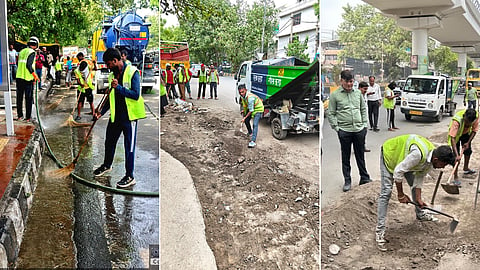
The field approach was designed around the actual characteristics of the road corridor. The pictorial implementation plan shows mechanised cleaning on both sides of a divided carriageway, manual cleaning of side and central verges, washing and dust removal, and coordinated collection and disposal.
Greenbelt cleaning was also incorporated because accumulated soil and loose material can become a recurring source of roadside dust. The map of Karol Bagh Zone identifies the major PWD road network selected for Phase I, while the photographs document the practical sequence of work.
The campaign produced measurable operational achievements.
Approximately 122 km of major road network was scientifically cleaned during the 41-day campaign. Around 228 metric tonnes of roadside dust was removed, while 150 metric tonnes of garbage and debris was cleared from central verges through systematic field operations.
Water sprinkling was undertaken throughout the campaign, mechanised road sweeper machines were deployed on both carriageways, and daily inspections supported quality assurance.
These outputs show the scale of municipal effort required to move from visible cleanliness to sustained dust mitigation. Mechanised sweeping addressed loose material on carriageways, manual cleaning targeted residual deposits at road edges and verges, while washing and sprinkling supported dust suppression.
Removal of garbage and debris reduced potential sources of further dust generation. Repeated cleaning and monitoring remained essential because dust is continuously deposited and can quickly return without sustained maintenance.
Following the initial phase, the initiative was extended into Phase II to cover connecting roads across Karol Bagh Zone, providing continuity between major arterial roads and adjoining networks.
The experience provides a practical framework that can be adapted by other urban local bodies. Its strength lies in integrating engineering interventions, mechanisation, sanitation manpower, waste management, field supervision and periodic maintenance within one operating system.
Regular mechanised sweeping, GIS-based road mapping, technology-enabled monitoring and performance evaluation can further improve efficiency. The model is particularly relevant for high-traffic corridors where dust accumulation is recurrent and municipal agencies have direct operational control over cleaning and roadside management.
Urban road dust is a significant and locally controllable contributor to particulate pollution in metropolitan cities such as Delhi. The Dust Free Delhi Initiative implemented by MCD in Karol Bagh Zone demonstrates that scientific municipal interventions can convert conventional road cleaning into a structured environmental-management programme.
By integrating mechanised road sweeping, manual kerb-edge cleaning, central verge and greenbelt maintenance, collection and disposal, water sprinkling, pressure washing, monitoring and periodic maintenance, the initiative established a systematic approach to dust mitigation.
The 41-day campaign, covering approximately 122 km of major roads and removing 228 metric tonnes of roadside dust and 150 metric tonnes of garbage and debris, demonstrates the operational scale of such interventions.
More importantly, dust management must be continuous rather than a one-time cleanliness drive. With Phase II extending coverage to connecting roads, the Karol Bagh experience provides a replicable municipal framework for cleaner road corridors and improved urban air-quality management.
Going forward, institutionalising this approach through regular mechanised sweeping, data-driven road prioritisation, GIS-based mapping, technology-enabled monitoring and performance evaluation can strengthen sustainability.
The initiative demonstrates that proactive municipal governance, supported by scientific planning and field-level execution, can contribute to cleaner roads, healthier urban environments and more sustainable cities.
Views expressed are the author’s own and don’t necessarily reflect those of Down To Earth