
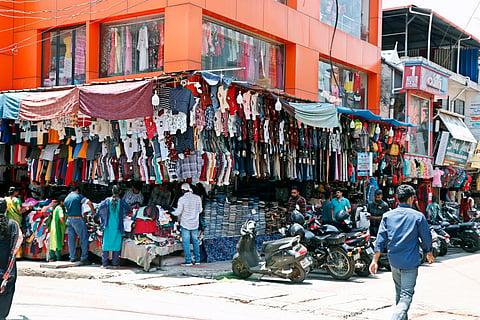
‘Microplastics now make up as much as 5% of particulate pollution in India’s cities’

As India grapples with chronic air pollution, researchers warn of a newly emerging menace — inhalable microplastics in the markets of metropolitan cities in India. Inhalable microplastics (iMPs) are plastic particles less than 10 micrometres (microns) in size, as compared to microplastics (less than 5 millimetres), and can thus enter human lungs through the nose.
A new study, titled The Dawn of a New Air Pollutant: Inhalable Microplastics as Emerging Vectors of Hazardous Contaminants and Their Implications for Human Health, published in the journal Environment International this month, is said to be the first to measure plastic particles at human breathing height in Indian markets.
Conducted by the Indian Institute of Science Education and Research, Kolkata in collaboration with the Institute of Mathematical Sciences (IMSc), Chennai, and the All India Institute of Medical Sciences (AIIMS), Kalyani, the study also found iMPs to be carriers for pathogenic bacteria and viruses.
To know more, Down To Earth spoke to Gopala Krishna Darbha, associate professor at the department of earth sciences at IISER Kolkata, the lead researcher of the study.

Ravleen Kaur (RK): What queries led to this study?
Gopala Krishna Darbha (GKD): I am an environmental scientist and the main focus of my research work is to understand human exposure pathways to various pollutants. Our earlier study on investigating arsenic in coconut water was the first that led us to look at environmental health. Most of my group members work on micro-nanoplastics. We have reported microplastics in water and fish in several rivers including the Mahanadi, Godavari and Chilika lake.
Studies have already shown plastics exist everywhere, including in the human body, which proves that plastic can eventually go inside. The major exposure pathways for this are food (packaged food), water (packaged milk and water, unpurified water from rivers), dermal contact (cosmetics) and inhalation. The last one, inhalation, is actually underreported.
In winter, there is always a red alert because of the high air pollution index values. This pollution is attributed to dust, which can have geogenic origins (particles of soil, sand) and vehicular emissions composed of unburnt fuel particles and tyre-wear particles, which are also released into the air. Also, it is important to know other contributors to dust: plastics that have a density lower than sand or silt, which must be present in significant fractions contributing to these particles. That was the question I had.
Also, there are pulmonary disease cases coming up now. One of our co-authors is a pulmonologist from AIIMS, Kalyani, who was interested in understanding the reason behind cancer in non-smokers. Plastics could be one of them.
RK: What did you find?
GKD: Inhalable microplastics, which are microscopic plastic fragments smaller than 10 micrometres, are an emerging class of air pollutants that pose a significant health threat, similar to, or potentially exacerbating, the issues caused by traditional particulate matter like PM2.5 and PM10.
The study, conducted in five markets each in Delhi, Kolkata, Chennai and Mumbai, found the highest concentrations of inhalable microplastics in Kolkata (14.23 microgrammes per cubic metre [µg/m³]) and Delhi (14.18 µg/m³), followed by Chennai (4 µg/m³) and Mumbai (2.65 µg/m³). An average city dweller could inhale nearly 2.9 grams of microplastics over their lifetime — roughly the weight of a small plastic bottle.
We chose markets to collect our samples because they are busy places with textiles and other fibres, as well as vehicular emissions like tyre wear, which was found to be a major contributor to iMPs. Anybody spending eight hours continuously in such areas is highly exposed to plastics.
Traditionally, PM10 and PM2.5, which are fine particles from dust, smoke and fuel, are blamed for air pollution. This study found microplastics now make up as much as 5 per cent of these particulate pollutants in India’s cities. Most of these plastics come from synthetic clothing (polyester), packaging, vehicle wear and footwear.
RK: What are the potential health impacts of iMPs?
GKD: Unlike dust, microplastics do not easily settle or wash away. Their light and aerodynamic shapes keep them floating for long periods, allowing them to travel far and wide. Once inhaled, they can reach deep into the lungs, enter the bloodstream and even affect internal organs.
Microplastics are not just pollutants, they act like Trojan horses. This study provides the first evidence that airborne microplastics can carry living microbes and toxic chemicals. Some of the microbes found were pathogenic and antibiotic-resistant, such as Aspergillus fumigatus (immunosuppression) and Candida (skin infections), along with Bacillus species carrying resistance genes.
Toxic chemicals like Diethyl Phthalate (DEP) — used in plastics and cosmetics — were also found in Delhi, Kolkata and Mumbai air samples. DEP exposure is linked to hormonal imbalances, fertility problems and respiratory irritation. Lead, often used in polyvinyl chloride or PVC and tyres, was detected above safe limits in Kolkata and Delhi. Continuous exposure to lead can damage the brain, kidneys and nervous system, especially in children.
Microplastics’ rough surfaces provide an ideal habitat for microbes. The burning or breakdown of plastic particles mixed with other pollutants can trigger serious diseases, including cancer, lung and gastrointestinal disorders, and hormonal and reproductive problems. The fate and toxicity of iMPs in the human body vary depending on their polymer, size and shape.
Larger particles (between 10-2.5 microns) are irritating and promote mucus formation in the upper airways, while finer particles (2.5-1 micron) interact with macrophages, reach alveoli and cause inflammation. Submicron particles (less than 1 micron) can pass the alveolar-capillary barrier, leading to oxidative and cellular stress and other health issues.
So imagine a COVID-like situation where viruses sitting on these plastics spread through the air. Some of these particles have a lifespan of more than 100 years. So we are not just talking about plastic toxicity here, but also heavy metals and disease-causing microbes that they carry.
RK: Did the study prove a conclusive link between iMPs and lung cancers?
GKD: We are not completely proving it, but through a collaboration with IMSc Bangalore, we systematically tried to identify the types of plastics. We found 11 polymers in our study, the most common being polyethylene terephthalate or PET, polyethylene and synthetic butadiene rubber. We did not actively work on finding the link, but from existing literature we know these polymers can be related to cancers. We just related these polymers’ adverse outcome pathways.
RK: What challenges did you face while conducting this study?
GKD: Initially, we thought of confining the study only to Kolkata. But the scope was expanded later to major metropolitan cities to get more impactful baseline information. It took us more than two years to collect the samples from five markets in each city and analyse them. To mimic human breathing, ‘Cascade Impactors’, which have filters with different pore sizes, were used. The bigger particles are stopped in the beginning while the smaller fractions go inside.
The problem in detecting iMPs is their small size. Unlike microplastics that are visible to the eye, iMPs are less than 10 microns and nanoplastics are less than 1 micron. Therefore, most researchers till now have focused on millimetre-sized particles. This study is the first to detect iMPs in India using Pyrolysis Gas Chromatography–Mass Spectrometry (Pyrolysis GC-MS) at human breathable height. It is a very advanced technique for quantification of micro- and nanoplastics. In India, only IIT Madras and IISER Kolkata have this facility.
But it was not easy because one had to examine particle size (0–10 microns), type of particles and also the total particles deposited on the filter paper to get qualitative as well as quantitative information. Because of limited expertise in India on Pyrolysis GC-MS, my students had to collaborate with instrumental-technique expert engineers to calibrate, validate and devise a methodology to detect these microplastics, which took some time.
RK: Given the hazardous impacts of iMPs, what are your recommendations to manage this new pollutant?
GKD: The highest iMP levels were observed during winter evenings, when markets are crowded and the air is trapped due to temperature inversion. Human activity — from wearing synthetic clothes to poor waste management — directly contributes to plastic emissions. These particles do not just stay in cities — they can travel through air to rivers and oceans, eventually returning to us through seafood and salt.
This discovery redefines what we know about air pollution. Microplastics are not yet included in air quality standards like PM2.5 and PM10, but their persistence and toxicity mean they should be. Meanwhile, people should avoid synthetic and heavily worn-out clothes and use eco-friendly fabrics like khadi, reduce single-use plastics, encourage vehicle-free and green market zones and stop waste burning.
Also, most of the garments sold in markets like Sarojini Nagar in Delhi are “imported reusable goods”. They come from Korea or other Western countries and have already been used once. They are produced in Bangladesh, where they must be causing emissions too, and then dumped here for reuse before final disposal in landfills. This needs to be addressed.
We also need further studies to identify which plastic polymers suit different types of microbes.