
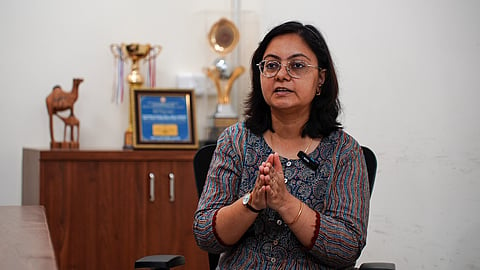
Sea of plastic: FMCG companies should be held responsible for food-packaging waste, says Parama Roy

Okapi Research’s Parama Roy says plastic entering the ocean often begins as poorly managed waste in cities, where food packaging and single-use plastics remain common.
Chennai’s Urban Oceans work found that segregation at source is a key challenge, even where decentralised waste-management facilities exist.
Roy says FMCG companies should be held responsible for food-packaging waste, while neighbourhood-level composting, soft-plastic collection and trust-building can help cities move towards zero waste.
Plastic entering the ocean often begins as poorly managed waste in cities, says Parama Roy, executive director of Okapi Research and Advisory, an IIT Madras-incubated research organisation.
In this interview with Down To Earth, she explains how Okapi’s work under the Urban Oceans programme in Chennai led to the We Segregate project in Kasturba Nagar, where residents, local associations and waste workers are using composters, soft-plastic collection systems and door-to-door campaigns to improve segregation at source and move towards zero-waste neighbourhoods.
Akshit Sangomla (AS): What work on waste management, especially marine litter, are you involved with right now?
Parama Roy (PR): Our work related to waste management started with the Urban Oceans programme in 2021. Urban Oceans is an internationally funded programme on marine litter, mainly looking at how to prevent plastic from entering the oceans.
The programme has been conceptualised broadly enough to recognise that the waste in our water bodies comes from inland. The source is where people live. In the various cities where Urban Oceans is working, it developed a circularity assessment protocol methodology. Under this, each city carried out rigorous research to understand its waste-management processes.
For Chennai, we went around the city for almost the entire first year of the project, looking at public litter on streets in different locations. This was to understand what kind of material was being dumped into the environment. We also spoke to different stakeholders, such as grocery stores, food vendors and restaurants, to assess the materials they use for serving food and selling products. We focused a lot on food-packaging material.
AS: What were your learnings from the research?
PR: We understood from our detailed research that segregation at source is one of the key challenges we are struggling with. Chennai was one of the cities where some sort of decentralised waste-management system existed, with micro-composters for wet waste and resource-recovery facilities where dry waste was managed. This was a good way of handling wet and dry waste properly.
Despite having the network, the facilities were not running very efficiently. The major reason was that they could not get the required segregation rate for the facilities to work. Chennai has now closed down many of these micro-composting centres and resource-recovery centres. Instead, the focus has shifted towards waste-to-energy plants.
We have to understand that even for waste-to-energy plants to work, waste has to be properly segregated. The quality of the waste affects the efficiency of these plants. This is why we have seen so many waste-to-energy plants across India shut down or fail to run successfully. Unless we segregate at source, there are few choices we have.
Chennai had prepared a climate action plan, which recognised that we need to work towards developing zero-waste or near-zero-waste neighbourhoods. Around 13-14 per cent of greenhouse gas emissions come from the waste sector. This also points us towards managing our waste more sustainably.
Another learning was the prevalence of single-use plastic litter on the streets, despite the ban on these items being in place for a long time. For small vendors, it is difficult to switch because alternatives are not available at a cost they can afford. FMCG companies should be held responsible for food-packaging materials. These companies are big enough, so if they wanted to, they could manage the waste.
From the understanding gained through our own research and the climate action plan, we wanted to pilot a project to see if we could create a zero-waste neighbourhood. Our learnings would actually be applicable to most Indian cities.
AS: How did you proceed with the pilot project to create a zero-waste neighbourhood?
PR: In the second year of the Urban Oceans project, we spoke with stakeholders to understand what pilot projects would be feasible and what we could focus on. This is how we got in touch with the Residents of Kasturba Nagar Association, or ROKA. They were already doing some good work on waste management in their neighbourhood, so we selected them as the pilot project area and started the We Segregate project.
The idea was to work with residents and help them understand why segregation is so important. We thought it would be interesting to introduce a few physical nudges, along with awareness campaigns, which are also integral to this kind of project.
Among the physical nudges, we introduced lane composters in the area. If residents could see lane composters working in front of their homes, using segregated wet waste from their households and turning it into something productive that could be used in their own gardens, it would help them understand why this is really critical.
It was possible to turn 40-45 per cent of the waste generated in households, which is food waste, into compost that comes back to their gardens. There was also a school garden in the locality where the use of this compost was showcased. More residents are now coming to the occasions when we harvest the compost and showing interest in buying it.
Another stream of waste we wanted to address was dry waste, especially soft plastics, including milk packets, biscuit packets and plastic bags. Informal waste workers and conservancy workers find value in hard plastics because they can be sold. But soft plastics do not have much economic value in the market unless they are collected in bulk.
The quality of soft plastics also matters, because they have to be free of contamination. For soft plastics to be segregated, one additional step, such as washing milk packets, needs to be taken. So, to make it easier for residents to segregate soft plastics, we introduced Punch the Plastic hooks in the neighbourhood. These are simple hooks installed in individual households, or larger ones for an entire building.
Once enough soft plastics are collected, they can be transported to recyclers. Bisleri’s Bottles for Change programme is collecting soft plastics from Kasturba Nagar once a month and sending them to Spreco, a recycling company that converts soft plastics into furniture boards.
AS: How were residents made aware that segregation at source was important?
PR: The third component of the project was making residents aware of the importance of segregation at source. Our team members, along with ROKA team members, have been conducting door-to-door campaigns to create awareness. We also brought in interns from colleges who have helped us with these campaigns.
During the campaigns, we talk to residents about the critical importance of segregation for their environment and health, and how they can do it. Some of the messaging also happens through social media, but that is not enough. This is the most challenging task because behavioural change is always difficult.
The door-to-door campaigns have given us the opportunity to monitor change more closely. We wanted to understand whether our interventions were bringing any changes in segregation levels, and in people’s behaviour and attitude towards waste and its management.
Trust-building is crucial for such a project to work. Residents wanted to know whether the waste they were segregating would be handled appropriately. Sometimes waste collectors put everything into the same compartments. ROKA built a relationship with the waste-collection drivers to ensure that this did not happen.
To build trust, we have also been showing residents each step and component of the waste-management process. This helped them understand that it was worth making the effort to segregate. We have been able to keep a record of how things have changed. The percentage of residents segregating well has gone up from 37 per cent to 60 per cent, which gave us the motivation to continue further.
AS: What are the future plans for the project?
PR: We are trying to go beyond Kasturba Nagar and work with other neighbourhoods. Last year, we started the We Segregate stewardship programme, through which we advertised what we were doing in Kasturba Nagar across the city and encouraged other neighbourhoods and residents’ welfare associations that may be interested in replicating the project.
We brought them to Kasturba Nagar to show them what we are doing, how we are doing it and what the challenges are. Whoever wins the stewardship programme gets a lane composter.
We have also developed a We Segregate guide, which documents all the experiences and challenges of the project. The maintenance and sustainability of the project are also addressed in the guide. It is publicly available on our website.
Clover by the River, a community in Kotturpuram, won the stewardship programme, and the first harvest from its lane composter has already happened. Other communities have also started reaching out to us, saying they want to replicate the project. Kalakshetra Colony has shown interest in the Punch the Plastic hooks.