
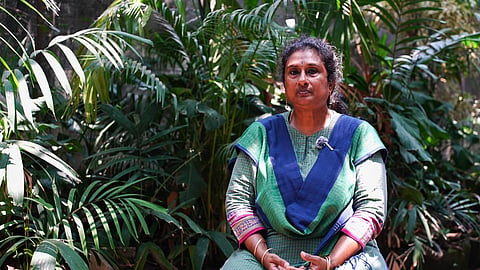
Sea of plastic: Ghost nets are death traps for turtles, dolphins and fish, says Supraja Dharini

India’s east coast is a crucial habitat for olive ridleys, green turtles, hawksbills and leatherbacks, says Tree Foundation founder Supraja Dharini.
Dharini says ghost nets and everyday plastic waste are injuring and killing sea turtles, dolphins, fish and other marine organisms.
Tree Foundation’s incentive programme has helped fisherfolk retrieve more than 200 tonnes of ghost nets from the Chennai and Chengalpattu coast, while also rescuing entangled marine species.
Ghost nets are among the most dangerous forms of marine litter, continuing to trap fish, turtles, dolphins and other marine species long after they are lost or abandoned at sea, says Supraja Dharini, founder and head of environmental conservation organisation Tree Foundation.
In this interview with Down To Earth, she explains why India’s east coast is critical for sea turtles, how fisherfolk are helping retrieve ghost nets and rescue entangled animals, and why reducing ocean plastic requires awareness, incentives and a deeper understanding of the connection between land and sea.
Akshit Sangomla (AS): How important is the east coast of India as a sea turtle habitat?
Supraja Dharini (SD): The east coast of India is a very important area for sea turtles, not just olive ridleys but all species. We have nesting olive ridleys, and foraging green turtles, hawksbills and leatherbacks along the east coast of India. During the fishing season, we get olive ridleys, green turtles, hawksbills and leatherbacks as bycatch.
AS: What conservation process does Tree Foundation follow, and what are the main concerns when it comes to ghost nets?
SD: As part of the conservation process, we have trained fishing communities from coastal villages as sea turtle protection force members. We also get a lot of information about the coastal areas from them, which we would otherwise not know.
Many fisherfolk told us that turtles were getting injured by fishing gear and what they call ‘waste nets’. Technically, these are called ghost nets. Ghost nets are carelessly abandoned fishing gear, or gear that is lost at sea when fisherfolk set it up and a storm or cyclone strikes. When they go back after the storm or cyclone, they cannot find the fishing gear.
Ghost nets also contain waste plastic, styrofoam, ropes and other things that we throw on land and that eventually reach the ocean. All these move with sea currents and constantly trap fish, commercially viable species and endangered marine species.
Since 2010, we have had permission from the Chief Wildlife Warden of Tamil Nadu, and since 2013 from the Chief Wildlife Warden of Andhra Pradesh, to run a temporary rescue and rehabilitation centre for injured sea turtles and terrapins.
We started getting many turtles trapped in ghost nets. They would have nets stuck around their flippers or necks. Some of these turtles are still alive, so our sea turtle protection force members bring them to our centre and we administer treatment. Those that survive are released back into their habitat. We realised that the impact of ghost nets on sea turtles is huge.
AS: How do sea turtles and other marine organisms get trapped in ghost nets?
SD: Sea turtles normally swim with the currents, so when ghost nets are also present in these currents, they get caught in them.
Ghost nets can contain different types of material, such as polyester, polypropylene, nylon, PET, styrofoam and parts of buoys. It is a big mesh of all these materials. When the flipper or neck of a sea turtle gets caught in a ghost net, it is very difficult for the turtle to untangle itself. The turtle constantly tries to get out of it, and the nylon or polystyrene gets embedded in the body.
We have found many sea turtles with their flippers amputated, cut and hanging, or with the net embedded in the neck. Sometimes we are able to rescue them in time, the wound heals and we can release them back into the sea. Most often, they lose the flippers. We have found many ghost nets with dead turtles, dead baby dolphins and different varieties of commercial fish as well.
AS: How have fisherfolk responded to the conservation of sea turtles and other marine life, keeping in mind that fishing is their main livelihood?
SD: In 2021, we started a programme as an alternative income mechanism for fisherfolk. We asked them to collect ghost nets during their fishing effort. If they see anything floating in the ocean, we ask them to steer their boat towards it and check if it is a ghost net and whether any endangered species is stuck in it.
They then pull the ghost net closer, cut the net, release the species, document the entire effort through photos and videos, and share it with our respective coordinators. Fisherfolk have been doing this and also bringing ghost nets back to shore, for which we give them an incentive directly into their bank accounts.
Fifty per cent of the incentive is given to the fisherman and 50 per cent to his wife, or to his mother if he is unmarried, ensuring that it goes to the family. This has been working really well and we are getting a good response.
We have been able to collect more than 200 tonnes of ghost nets from just along the Chennai and Chengalpattu coast. The incentive programme is supported by AstraZeneca, Aisha Group Foundation and Royal Enfield.
AS: What is the difference between waste nets and ghost nets? How can one differentiate between the two, and how can they be recycled?
SD: People often get confused between waste nets and ghost nets. They think fishing gear that fisherfolk have used, that is damaged, no longer used for fishing and left on the shore, is a ghost net. But that is not the case.
Ghost nets are different types of fishing gear and nets mixed together with ropes, styrofoam, buoys and plastic. Unused nets abandoned on the shore can easily be recycled and even reused with some repair, as they are usually made of one specific type of material, such as polystyrene or nylon. With ghost nets, only when you segregate the different types of material can they be taken for recycling.
If we have to use ghost nets, there are two ways. We can shred them and make pathways out of the material. A pathway we made one-and-a-half years ago is still working well. This June, we are going to lay a road using ghost nets. We can use this material as an aggregate, and this is a good way of using or recycling ghost nets.
We have also made many marine life models out of ghost-net material. Fisherfolk are very good at weaving. We had artists prepare the skeletons of the marine life models, and the fisherfolk wove the nets they had segregated from ghost nets to complete these beautiful models.
We hoped that resorts along the coast would purchase these marine life models and display them along with a standee carrying information on how marine litter such as ghost nets affects the marine ecosystem.
AS: Apart from ghost nets, what other litter can be harmful to the marine environment?
SD: Apart from ghost nets, everyday plastic items such as sachets, water packets and other such material can also be harmful to marine organisms.
We once found a green turtle with a water packet stuck in its throat. It had been feeding on seagrass, where the water packet was stuck. When the turtle came to us, it had impaction and could not move. After 22 days of medication and treatment, the water packet, along with the seagrass entangled around it, came out of the turtle. That is how we realised how our careless actions affect marine life.
This was just one among many animals in the sea that have been affected by plastics and other human waste material. One of the turtles we found had a Kinder Joy toy stuck inside its throat. Sometimes there are buttons, pieces of sponge and pieces of plastic.
These materials get washed into the sea through streams and rivers, and marine organisms keep swallowing them, thinking they are food. Most often, they are not able to digest these materials and die.
When we go to uninhabited islands, such as the sandbars in the Krishna river estuary, we can see plastic covers and other litter stranded all along the shore. This is something on which we all have to consciously take action. When we use something non-biodegradable, we should dispose of it responsibly.
AS: As you have travelled to many places along the eastern coast, are there certain parts of the coast that are more prone to marine litter?
SD: We find a lot of ghost nets along coasts close to harbours and ports. When large shipping vessels move, whatever is thrown overboard from them gets washed ashore to fishing villages near harbours and ports. Waste from these ports and harbours also finds its way to these villages.
AS: What steps could policymakers take to manage marine litter?
SD: My humble request to policymakers would be that whenever they are designing and releasing fishing gear, they should create awareness among fisherfolk that when their fishing gear is no longer useful, they should not throw it into the ocean. They should dispose of it properly, and this should be communicated to fisherfolk when they are buying the gear.
Awareness should also be created for the shipping industry, because most shipping vessels do not follow their own strict marine litter policies. Fisherfolk have told us that when they go fishing around 20 nautical miles, or 37 km, from the shore, they see many large vessels dumping waste at sea.
When these vessels dump their waste at shore, they have to pay for it, so they dump it just before they reach a particular harbour or port. People need to become self-aware. Nobody should need to monitor what is happening; we have to do it for ourselves.
With self-motivation, we will be able to reduce much of the plastic entering the ocean and terrestrial ecosystems. Fisherfolk also need to understand that it is their ecosystem that is getting destroyed. If marine organisms keep getting killed after becoming entangled in ghost nets, they are not able to carry out their services in a particular ecosystem. Once fisherfolk understand this, there will be a reduction in ghost nets at sea.
AS: Your work through Tree Foundation with fisherfolk is built on trust. What are your suggestions for other organisations working in conservation on building this trust?
SD: It has taken us 24 years to get where we are. It is not easy. We have had to show continuous perseverance and never give up, despite all the challenges we faced.
Working with communities is not easy because different people have different mindsets. So we have to be very careful and speak to them in a way they understand. We are fortunate because we built trust with fisherfolk in our initial period, and they were the ones who took the programme forward.
Sea turtle protection force members are the nodal members in each fishing village. They take the programme forward and, along with our coordinators, disseminate information about it to their communities.
Apart from that, we have also been working with the forest department, fisheries department, marine police and the Indian Coast Guard. Whenever we create awareness among communities about reducing ghost nets and bycatch mortality through stakeholder workshops, we always take personnel from all these departments with us, and they participate.
The departments also appreciate fisherfolk who bring back ghost nets or release endangered marine species entangled in fishing gear. This has instilled pride among fisherfolk, and social media also helps. Whenever a fisher person shares a video of such work with us, we turn it into a small social media post and share it with the community and the public.
They also share it with their friends and relatives. This has been taken more seriously by younger fisherfolk, though older fisherfolk are also involved.
Shreya KA (SKA): People who live away from the coast are not really thinking about what is happening in the oceans. What is at risk, and how significant is it?
SD: Whatever action we take on land, even thousands of kilometres away from the shore, affects the oceans. A farmer who uses pesticides or fertilisers on his farm, even a thousand kilometres away, may see excess pesticides and fertilisers washed into streams and rivers and carried into the ocean.
We should understand the land-ocean connection. We are connected to the ocean. Most often, people do not realise that our actions affect the oceans. Many are even unaware that the ocean gives us the oxygen we breathe and much of the water we drink. They are our rainforests, because a lot of flora and fauna in the ocean help us get rains.
More than 50 per cent of people living in coastal areas get their protein from the ocean. The ocean is our life-support system, giving us air to breathe, water to drink and food to eat. Still, we do not understand the land-ocean connection.
Once people understand the connection between land and ocean, awareness will grow. Once we know, we learn to care, and once we care, we can protect. Without understanding, we will not be able to protect.
Unfortunately, most people in our country are unable to go snorkelling or scuba diving, unlike in some other countries. So when you go to the beach, you are only standing on the shore and seeing an expanse of water. Even when you are playing in the intertidal area and jumping in the water, you do not realise that you are stomping on someone’s home.
If you stop and look, you will see small openings and closings. Those are small bivalves, molluscs and crustaceans living in the intertidal area. Often, we do not stop to look and we think only of our own enjoyment. If you look at and observe nature, its abundant beauty, awe and wonder, each one of us will want to protect it.