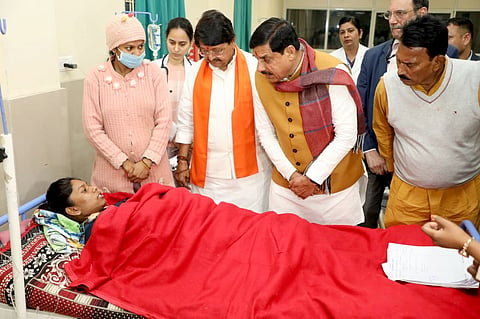


Indore’s contaminated drinking water has tarnished its reputation as one of the cleanest cities in India. The New Year has begun on a somber note in the city’s Bhagirathpura neighbourhood where 15 people have died and more than 200 are still being treated after drinking contaminated water. Residents in this area had been complaining about dirty drinking water for a long time, but the administration has been alerted only now, after the tragedy.
But even as the city and the state are still reeling from shock, a quick background check by Down To Earth (DTE) has revealed that there had been prior warnings about the contamination of drinking water in Madhya Pradesh in the not-so-recent past.
According to media reports, the tragedy happened due to the mixing of sewage water with drinking water. The report received by the state health department on January 1, 2026, has confirmed that the cause of illness is contaminated drinking water, but concrete information about which bacteria has been found in it will be available only after a detailed culture report of the contaminated drinking water. Testing is underway at Medical College, Indore. However, it is suspected that the bacterium is one that poses a risk of spreading cholera.
Govind Sharma, a resident of Indore city, told DTE that water cannot be drunk directly from any tap anywhere in the city. Citizens use the water they receive once every two days after purifying it with alum and chlorine. In some places, there are 40 to 50-year-old supply lines that are 5 feet, 7 feet, and even 10 feet underground, and on these, gutters and drainage lines have been installed.
The Government of Madhya Pradesh presented its status report in the matter in the High Court on January 2, 2026. In this status report, only four deaths have been recorded due to dirty drinking water, whereas according to various media reports, 15 deaths have been reported so far in this area.
The next hearing in this case will be held on January 6. The Madhya Pradesh Human Rights Commission has also taken cognizance of the matter and has asked the chief secretary to submit a report within two weeks.
Rehmat, who works on issues related to water in Madhya Pradesh, told DTE that in 2004, the Asian Development Bank had given a loan of $200 million to the four major cities of Madhya Pradesh - Bhopal, Indore, Jabalpur and Gwalior. The amount was provided for improving both the quantity and quality of urban water supply systems. Sanitation was also a major issue to be addressed. The project stipulated that everyone would have access to adequate and clean water.
The Comptroller and Auditor General (CAG) of India released a report on water management in Bhopal and Indore in 2019. This report revealed serious deficiencies in both cities. The work done on the project has been deemed inadequate. Even after the report came out, no action has been taken.
The CAG report raised serious questions about the water management system in Bhopal and Indore. It noted that:
Water is being supplied daily in only four zones in Indore and only five zones in Bhopal.
Of 941,000 families in both cities, only 530,000 have been given tap connections.
It takes 22 to 108 days for municipal corporations to control leakage.
Between 2013 and 2018, 4,481 water samples were found unfit for drinking. Some 362,000 families in Bhopal and 533,000 families in Indore were denied clean water. During this period, 545,000 cases of waterborne diseases were reported.
Non-revenue water amounts range from 30 to 70 per cent. This means no one knows where all this water is going.
Expected water tariff collections are not forthcoming. Water tax dues in both cities total Rs 470 crore.
Only 9-20 Litres Per Capita Per Day (LPDC) is being supplied in Bhopal and 36-62 LPDC in Indore.
Overhead tanks are not being cleaned regularly.
If water audits are not being done, how will water wastage be detected?
Rehmat said the way contamination has occurred in the pipeline is criminal. “This makes it clear that life has no meaning in the eyes of the system. It is not even being seen where sewage lines will be laid and whether there is any drinking water line passing near it.”
He added: “Dirty water is not a new issue in Indore, and the deaths are highlighting it. If even one of the two pipelines had been in good condition, this tragedy would not have occurred. The water being contaminated means both pipelines are damaged.”
Social activist Arun Dike said, “I’m against cities. If we really want to survive, we’ll have to turn to the villages.” He added that the way indiscriminate urbanisation is happening, no politician, political party or administration can do anything about it. Indiscriminate urbanisation will bring similar incidents to the fore in new forms.
He mentioned what social activist Medha Patkar had said in Indore that we are creating such a cocoon around ourselves that one day we will die like silkworms.
