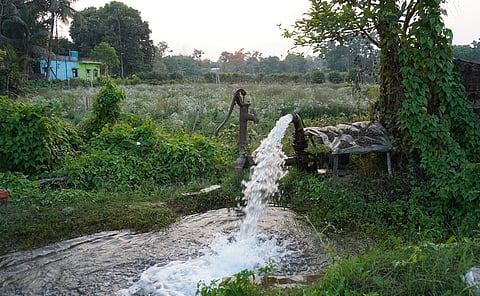


Groundwater is India’s invisible lifeline. It supplies 85 per cent of the country’s drinking water, two-thirds of its irrigation needs, and half of its industrial water requirements. The sustainability of groundwater is therefore central to India’s water and food security, and this importance is increasing as climate change intensifies. Access to groundwater irrigation remains one of the most reliable buffers rural communities have against erratic rainfall.
The scale of India’s groundwater economy is expansive. India has over 20 million pumps, up from roughly 6 million in 1980s, pumping around 250 billion cubic metres (bcm) annually, or about one-fifth of all groundwater extracted globally. Historically, largely unregulated abstraction has been associated with several adverse impacts including falling water tables, notably across northwest and Peninsular India, wells running dry, reducing baseflows to rivers, and resulting inequities in access between those who can afford deeper pumps and those who cannot.
While India’s groundwater depletion has received considerable attention in global discourse, there is comparatively less visibility of the equally significant policy efforts focused on recharge. The policy response to groundwater depletion from supply side has centred on Managed Aquifer Recharge (MAR) — artificially replenishing groundwater through structures that capture excess monsoon runoff and recharge it. India’s ambitious master plan for artificial recharge to groundwater (2020) envisages recharging 185 bcm of water through nearly 14 million MAR structures at estimated cost of around $16 billion.
Over the past two decades, multiple government programmes such as watershed management programmes and the Mahatma Gandhi National Rural Employment Guarantee Scheme (MGNREGS) have invested heavily in building small-scale recharge structures.
In addition, a range of non-governmental and CSR initiatives have supported the construction of ponds, check dams, and percolation tanks.
MGNREGS alone has spent over Rs 4,50,000 crore (approximately $49 billion) on natural resource management over the last decade, with 70 per cent of this share directed towards soil and water conservation measures including recharge interventions.
The recently launched Jal Shakti Abhiyan: Catch the Rain and Jal Sanchay Jan Bhagidari (JSJB) have accelerated these efforts. JSJB, launched in 2024, set a target of constructing a minimum of 10,000 artificial recharge and storage structures in each district, and 3,000 structures in Northeastern and hilly states.
By November 2025, 27.6 lakh (2.76 million) structures had been constructed nationwide against a target of 10 lakh (1 million) structures. This demonstrates strong government policy support and growing commitment to water security and groundwater management. Assessments by the Central Ground Water Board (CGWB) show a consistent increase in groundwater recharge attributable to these recharge interventions, from 13.98 bcm in 2017 to 25.34 bcm in 2024.
As India accelerates investment in groundwater recharge under the Viksit Bharat 2047 vision, the focus on water security is timely and necessary. To ensure these investments deliver lasting impact, the next step is to pair the scale of construction with an equally robust system of performance measurement and outcome monitoring.
A significant opportunity lies in building out the evidence base for what these structures actually achieve. Systematic field studies on recharge outcomes are still evolving and have yet to fully match the scale of infrastructure built, and closing this gap will be essential to making smarter decisions going forward. Recharge is undoubtedly happening; the task now is to measure it with the same rigour we bring to building.
Current programmes have done well at tracking inputs, structures built, area treated, funds deployed, which are critical during a phase of rapid scale-up. As programmes mature, expanding the measurement framework to capture end results such as groundwater level changes, estimated recharge volumes, and increases in irrigated area will strengthen accountability and improve targeting. This shift was also reflected in the management information system of MGNREGS which had so far had limited provision for capturing these parameters, though circulars mandated reporting of expected outcomes as part of the estimate — a gap worth closing.
Evidence from across India’s water infrastructure history shows that structures face challenges related to maintenance and sustained use after construction, eroding the value of past investment. India has seen this pattern before in large canal systems: build, neglect, rebuild. The investments being made for recharge structures can set a new benchmark and avoid cycles of construction followed by maintenance challenges that has undermined past investments.
As the old saying goes, we cannot manage what we cannot measure.
With the new shape of MGNREGS in the form of Viksit Bharat-Guarantee for Rozgar and Ajeevika Mission (Gramin) (VB-G RAM G) and emphasis on water security at its centre in Viksit Bharat 2047 vision, there is need to shift from a paradigm of construction to one of measured impact. The first requirement is genuine participation. There is strong evidence that community participation in planning and managing water structures leads to better long-term outcomes. The government has long emphasised this principle, including in recently launched programs such as Jal Shakti Abhiyan and Jal Sanchay Jal Bhagidari. Prime Minister Narendra Modi has prioritised water conservation as a mass movement (Jan Andolan) rather than just government policy, emphasising community participation (Jan Bhagidari) to secure India’s water future. The bottom-up demand process embedded in VB-GRAM G (formerly MGNREGS) and other programmes also provides a foundation to build on.
However, meaningful participation takes time as it depends on behavioural change, trust-building, and effective communication. When incentives emphasise speed and scale, participatory processes may receive less attention. Ensuring that public recharge investments have broad-based community ownership, particularly for structures that require sustained maintenance, must be a non-negotiable condition of funding and part of multi-year efforts.
The second requirement is a shift from construction targets to outcome metrics. Moving on from counting structures, where we have achieved commendable progress, programmes should now track what those structures are delivering. This includes changes in groundwater levels, recharge volumes estimated through monitoring, and water availability for communities. This will require investment in monitoring infrastructure and technical capacity at the district level. It may also require a more honest conversation on the scale of investment. Doing 100,000 structures well, with monitoring and maintenance, may ultimately deliver more than doing 10 million structures that are neither measured nor maintained.
The third requirement is clarity of purpose. A water harvesting pond intended to recharge groundwater should be designed, sited, and maintained differently from one intended for keeping water for livestock watering or community use. This distinction has real consequences. Recharge ponds require frequent desilting to maintain infiltration capacity, since accumulated sediment rapidly seals the pond bed and curtails recharge, which may be what is needed in structures that should store water for livestock watering or community use. Previous guidelines/circulars under MGNREGS may not have fully captured this complexity advising desilting once every five to 10 years for all water bodies, regardless of their purpose. That needs to change and VB-GRAM G should acknowledge this aspect in program guidelines.
The fourth requirement is smarter deployment of recharge wells. Recharge wells are structures that channel water directly from ponds into the aquifer through boreholes fitted with filter packs. When properly designed and maintained, they can perform much better than simple percolation ponds.
However, they are costly, technically demanding, and critically dependent on regular maintenance to ensure groundwater quality is not adversely impacted. Spreading them thinly across thousands of sites without maintenance budgets or institutional oversight may lead to suboptimal performance and sustainability challenges. They work best where long-term institutional mechanisms already exist such as schools, public buildings, Water User Associations and where maintenance can be reliably ensured. Depth of implementation at a smaller number of well-supported sites should be the way forward.
The fifth requirement is quality of water used for recharge. This remains a largely unresolved question in Indian MAR policy. What quality of water should be recharged? What quality criteria should apply, who sets them and who will enforce them. The recent CGWB guidelines provide broader principles in the form of dos and don’ts so that recharge doesn’t cause groundwater contamination. However, much more need to be done to translate them into clear set of parameters and more importantly applying these principles uniformly across states and implementing agency.
As recharge programmes scale up, the risk of inadvertently injecting poor-quality water, including fertilisers and pesticides used in farming, or other contaminants, into aquifers will increase. Clear, enforceable quality standards for artificial recharge are long overdue.
As India matures as a leader in water conservation programs, shifting institutional incentives, building monitoring capacity, and enforcing quality standards are needed. As climate change alters monsoon patterns and increases the pressure on groundwater systems, the stakes will only rise. India has built an extraordinary foundation of recharge infrastructure over the past two decades. The task now is to make that infrastructure work. This requires moving from counting what has been built to understanding what it delivers and using that understanding to build better.
Water security under Viksit Bharat 2047 will not be achieved by the number of structures built alone but by sustained improvement in groundwater levels, by wells that do not run dry, and by communities that can depend on water when they need it.
Mohammad Faiz Alam works with International Water Management Institute
Views expressed are the author’s own and don’t necessarily reflect those of Down To Earth
