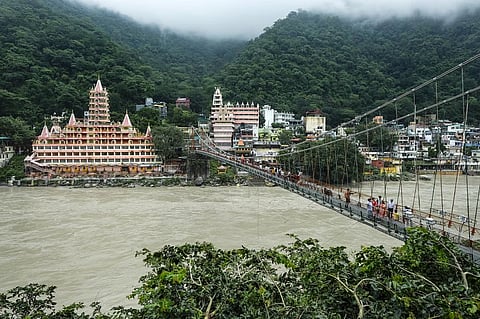


Nearly a third of sewage treatment plants (STP) in Uttarakhand are discharging untreated sewage into the Ganga and its tributaries, according to a recent audit by the Comptroller and Auditor General of India (CAG), raising concerns about pollution along the river stretch from Devprayag to Haridwar despite significant public spending.
The CAG report found that 12 out of 44 STPs or around 32 per cent were releasing untreated wastewater due to inadequate capacity, faulty connections and poor maintenance.
Efforts to clean the Ganga have been ongoing since 1985, but the audit suggests that pollution levels remain high, particularly in Uttarakhand, where the river’s upper stretches are located.
The CAG report, which reviewed projects implemented between 2018 and 2023, was recently tabled in the state assembly. It highlights gaps between investment and outcomes, with nearly Rs 1,000 crore spent in the state during the period but limited improvement in sewage management.
According to the audit, physical inspections found that 12 STPs were discharging untreated sewage into the Ganga due to a range of technical and operational issues. The 7.50 million litres per day (MLD) STP at Chandreshwar Nagar/Dhalwala in Rishikesh was releasing sewage directly owing to insufficient treatment capacity. The 10 kilolitres per day (KLD) STP at Kirti Nagar faced a similar issue.
The 50 KLD STP at Belni Road in Rudraprayag was damaged due to drain tapping during the rains, while the 100 KLD STP near SBI suffered similar damage. The 75 KLD STP near the bus stand discharged untreated sewage due to excess grey water and reduced capacity, and the 125 KLD STP near Steel Bridge also released untreated effluent because of insufficient capacity. Capacity constraints were likewise observed at the 75 KLD STP at Srikot.
At Gopeshwar, the Papadiana drain tapping system at the 1.25 MLD STP at Pokhari Bend was completely damaged during the rains, and the operating agency failed to repair it. Several STPs in Karnaprayag were also affected: the 100 KLD STP near the old bridge was unable to tap grey water from nearby households; the 100 KLD STPs in Wards 1 and 3, along with the 50 KLD STP near the new bridge, experienced leaks in their drain tapping systems; and the 50 KLD STP near the police post suffered from clogged drain tapping systems.
These cases show that a significant number of STPs are failing to prevent wastewater from entering the Ganga due to technical faults, inadequate maintenance, and poor planning.
The audit also flagged lapses in oversight. During a surprise inspection on February 9, 2023, a contractor was found to be discharging untreated sewage directly into the Ganga. The report noted that no legal action was taken against those responsible.
In addition, the condition of infrastructure was such that the maintenance agency declined to take over 18 of the 44 STPs, citing serious construction, safety and operational issues. In some cases, handovers were delayed by up to five years.
This, the report said, led to a breakdown in monitoring and maintenance systems.
Of the 44 STPs inspected between January and March 2023, only five met the standards set by the National Green Tribunal (NGT), while 35 failed.
The situation worsened later in the year, with only three plants meeting standards between August and November 2023, while 36 failed.
Thirty-three plants also failed to meet norms set by the Union Ministry of Environment, Forest and Climate Change. The audit raised concerns about water quality monitoring and reliability of data.
Fecal coliform levels, an indicator of contamination, far exceeded safe limits. The acceptable level is below 1,000 most probable number (MPN) per 100 ml, but readings reached significantly higher levels, indicating severe pollution. Tests found this level had risen to 1,700, reaching 24 × 10¹¹. This indicates that the water’s turbidity and faecal contamination had reached hazardous levels, clearly pointing to sewage pollution and inadequate treatment.
According to the report, the Ganga’s water quality in Haridwar remained in the ‘B’ category throughout the audit period, while in Rishikesh it stayed in the ‘B’ category between 2019 and 2023, only briefly improving to ‘A’ during 2020-21 amid the COVID-19 lockdown.
Total coliform levels increased 32-fold over just 93 kilometres between Devprayag and Haridwar, underscoring the growing pollution burden.
The report also found discrepancies between data recorded by the Central Pollution Control Board and the Uttarakhand Pollution Control Board, raising questions about monitoring systems. In March 2023, while the state board recorded faecal coliform at 58, the central board reported 14 × 10³ for the same parameter, raising serious concerns about the reliability of the monitoring system.
Furthermore, the Uttarakhand Pollution Control Board was allocated Rs 16.21 crore for National Accreditation Board for Testing and Calibration Laboratories accreditation, but only Rs 5.55 crore, about 34 per cent, was spent over five years, and not a single laboratory applied for accreditation during this period.
The audit noted that while funds were allocated under the Namami Gange programme, key infrastructure gaps remain.
According to the report, Rs 14,260 crore was released under the programme between 2014 and 2023. Of this, Rs 1,149 crore was sanctioned for Uttarakhand between 2018 and 2023, and the state received Rs 985.98 crore.
Uttarakhand spent a total of Rs 873.17 crore over six years, but the construction of STPs and the connection of households to the sewerage network — key to preventing domestic sewage from entering the Ganga — remained incomplete. In several cases, treatment plants were built but not connected to any households.
The CAG described 21 such plants across seven towns — Nandprayag (2), Karnaprayag (5), Rudraprayag (6), Kirtinagar (2), Chamoli (1), Srinagar and Srikot (3), and Joshimath (2) — as “symbolic”, as they were not linked to a functioning sewage system.
The audit also found stark contrasts in how STPs are functioning — with some operating far beyond capacity, while others remain severely underutilised.
In Joshimath, the CAG noted that infrastructure built under schemes in 2010 and 2017, at a cost of Rs 42.73 crore, did not include sewer connections to a single household. Despite the expenditure, no effective sewage network was created. The audit also identified irregularities worth Rs 1 crore linked to STP upgrades.
In Haridwar, a 68 million litres per day (MLD) STP was treating an average of 71 MLD of sewage in March 2023, with peak inflows reaching 84 MLD, exceeding its designed capacity years ahead of its schedule of 2028.
A similar situation was observed in Rishikesh, where a 5 MLD plant was receiving around 17 MLD of sewage, according to a CPCB inspection in June 2023. In contrast, the Devprayag STP was operating at just 3-4 per cent of its capacity due to insufficient sewage inflow, reflecting poor planning and mismatched infrastructure.
The audit highlights significant gaps in sewer network coverage across towns.
In Chamoli-Gopeshwar, only 354 out of 5,510 households, around 6.4 per cent, were connected to the sewer system. In Uttarkashi, the figure was 572 out of 6,089 households (9.3 per cent), while in Srinagar, 797 out of 6,523 households (12.2 per cent) had connections.
Rishikesh showed relatively better coverage, with 9,966 out of 34,756 households — about 28.6 per cent — connected.
The findings indicate that a large proportion of households continue to discharge wastewater outside the formal sewage network.
At the district level, no such plans were prepared either. The District Ganga Committees also did not prepare a district-level river basin management plan in any district, the report noted.
This suggests that large-scale projects were implemented without a comprehensive, river-based planning framework.
The audit also highlights a lack of community involvement in planning and implementation. The State Ganga Committee, SMCG and implementing agencies did not involve local people in planning the Namami Gange infrastructure, the report said.
A social audit cited in the report found that residents were dissatisfied with the infrastructure created, describing it as poorly aligned with local needs.
This, the audit suggested, reflects a top-down approach to implementation.
The report also raised questions about the role of the state government. It noted that the state had not constructed any STPs or sanitation infrastructure in 16 Ganga-front towns using its own resources, leaving projects largely dependent on central funding and planning.
In several cases, the location of STPs has made them vulnerable. Seventeen of the 44 plants were built on steep slopes or near riverbanks, exposing them to damage. One such plant, constructed at a cost of Rs 8.8 million, was destroyed in a landslide.
The report also referred to a serious accident at a plant in Chamoli, where 28 people were electrocuted and 16 died. The incident, it said, raised concerns about safety standards in infrastructure built under river-cleaning programmes.
The audit flagged serious lapses in the handling of sludge generated during sewage treatment. In Haridwar, three STPs produced over 64,000 cubic metres of sludge, of which more than 51,000 cubic metres was distributed to farmers.
Tests showed high levels of heavy metals, including zinc and cadmium. The raw sludge contained zinc at 2,730 milligrams per kilogram and cadmium at 18.51 milligrams per kilogram, far exceeding prescribed standards. Despite this, the sludge was used in agriculture. The report also noted that a sludge management plant, built at a cost of Rs 4.93 crore, was never operational despite full payment being made to the contractor.
Spending on environmental components of the programme remained low. Of Rs 885.91 crore allocated for afforestation, only Rs 144.27 crore, about 16 per cent, was spent. Of 11 crematoriums constructed, 10 remained unused and one was underutilised.
In addition, no urban local body was authorised for solid waste management over a seven-year period (2017-18 to 2022-23).
The audit also identified gaps in financial management. Liquidated damages of Rs 20.59 crore were to be recovered from contractors, but only Rs 0.89 crore was recovered.
It also noted that stricter standards recommended by the Indian Institute of Technology (IIT) Roorkee — including zero fecal coliform levels — were relaxed to 100 MPN per 100 ml during the tendering process.
Rapid population growth, rising living standards, and accelerating industrialisation and urbanisation have placed the Ganga River under severe pollution pressure, despite decades of government intervention aimed at preserving its purity.
Efforts to clean the river date back more than 40 years. In 1985, the Government of India launched the Ganga Action Plan Phase I to control pollution by intercepting, diverting and treating wastewater from 25 Class I cities—those with populations exceeding 100,000—across Uttar Pradesh (including present-day Uttarakhand), Bihar and West Bengal.
This was followed by Ganga Action Plan Phase II in 1993, which was later extended to tributaries such as the Yamuna, Damodar and Gomti. The programme focused largely on interception and diversion projects, along with the construction of STPs.
However, its emphasis on urban wastewater, coupled with planning and implementation shortcomings, meant it fell short of its objectives. In 2009, the National Ganga River Basin Authority was established as another attempt to strengthen conservation efforts.
In 2014, the government launched the Namami Gange programme as an integrated mission to clean the river. However, the audit suggests that longstanding issues in planning, implementation and monitoring continue to limit the effectiveness of these efforts.
