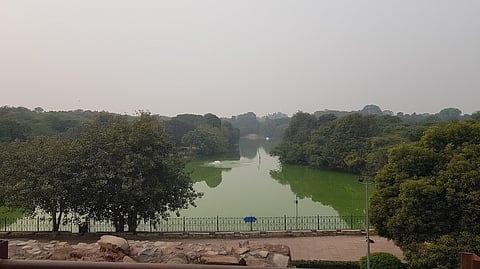


The tranquil waters of Hauz Khas Lake, surrounded by magnificent 700-year-old monuments, offer one of Delhi’s rare landscapes where history, biodiversity, and urban life coexist. Every winter, the lake transforms into a vibrant refuge for migratory birds, while throughout the year ducks, herons, and other water birds forage peacefully along its shoreline. At first glance, Hauz Khas appears to be a thriving urban oasis. Yet, beneath its calm surface lies a growing ecological crisis that threatens not only this historic lake but also many other water bodies across Delhi.
Constructed during the reign of Sultan Alauddin Khilji as a major water reservoir for medieval Delhi, Hauz Khas Lake covers approximately 5.85 hectares and is located at 28°33'14.47"N latitude and 77°11'35.46"E longitude. Today, the lake receives water primarily from rainfall, urban storm water runoff, and treated wastewater discharged from the Vasant Kunj Sewage Treatment Plant. Although the treated wastewater helps maintain water levels throughout the year, it also introduces substantial quantities of nitrogen and phosphorus into the lake. These nutrients, while essential for aquatic ecosystems in limited amounts, become serious pollutants when present in excess.
The ancient Sanskrit proverb Ati Sarvatra Varjayet—meaning “Excess of anything is harmful” — perfectly captures the environmental condition of Delhi’s lakes today. The challenge is no longer water scarcity alone, but the excessive accumulation of nutrients that silently degrades freshwater ecosystems.
Nutrient pollution has become one of the most overlooked environmental problems in Indian cities. Unlike industrial pollution, which is often immediately visible, nutrient pollution develops gradually and quietly. Domestic sewage, phosphate-rich detergents, food waste, untreated wastewater, fertiliser runoff, pet waste, and urban storm water continuously introduce excessive nitrogen and phosphorus into lakes. Over time, these nutrients accumulate and fundamentally alter aquatic ecosystems.
Initially, nutrients stimulate rapid growth of algae and aquatic plants. However, as dense algal blooms spread across the water surface, sunlight penetration declines, aquatic vegetation dies, and dissolved oxygen levels fall dramatically. Eventually, fish kills become common, unpleasant odours develop, biodiversity declines, and the lake gradually loses its ecological functions. The nutrient pollution as “silent pollution”, because its impacts become evident only after extensive ecological damage, has already occurred.
Recent water quality investigations clearly demonstrate that Hauz Khas Lake is experiencing continuous nutrient enrichment resulting from anthropogenic activities.
The water quality characteristics at four sampling locations in Hauz Khas Lake, revealed considerable spatial variation in key physicochemical parameters. Dissolved oxygen (DO) was extremely low at Sampling Points 1 and 2 (0.00-0.03 mg/L), indicating severe oxygen depletion and poor ecological conditions, whereas higher DO concentrations were recorded at Sampling Points 3 and 4 (14.00-15.00 mg/L), suggesting relatively better aeration. Biochemical Oxygen Demand (BOD) ranged from 69 to 117 mg/L, with the highest values observed at Points 1 and 2, reflecting a high organic pollution load. Nitrate (NO₃⁻) concentrations varied between 8.39 and 13.91 mg/L, with the maximum concentration at Point 2, while ammonium (NH₄⁺) ranged from 1.46 to 4.32 mg/L, showing elevated levels at Point 1, indicative of recent organic contamination and limited nitrification. Phosphate (PO₄³⁻) concentrations were consistently high across all sampling locations (4.68-7.36 mg/L), with the highest value recorded at Point 1, suggesting significant nutrient enrichment that may promote eutrophication. Overall, the results indicate that the inlet or polluted sections of Hauz Khas Lake (Points 1 and 2) are characterised by severe organic and nutrient pollution, whereas water quality improves towards Sampling Points 3 and 4, likely due to natural dilution, aeration, and biological uptake processes. These findings confirm that despite receiving treated wastewater, Hauz Khas Lake continues to experience nutrient loading well above natural background levels, disrupting its ecological balance.
Despite ongoing ecological pressure, Hauz Khas Lake supports notable biodiversity along its banks, dominated by Cynodon dactylon (Bermuda grass) and Marsilea minuta (Dwarf water clover), which both exhibit the highest frequency of occurrence, alongside associated peripheral species including Oplismenus compositus, Origanum majorana, Cleome viscosa, Tropaeolum majus, Malvastrum coromandelianum, and Sisymbrium indicum.
One of the greatest misconceptions surrounding urban lakes is that treated wastewater is entirely safe for discharge into natural ecosystems. The sewage treatment plants are primarily designed to remove suspended solids and reduce organic pollution. However, many existing treatment facilities are not adequately equipped to remove dissolved nitrogen and phosphorus. Consequently, treated effluent may appear visually clean while still containing sufficient nutrients to trigger eutrophication after entering the lake. This treatment illusion explains why many urban lakes continue to deteriorate despite receiving water that meets conventional wastewater treatment standards.
Continuous nutrient enrichment has transformed many of Delhi’s lakes into highly vulnerable ecosystems. Frequent algal blooms consume dissolved oxygen during decomposition, leading to hypoxic conditions that threaten fish, aquatic insects, and beneficial microorganisms. The resulting ecological imbalance reduces biodiversity and weakens the lake’s natural capacity to purify water.
Hauz Khas Lake remains an important habitat for numerous resident and migratory bird species, including Northern Shoveler, Spot-billed Duck, Black-winged Stilt, Mallard, geese, and many other water birds. The surrounding green landscape also supports peafowl, deer, reptiles, insects, and diverse plant communities. As eutrophication intensifies, these habitats become increasingly degraded, placing valuable urban biodiversity at risk.
Beyond biodiversity conservation, Delhi’s lakes perform numerous ecosystem services. They regulate local climate, recharge groundwater, mitigate urban flooding, provide recreational spaces, support environmental education, and improve the quality of life for millions of residents. Their degradation therefore carries significant ecological, social, and economic consequences.
Scientific evidence highlighting nutrient pollution in Delhi’s lakes has already been communicated to regulatory authorities. Nevertheless, a major policy gap remains. Existing wastewater monitoring programmes primarily focus on conventional parameters such as Biological Oxygen Demand (BOD), Chemical Oxygen Demand (COD), and Total Suspended Solids (TSS). Nutrient concentrations, particularly nitrogen and phosphorus, often receive comparatively little regulatory attention. The mandatory nutrient standards for treated wastewater and routine monitoring at every sewage treatment plant before discharge into lakes as well as infrastructure improvements alone cannot solve the problem.
Protecting Delhi’s lakes requires an integrated approach that combines scientific management, technological advancement, and strong environmental governance. Sewage treatment plants should be upgraded with advanced biological nutrient removal technologies capable of effectively reducing nitrate and phosphate concentrations before discharge. Regular monitoring of nitrogen and phosphorus should become mandatory across all treatment facilities, with transparent reporting of nutrient levels. Equally important is reducing nutrient inputs at their source. The promotion of phosphate-free detergents, improved storm water management, restoration of wetlands, better solid waste management, and public awareness campaigns can substantially reduce nutrient loading.
Urban lakes should also be monitored using modern scientific tools, including remote sensing, GIS-based assessment, and continuous water quality monitoring systems to detect early signs of eutrophication and guide timely management interventions.
The story of Hauz Khas Lake reminds us that environmental degradation is often caused not by scarcity but by excess. Nutrients that naturally sustain aquatic life become pollutants when human activities overwhelm the ecological capacity of lakes.
The wisdom contained in the ancient Sanskrit saying Ati Sarvatra Varjayet remains remarkably relevant today. Restoring Delhi’s lakes requires restoring balance between urban development and environmental protection between wastewater treatment and ecological sustainability and between scientific knowledge and effective policy implementation. Only by recognising nutrient pollution as one of the greatest emerging threats to urban freshwater ecosystems can Delhi protect its historic lakes for future generations. Healthy lakes are not merely beautiful landscapes they are living ecosystems that safeguard biodiversity, climate resilience, water security, and public well-being.
Prabhat Kumar Tanwar and Sarita Bansal work with Sustainable India Trust (SIT)
N Raghuram is with the SIT as well as with Centre for Sustainable Nitrogen and Nutrient Management, School of Biotechnology, Guru Gobind Singh Indraprastha University and Adjunct Professor with the Department of Plant Sciences at University of Hyderabad
Views expressed are the authors’ own and don’t necessarily reflect those of Down To Earth